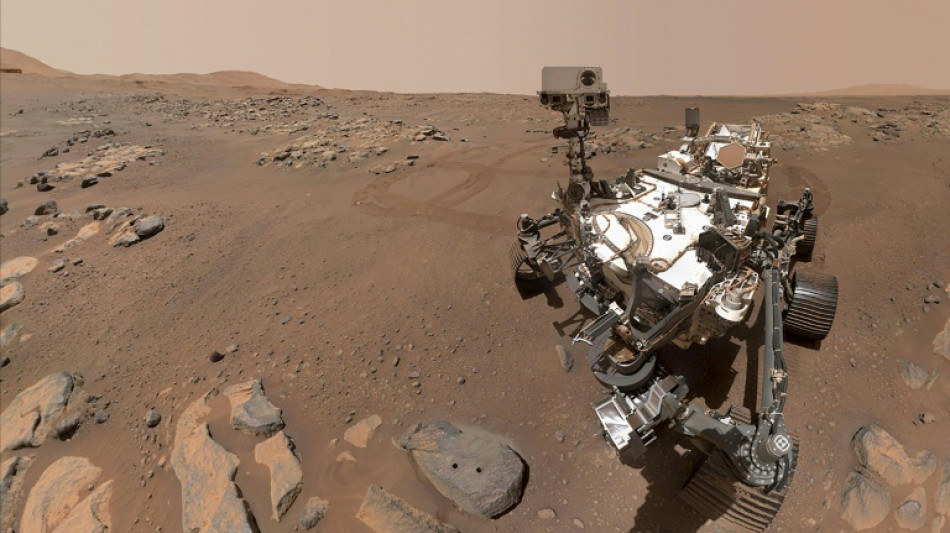
NASA seeks faster, cheaper way to bring Mars rocks to Earth / Photo: Handout - NASA/AFP/File

 Nigeria miners struggled to breathe in cell before 37 died: survivors

 Warren Buffett steps down as Berkshire Hathaway chairman

 Isolated Syrian-Druze city blames Damascus for shortages

 Kerry James Marshall: American 'blackness' painter celebrated in Europe

 Infantino 'must go', says German FA vice-president

 Japan's busiest rail station tests robot bins

 Backpackers fret over Australian visa crackdown

 Bank of Japan hikes rates to 31-year high to battle inflation

 AI doomsday warnings unlikely to slow IPOs but questions linger

 In Brazil's Amazon, the hunt for oil fuels hopes and fears

 Baby orangutans in India expose 'frightening' scale of trafficking

 Oversight Board blasts 'inadequate' Meta safeguards for AI deepfakes

 Harry makes first public appearance since return to UK

 Princess Diana's brother makes new explosive claims against Charles

 Trump admin overhauls key protection for endangered species

 Mbappe draws political fire over Ceuta t-shirt controversy

 Third malaria death in Germany from outbreak tied to Frankfurt airport

 AtlasClear Holdings Reports Preliminary Fiscal 2026 Revenue of Approximately $20.1 Million, Up 85%; Revenue Plus Interest Income of Approximately $21.9 Million

 'Another arrow to the quiver': World Bank posts record private capital mobilization

 Ireland to boycott Eurovision 2027 over Gaza

 India's Tata Sons reappoints N. Chandrasekaran as chairman

 Germany urges EU action against China to defend carmakers

 Japan eyes changing prostitution law to punish sex buyers

 Modi pitches India as global chipmaking hub

 Ukraine plans record defence spending in 2027

NASA said Monday it was looking for ways to bring Martian rocks collected by the Perseverance rover back to Earth earlier and at a lower cost than planned after facing criticism for going massively over budget.
The effort comes as China is making progress towards a simpler "grab-and-go" sample return mission to the red planet "around 2030," according to state media, which would make it the first nation to achieve the feat.
"The bottom line is that $11 billion is too expensive, and not returning samples until 2040 is unacceptably too long," the US space agency's chief Bill Nelson told reporters on a call.
NASA and the European Space Agency (ESA) had planned to land a vessel around the Jezero Crater, where the Perseverance rover has spent years searching for signs of ancient microbial life that may have existed billions of years ago when Mars was warmer and wetter than today.
Thirty sample tubes collected by the rover would be loaded onto a small rocket and launched into orbit, where another spacecraft would capture them and bring them home.
But a recent audit of NASA's plans by an independent review board said the Mars Sample Return mission was established "with unrealistic budget and schedule expectations from the beginning" and that it had a "near zero" chance of keeping to planned launch dates.
The outside experts also found the overall costs could potentially balloon to $11 billion, nearly double what NASA had stated.
As a result, NASA plans to solicit new proposals from the space industry that would pare back some of the mission's ambitions.
"In order to do things faster, we may have to lower the scope of the number of samples," NASA's Nicky Fox told reporters, without specifying what the new number would be.
Nelson said the agency's hand was also forced by budgetary constraints imposed by Congress which led NASA to request over $2 billion less than it had hoped for 2025 as a result of a debt ceiling agreement reached last year.
China's Tianwen-3 Mars sample return mission is working toward a launch around 2030, state media said last month.
Though China's mission is simpler and would only take samples from the immediate vicinity of its landing site, being the first to return rocks from another world would still be a huge geopolitical win.
China could also be the next nation to place crew on the Moon if its 2030 mission there happens before the NASA-led Artemis 3 landing.
"If they are able to return samples from Mars before the US does, even if it's a grab sample, which is nearly scientifically worthless, that is much more like a Sputnik moment," G. Scott Hubbard, a former top NASA official and professor at Stanford, told AFP recently, indicating it would be a wake-up call for Western nations.
Y.Tengku--CPN