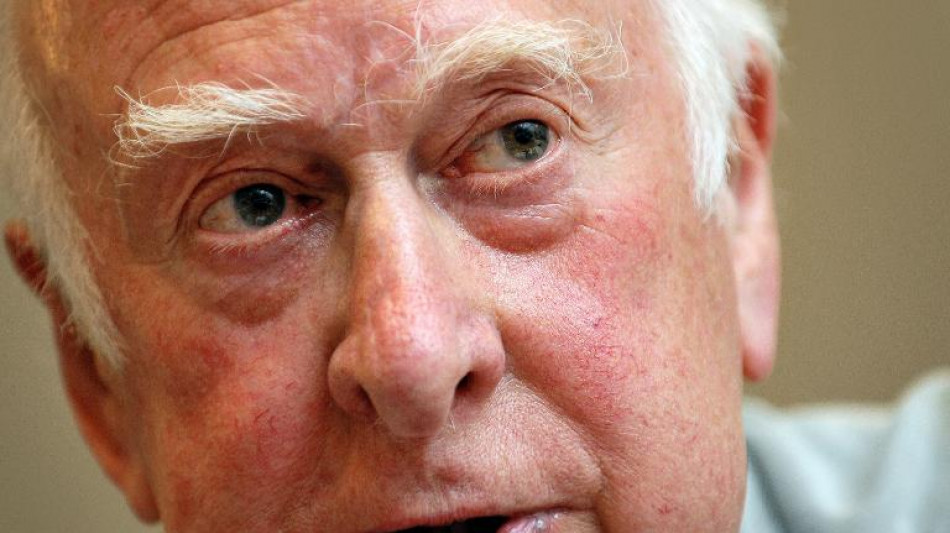
Peter Higgs: physicist who predicted 'God particle' / Photo: Fabrice Coffrini - POOL/AFP/File

 Nigeria miners struggled to breathe in cell before 37 died: survivors

 Warren Buffett steps down as Berkshire Hathaway chairman

 Isolated Syrian-Druze city blames Damascus for shortages

 Kerry James Marshall: American 'blackness' painter celebrated in Europe

 Infantino 'must go', says German FA vice-president

 Japan's busiest rail station tests robot bins

 Backpackers fret over Australian visa crackdown

 Bank of Japan hikes rates to 31-year high to battle inflation

 AI doomsday warnings unlikely to slow IPOs but questions linger

 In Brazil's Amazon, the hunt for oil fuels hopes and fears

 Baby orangutans in India expose 'frightening' scale of trafficking

 Oversight Board blasts 'inadequate' Meta safeguards for AI deepfakes

 Harry makes first public appearance since return to UK

 Princess Diana's brother makes new explosive claims against Charles

 Trump admin overhauls key protection for endangered species

 Mbappe draws political fire over Ceuta t-shirt controversy

 Third malaria death in Germany from outbreak tied to Frankfurt airport

 AtlasClear Holdings Reports Preliminary Fiscal 2026 Revenue of Approximately $20.1 Million, Up 85%; Revenue Plus Interest Income of Approximately $21.9 Million

 'Another arrow to the quiver': World Bank posts record private capital mobilization

 Ireland to boycott Eurovision 2027 over Gaza

 India's Tata Sons reappoints N. Chandrasekaran as chairman

 Germany urges EU action against China to defend carmakers

 Japan eyes changing prostitution law to punish sex buyers

 Modi pitches India as global chipmaking hub

 Ukraine plans record defence spending in 2027

Nobel laureate Peter Higgs gave his name to one of the great scientific discoveries of the last century, earning a place alongside Albert Einstein and Max Planck in physics textbooks.
Through ground-breaking theoretical work, Higgs, who died on Monday aged 94, helped explain how the Universe has mass, resolving one of the greatest puzzles in physics.
His 1964 theory of a mass-giving particle, which became known as the Higgs boson or the "God particle", earned him and Belgian physicist Francois Englert the 2013 Nobel Prize for Physics.
But when the announcement for which he had been waiting for half a century came, the unassuming physicist was nowhere to be found, having slipped out his back door into a pub, according to the 2022 biography "Elusive".
Higgs later admitted that the sudden fame was "a bit of a nuisance".
Announcing his death on Tuesday, the University of Edinburgh -- where he had taught and researched in various capacities since the 1950s -- hailed him a "great teacher and mentor".
It said he had inspired "generations of young scientists".
- 'Oh shit, I know...' -
The Higgs boson confers mass on some of the fundamental particles that make up matter.
Without it, theorists explain, we and all the other connected atoms in the universe would not exist.
Shy and unassuming, Higgs had seen the light almost half a century before the particle's existence was confirmed by the European Organisation for Nuclear Research (CERN) in Geneva in July 2012 in the Large Hadron Collider.
He realised in a eureka moment as a young lecturer in 1946 there could be a field of novel particles that confers mass.
"He said: 'Oh shit, I know how to do that!'" former colleague and friend Alan Walker told AFP of the breakthrough as recounted to him by Higgs.
Higgs published a paper on his theory in 1964, becoming the flag bearer of a premise to which several scientists had contributed over the years, including Englert, but which, at the outset, found few backers.
Particularly sceptical was CERN, which embarked on a years-long, multi-billion-dollar quest to find the needle-in-a-haystack particle, culminating in its own eureka moment on July 4, 2012.
Higgs was present in Geneva to hear CERN announce that it had found a particle "consistent" with the elusive boson.
"It's very nice to be right sometimes. It has certainly been a long wait," he declared.
He and Englert won a slew of awards for their work, including the prestigious Wolf Prize in 2004.
But Higgs revealed he had turned down a knighthood, saying he felt the British honours system was "used for political purposes."
- 'Gentle' -
Higgs was born in Newcastle upon Tyne, in northeastern England, on May 29, 1929, to a Scottish mother and an English father who worked as a sound engineer at the BBC.
He studied at King's College in London, gaining a PhD in 1954, and went on to lecture at Edinburgh University.
Balding and ruddy-cheeked, he retired in 1996 and continued to live quietly in the Scottish capital, where he was emeritus professor of theoretical physics.
A modest man, who published only around a dozen scientific papers over his career, he cringed every time the term "Higgs boson" was used in his presence.
But as a life-long atheist, he disliked the "God particle" even more.
"He is a very mild-mannered and very gentle man, but he actually does get a little tenacious if you say something wrong that (has to do with) physics," his former colleague and friend Walker once said.
Others credited with contributing to the Higgs theory include Americans Gerald Guralnik, Carl Hagen, and Briton Tom Kibble, who jointly did a separate paper on the mechanism in the same year as Higgs.
Higgs married American linguist Jody Williamson, with whom he had two children. The pair later separated but remained close until her death in 2008 of leukemia.
He campaigned against nuclear weapons, joining a call in 2015 for Britain to abandon its Trident nuclear deterrent.
P.Schmidt--CPN