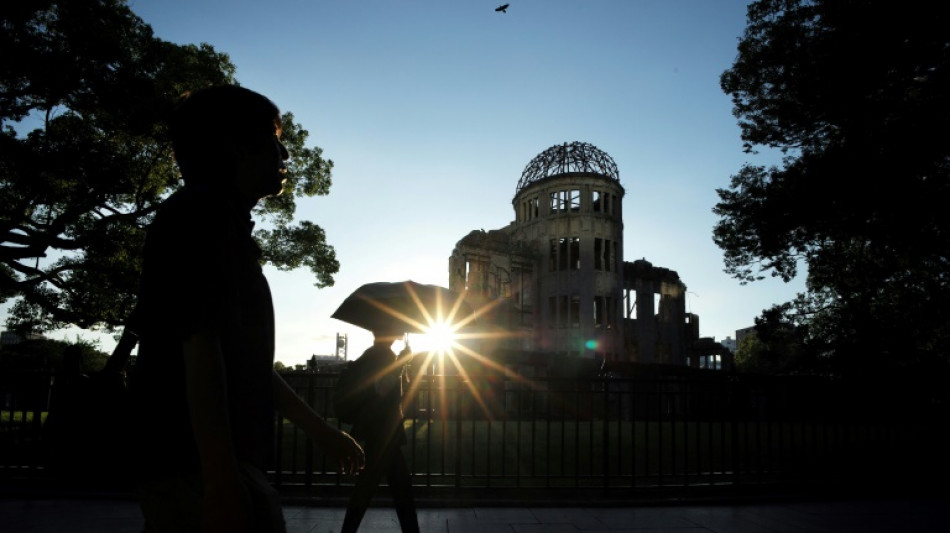
A-bomb saga 'Oppenheimer' finally opens in Japan / Photo: Kazuhiro NOGI - AFP

 Nigeria miners struggled to breathe in cell before 37 died: survivors

 Warren Buffett steps down as Berkshire Hathaway chairman

 Isolated Syrian-Druze city blames Damascus for shortages

 Kerry James Marshall: American 'blackness' painter celebrated in Europe

 Infantino 'must go', says German FA vice-president

 Japan's busiest rail station tests robot bins

 Backpackers fret over Australian visa crackdown

 Bank of Japan hikes rates to 31-year high to battle inflation

 AI doomsday warnings unlikely to slow IPOs but questions linger

 In Brazil's Amazon, the hunt for oil fuels hopes and fears

 Baby orangutans in India expose 'frightening' scale of trafficking

 Oversight Board blasts 'inadequate' Meta safeguards for AI deepfakes

 Harry makes first public appearance since return to UK

 Princess Diana's brother makes new explosive claims against Charles

 Trump admin overhauls key protection for endangered species

 Mbappe draws political fire over Ceuta t-shirt controversy

 Third malaria death in Germany from outbreak tied to Frankfurt airport

 AtlasClear Holdings Reports Preliminary Fiscal 2026 Revenue of Approximately $20.1 Million, Up 85%; Revenue Plus Interest Income of Approximately $21.9 Million

 'Another arrow to the quiver': World Bank posts record private capital mobilization

 Ireland to boycott Eurovision 2027 over Gaza

 India's Tata Sons reappoints N. Chandrasekaran as chairman

 Germany urges EU action against China to defend carmakers

 Japan eyes changing prostitution law to punish sex buyers

 Modi pitches India as global chipmaking hub

 Ukraine plans record defence spending in 2027

Oscars best picture winner "Oppenheimer" was finally released on Friday in Japan, where its subject -- the man who masterminded the creation of the atomic bomb -- is a highly sensitive and emotional topic.
The US blockbuster hit screens in the United States and many other countries in July at the same time as "Barbie", inspiring a viral phenomenon dubbed "Barbenheimer" by moviegoers.
But while "Barbie" was released in Japan in August, "Oppenheimer" was conspicuously absent from cinemas for months.
No official explanation was offered at the time, fuelling speculation the film was too controversial to be shown in Japan -- the only country to have ever suffered a wartime nuclear attack.
Around 140,000 people died in Hiroshima and 74,000 in Nagasaki when the United States dropped atomic bombs on the cities in 1945, days before the end of World War II.
At a large cinema in central Tokyo where "Oppenheimer" was showing on Friday, there was none of the prominent promotional material that might be expected for a global megahit.
Instead only one small poster advertised the film, which was shot on a $100 million budget and collected nearly $1 billion at box offices worldwide.
- 'America-centric' -
The film tells the story of US physicist J. Robert Oppenheimer, who oversaw the bomb's invention.
It drew rave reviews and was the most decorated title at this month's Oscars, scooping seven awards including best director for Christopher Nolan and best actor for star Cillian Murphy.
But in Hiroshima, the city devastated by the first nuclear bomb, the biopic's Academy Awards success met a mixed reaction.
Kyoko Heya, president of the city's international film festival, told AFP after the awards ceremony that she had found Nolan's movie "very America-centric".
"Is this really a movie that people in Hiroshima can bear to watch?" she asked.
Today the city is a thriving metropolis of 1.2 million people, but the ruins of a domed building still stand as a stark reminder of the horrors of the attack, along with a museum and other sombre memorials.
Heya said that after much reflection, "I now want many people to watch the movie."
"I'd be happy to see Hiroshima, Nagasaki and atomic weapons become the subject of discussions thanks to this movie," she said.
Last year, viral "Barbenheimer" memes sparked anger online in Japan, where media reports have highlighted critics who say the film does not show the harm caused by the bombs.
"There could have been much more description and depiction of the horror of atomic weapons," bomb survivor and former Hiroshima mayor Takashi Hiraoka, 96, said at a special screening in the city earlier this month.
"Oppenheimer" was also shown at a preview event in Nagasaki, where survivor Masao Tomonaga, 80, said he had been impressed by the movie.
"I had thought the film's lack of... images of atomic bomb survivors was a weakness," said Tomonaga, who was two when the second bomb was dropped and later became a professor studying leukaemia caused by the attacks.
"But in fact, Oppenheimer's lines in dozens of scenes showed his shock at the reality of the atomic bombing. That was enough for me."
D.Philippon--CPN