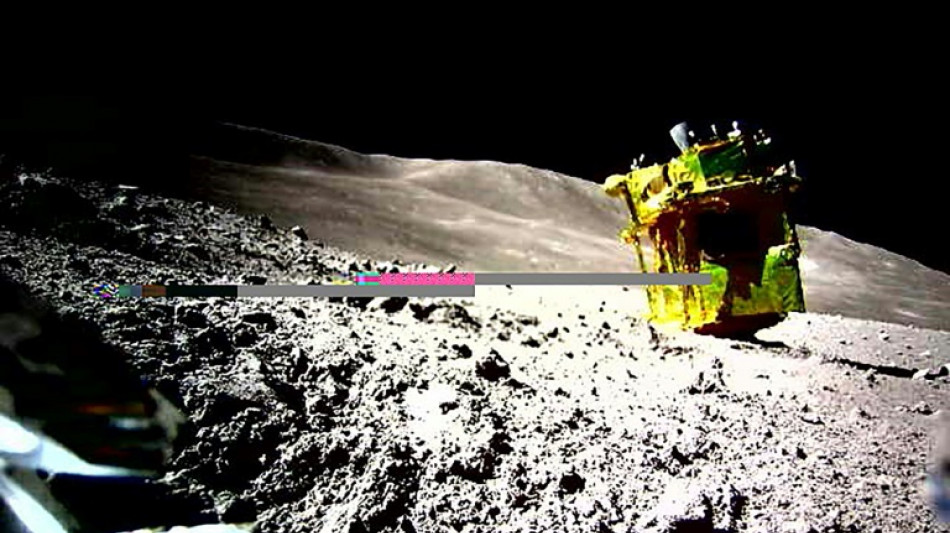
Japan Moon probe survives second lunar night / Photo: Handout - JAPAN AEROSPACE EXPLORATION AGENCY (JAXA)/AFP/File

 Nigeria miners struggled to breathe in cell before 37 died: survivors

 Warren Buffett steps down as Berkshire Hathaway chairman

 Isolated Syrian-Druze city blames Damascus for shortages

 Kerry James Marshall: American 'blackness' painter celebrated in Europe

 Infantino 'must go', says German FA vice-president

 Japan's busiest rail station tests robot bins

 Backpackers fret over Australian visa crackdown

 Bank of Japan hikes rates to 31-year high to battle inflation

 AI doomsday warnings unlikely to slow IPOs but questions linger

 In Brazil's Amazon, the hunt for oil fuels hopes and fears

 Baby orangutans in India expose 'frightening' scale of trafficking

 Oversight Board blasts 'inadequate' Meta safeguards for AI deepfakes

 Harry makes first public appearance since return to UK

 Princess Diana's brother makes new explosive claims against Charles

 Trump admin overhauls key protection for endangered species

 Mbappe draws political fire over Ceuta t-shirt controversy

 Third malaria death in Germany from outbreak tied to Frankfurt airport

 AtlasClear Holdings Reports Preliminary Fiscal 2026 Revenue of Approximately $20.1 Million, Up 85%; Revenue Plus Interest Income of Approximately $21.9 Million

 'Another arrow to the quiver': World Bank posts record private capital mobilization

 Ireland to boycott Eurovision 2027 over Gaza

 India's Tata Sons reappoints N. Chandrasekaran as chairman

 Germany urges EU action against China to defend carmakers

 Japan eyes changing prostitution law to punish sex buyers

 Modi pitches India as global chipmaking hub

 Ukraine plans record defence spending in 2027

Japan's Moon lander woke up after unexpectedly surviving a second frigid, two-week lunar night and transmitted new images back to Earth, the country's space agency said Thursday.
The unmanned Smart Lander for Investigating Moon (SLIM) probe touched down in January, making Japan only the fifth nation to reach the lunar surface without crashing.
But the lightweight spacecraft landed at a wonky angle that left its solar panels facing the wrong way.
The Japan Aerospace Exploration Agency announced the probe's latest surprise awakening in a post on X, formerly Twitter.
"We received a response from SLIM last night and confirmed that SLIM had successfully completed its second overnight," it said.
A black-and-white photo of the rocky surface of a crater accompanied the post on SLIM's official account.
"Since the sun was still high in the sky... and the equipment was still hot, we recorded images of the usual scenery with the navigational camera, among other activities, for a short period of time," it said.
Thursday's news came after an uncrewed American lander called Odysseus -- the first private spaceship to successfully land on the Moon -- had failed to wake up.
Its manufacturer, the Houston-based Intuitive Machines, had hoped the lander might revive like Japan's SLIM, but on Saturday declared the lander's mission over.
The Intuitive Machines spaceship also landed at the wrong angle but was able to complete several tests and send back photos before the most recent lunar night began.
- 'Moon Sniper' -
JAXA has dubbed SLIM the "Moon Sniper" for its precision landing technology.
The aim of its mission was to examine a part of the Moon's mantle -- the usually deep inner layer beneath its crust -- believed to be accessible at the crater where it landed.
About three hours after its nail-biting touchdown on January 20, JAXA switched the lander off remotely to save power, having received technical and image data from its descent.
As the sun's angle shifted, the probe came back to life in late January for two days and carried out scientific observations of a crater with a high-spec camera.
JAXA says the spacecraft was "not designed for the harsh lunar nights", when the temperature plunges below minus 130 degrees Celsius (-200 degrees Fahrenheit).
So scientists had cause for celebration when SLIM successfully woke up in late February against the odds.
The SLIM saga has been a boon for the space agency after a string of high-profile failures, including two previous Japanese lunar missions -- one public and one private.
The country unsuccessfully sent a lunar probe named Omotenashi as part of the United States' Artemis 1 mission in 2022.
Then in April 2023, Japanese startup ispace lost communication with its craft after what it described as a "hard landing".
This year Japan's space fortunes have also been mixed.
In February JAXA toasted a successful blast-off for its new flagship H3 rocket.
But two weeks ago a different rocket made by the Tokyo-based company Space One exploded into flames in a spectacular failure for the start-up's bid to put a satellite into orbit.
T.Morelli--CPN