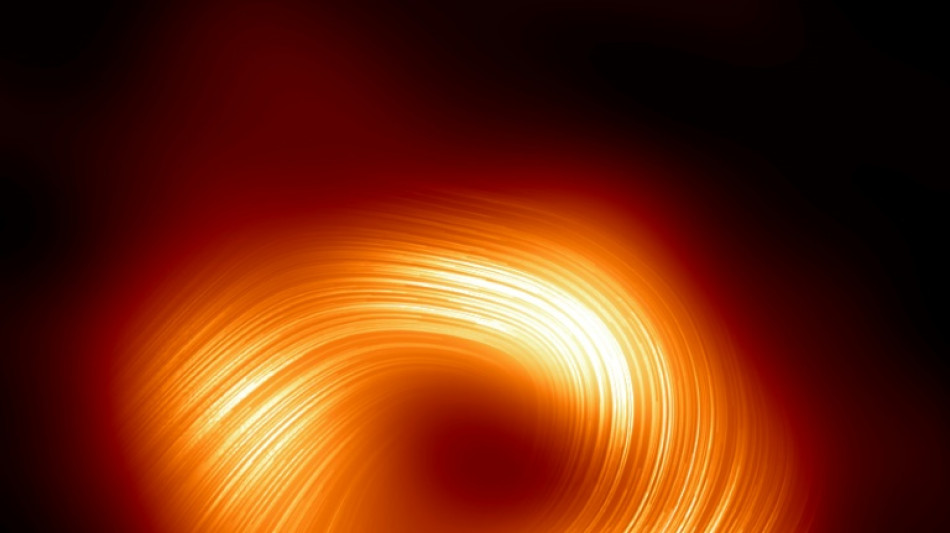
Milky Way's black hole surrounded by strong magnetic fields: astronomers / Photo: Handout - European Southern Observatory/AFP

 Nigeria miners struggled to breathe in cell before 37 died: survivors

 Warren Buffett steps down as Berkshire Hathaway chairman

 Isolated Syrian-Druze city blames Damascus for shortages

 Kerry James Marshall: American 'blackness' painter celebrated in Europe

 Infantino 'must go', says German FA vice-president

 Japan's busiest rail station tests robot bins

 Backpackers fret over Australian visa crackdown

 Bank of Japan hikes rates to 31-year high to battle inflation

 AI doomsday warnings unlikely to slow IPOs but questions linger

 In Brazil's Amazon, the hunt for oil fuels hopes and fears

 Baby orangutans in India expose 'frightening' scale of trafficking

 Oversight Board blasts 'inadequate' Meta safeguards for AI deepfakes

 Harry makes first public appearance since return to UK

 Princess Diana's brother makes new explosive claims against Charles

 Trump admin overhauls key protection for endangered species

 Mbappe draws political fire over Ceuta t-shirt controversy

 Third malaria death in Germany from outbreak tied to Frankfurt airport

 AtlasClear Holdings Reports Preliminary Fiscal 2026 Revenue of Approximately $20.1 Million, Up 85%; Revenue Plus Interest Income of Approximately $21.9 Million

 'Another arrow to the quiver': World Bank posts record private capital mobilization

 Ireland to boycott Eurovision 2027 over Gaza

 India's Tata Sons reappoints N. Chandrasekaran as chairman

 Germany urges EU action against China to defend carmakers

 Japan eyes changing prostitution law to punish sex buyers

 Modi pitches India as global chipmaking hub

 Ukraine plans record defence spending in 2027

Astronomers have discovered powerful magnetic fields spiralling around the black hole that sits at the centre of the Milky Way, the European Southern Observatory said Wednesday.
A new image from the Event Horizon Telescope (EHT) for the first time showed in polarised light a ring of magnetic fields surrounding the Sagittarius A* black hole.
The fields are similar to those observed around the M87* black hole at the heart of the M87 Galaxy, which the ESO says suggests that strong magnetic fields may be common to all black holes.
"What we're seeing now is that there are strong, twisted, and organised magnetic fields near the black hole at the centre of the Milky Way galaxy," said Sara Issaoun, from Harvard's Center for Astrophysics, and co-lead of the project.
Polarised light images allow the astronomers to isolate the magnetic field lines.
Supermassive black holes, which sit at the centre of galaxies, have masses millions and even billions greater than the Sun. They are believed to have emerged very early in the universe but their creation remains a mystery.
Nothing can escape their gravitational pull, not even light, making them impossible to observe directly.
But with M87* in 2019 and Sagittarius A* in 2022, the EHT captured the halo of light that is produced by the flow of matter and gas that black holes suck in and eject.
"By imaging polarised light from hot glowing gas near black holes, we are directly inferring the structure and strength of the magnetic fields that thread the flow of gas and matter that the black hole feeds on," said Angelo Ricarte, member of the Harvard Black Hole Initiative and a co-lead of the project.
Mariafelicia De Laurentis, deputy scientist at the EHT and professor at the University of Naples Federico II in Italy, said that "since both (black holes) are pointing us toward strong magnetic fields, it suggests that this may be a universal and perhaps fundamental feature of these kinds of systems."
Y.Uduike--CPN