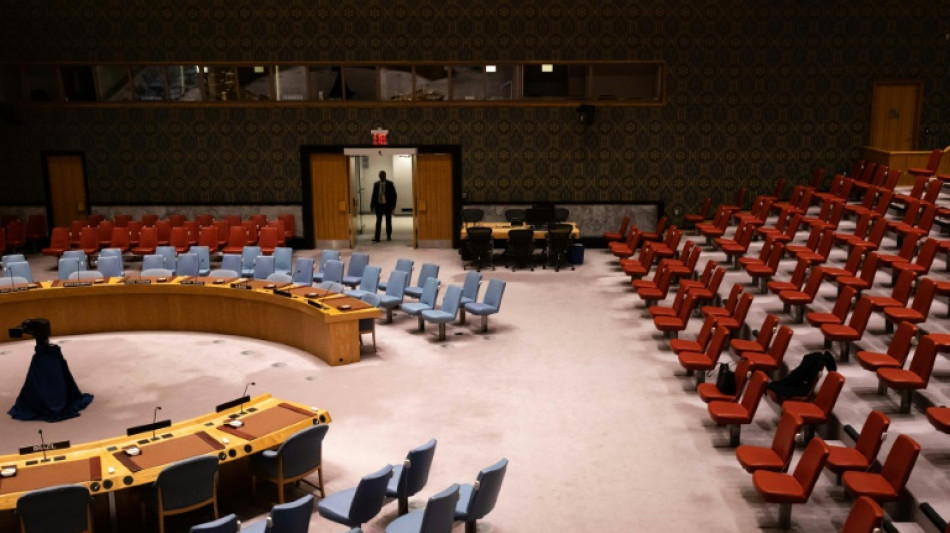
UN General Assembly calls for guidelines on AI's risks, rewards / Photo: Yuki IWAMURA - AFP/File

 Nigeria miners struggled to breathe in cell before 37 died: survivors

 Warren Buffett steps down as Berkshire Hathaway chairman

 Isolated Syrian-Druze city blames Damascus for shortages

 Kerry James Marshall: American 'blackness' painter celebrated in Europe

 Infantino 'must go', says German FA vice-president

 Japan's busiest rail station tests robot bins

 Backpackers fret over Australian visa crackdown

 Bank of Japan hikes rates to 31-year high to battle inflation

 AI doomsday warnings unlikely to slow IPOs but questions linger

 In Brazil's Amazon, the hunt for oil fuels hopes and fears

 Baby orangutans in India expose 'frightening' scale of trafficking

 Oversight Board blasts 'inadequate' Meta safeguards for AI deepfakes

 Harry makes first public appearance since return to UK

 Princess Diana's brother makes new explosive claims against Charles

 Trump admin overhauls key protection for endangered species

 Mbappe draws political fire over Ceuta t-shirt controversy

 Third malaria death in Germany from outbreak tied to Frankfurt airport

 AtlasClear Holdings Reports Preliminary Fiscal 2026 Revenue of Approximately $20.1 Million, Up 85%; Revenue Plus Interest Income of Approximately $21.9 Million

 'Another arrow to the quiver': World Bank posts record private capital mobilization

 Ireland to boycott Eurovision 2027 over Gaza

 India's Tata Sons reappoints N. Chandrasekaran as chairman

 Germany urges EU action against China to defend carmakers

 Japan eyes changing prostitution law to punish sex buyers

 Modi pitches India as global chipmaking hub

 Ukraine plans record defence spending in 2027

The UN General Assembly on Thursday called for the development of a set of international guidelines to address the risks and benefits of artificial intelligence.
The resolution, co-sponsored by dozens of countries and adopted by consensus, emphasizes the necessity of guidelines "to promote safe, secure and trustworthy artificial intelligence systems," while excluding military AI from its purview.
On the whole, the resolution, prepared by the United States, focuses more on the technology's positive potential, and calls for special care "to bridge the artificial intelligence and other digital divides between and within countries."
It also seeks "to promote, not hinder, digital transformation and equitable access" to AI in order to achieve the UN's Sustainable Development Goals, which aim to ensure a better future for humanity by 2030.
"As AI technologies rapidly develop, there is urgent need and unique opportunities for member states to meet this critical moment with collective action," US Ambassador to the UN Linda Thomas-Greenfield said earlier, reading a joint statement by the dozens of co-sponsor countries.
According to Richard Gowan, an analyst at the International Crisis Group, "the emphasis on development is a deliberate effort by the US to win goodwill among poorer nations."
"It is easier to talk about how AI can help developing countries progress rather than tackle security and safety topics head-on as a first initiative," he said.
- 'Male-dominated algorithms' -
The resolution does highlight the technology's threats when misused with the intent to cause harm, and also recognizes that without guarantees, AI risks eroding human rights, reinforcing prejudices and endangering personal data protection.
It therefore asks member states and stakeholders "to refrain from or cease the use of artificial intelligence systems that are impossible to operate in compliance with international human rights law or that pose undue risks to the enjoyment of human rights."
Warnings against the technology have become increasingly prevalent, particularly when it comes to generative AI tools and the risks they pose for democracy and society, particularly via fake images and speech shared in a bid to interfere in elections.
UN Secretary-General Antonio Guterres has made AI regulation a priority, calling for the creation of a UN entity modelled on other UN organizations such as the International Atomic Energy Agency (IAEA).
He has regularly highlighted the potential for disinformation and last week warned of bias in technologies designed mainly by men, which can result in algorithms that ignore the rights and needs of women.
"Male-dominated algorithms could literally program inequalities into activities from urban planning to credit ratings to medical imaging for years to come," he said.
Gowan of the International Crisis Group said he didn't "think the US wants Guterres leading this conversation, because it is so sensitive" and was therefore "stepping in to shape the debate."
A race is underway between various UN member states, the United States, China and South Korea, to be at the forefront of the issue.
In October, the White House unveiled a set of measures intended to ensure that the United States leads the way in AI regulation, with President Joe Biden insisting on the need to govern the technology.
P.Kolisnyk--CPN