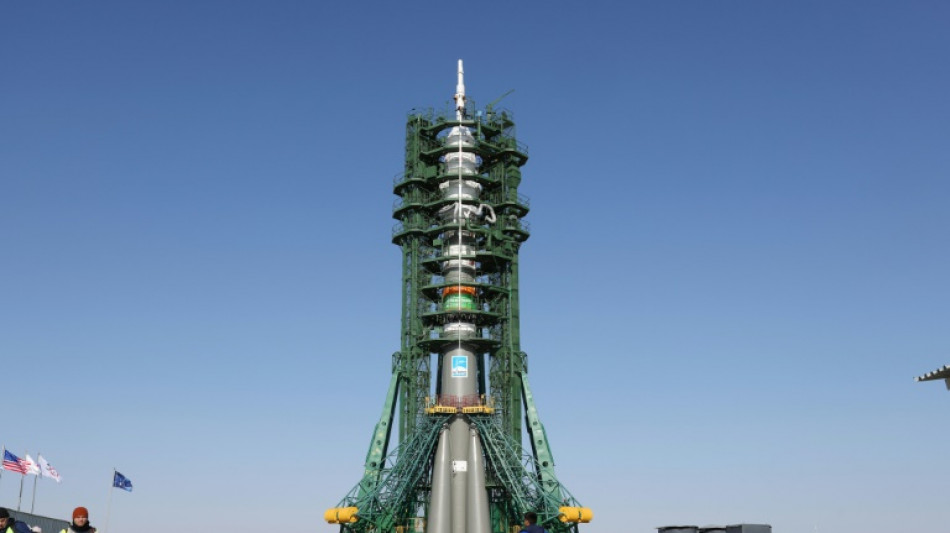
Russian spacecraft launch aborted seconds before take-off / Photo: Handout - ROSCOSMOS/AFP

 Nigeria miners struggled to breathe in cell before 37 died: survivors

 Warren Buffett steps down as Berkshire Hathaway chairman

 Isolated Syrian-Druze city blames Damascus for shortages

 Kerry James Marshall: American 'blackness' painter celebrated in Europe

 Infantino 'must go', says German FA vice-president

 Japan's busiest rail station tests robot bins

 Backpackers fret over Australian visa crackdown

 Bank of Japan hikes rates to 31-year high to battle inflation

 AI doomsday warnings unlikely to slow IPOs but questions linger

 In Brazil's Amazon, the hunt for oil fuels hopes and fears

 Baby orangutans in India expose 'frightening' scale of trafficking

 Oversight Board blasts 'inadequate' Meta safeguards for AI deepfakes

 Harry makes first public appearance since return to UK

 Princess Diana's brother makes new explosive claims against Charles

 Trump admin overhauls key protection for endangered species

 Mbappe draws political fire over Ceuta t-shirt controversy

 Third malaria death in Germany from outbreak tied to Frankfurt airport

 AtlasClear Holdings Reports Preliminary Fiscal 2026 Revenue of Approximately $20.1 Million, Up 85%; Revenue Plus Interest Income of Approximately $21.9 Million

 'Another arrow to the quiver': World Bank posts record private capital mobilization

 Ireland to boycott Eurovision 2027 over Gaza

 India's Tata Sons reappoints N. Chandrasekaran as chairman

 Germany urges EU action against China to defend carmakers

 Japan eyes changing prostitution law to punish sex buyers

 Modi pitches India as global chipmaking hub

 Ukraine plans record defence spending in 2027

The launch of a Russian spacecraft to the International Space Station was aborted at the last minute on Thursday, in another high-profile setback for Russia's space programme.
The Russian Soyuz MS-25 mission was due to take off from the Baikonur space port in Kazakhstan on Thursday, carrying three astronauts from Russia, the United States and Belarus.
But the launch was cancelled just seconds before scheduled blast-off at 4:21 pm Moscow-time (1321 GMT), when engines didn't fire up as the crew were strapped in and counting down.
"Attention at the launch complex. There was an automatic launch cancellation. Bring the units of the launch complex to the initial state," the flight controller said in a live broadcast by Russia's space agency Roscosmos.
A separate NASA broadcast of the planned launch said it was aborted 20 seconds before take-off.
"This is Mission Control Houston. To recap: today's launch of Soyuz MS-25 was aborted at about the T minus 20 second mark," the announcer said.
The announcer said the "engine sequence start" did not occur as expected, triggering an "automatic command to abort the countdown".
Roscosmos head Yury Borisov later said a "voltage dip" had occurred in a chemical power source during the final pre-launch preparations, Russian state news agencies reported.
"This is the thing with space. The situation is quite understandable," he told reporters.
He said the launch would be rescheduled to Saturday.
- Latest setback -
Russia had devoted the mission to Yuri Gagarin, the first man in space, who would have turned 90 this month.
Moscow's once pioneering space programme has faced multiple setbacks since it won the first leg of the space race more than 60 years ago.
The programme has suffered since the collapse of the USSR, including with the loss of its first lunar probe in almost 50 years last August.
The Russian segment of the ISS also suffered three coolant leaks in under a year, spraying flakes of frozen coolant into space on multiple occasions in 2023.
Roscosmos said the crew were safe and were being extracted from the spacecraft after Thursday's failed launch.
Space is one of the final areas of US-Russia cooperation amid an almost complete breakdown in relations between Moscow and Washington over the last two years.
But Russia has said it plans to ditch the ISS and build its own space station.
It previously said it would quit "after 2024," but the most recent position is that Russia will remain a participant until 2028.
Russian officials have decried outdated equipment on board the ISS and said it justifies their desire to quit the initiative.
"The International Space Station is approaching the finish line of its existence," Borisov said last year.
For almost a decade, Russian Soyuz launches were the only way to ferry astronauts between Earth and the ISS, after NASA halted its Space Shuttle programme.
But the United States has now moved to using privately-built SpaceX rockets and capsules, ending Russia's monopoly on manned launches.
O.Hansen--CPN