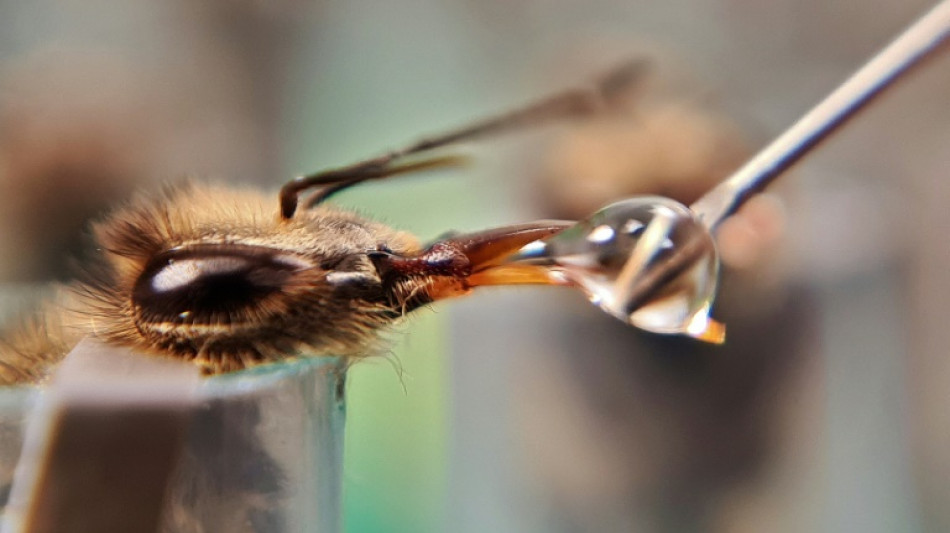
Colombian researchers seek safety for bees in urban jungle

 Wildfires push endangered Sumatran elephants to brink: Indonesian NGO

 Bank of Japan set to raise rates under pressure from inflation, US

 EU chief to unveil social media, gaming curbs for under-15s

 'Resident Evil' film brings video game's ethos to the big screen

 i-payout Expands U.S. Money Transmitter Licensing Footprint and Advances European EMI Strategy

 US Senate crypto bill collapses amid partisan deadlock

 OpenAI, Anthropic and Google are working to create an AI standards body

 Protesting shepherds, farmers clash with Romanian police

 Foundation Lets Ledger Users Switch to Open Source Without Starting Over

 EU to propose curbing social media, online games for under 15s

 FX Junction Reaches 40,600 Members and 26 Million Trades

 'We unleashed the beast': the world's fears and hopes about AI

 Hospitality leaders ask Burnham to halve VAT amid rising costs

 Worcestershire invited to nominate groups for 2027 King’s volunteer award

 Berlin's run-down public spaces at heart of election campaign

 'Widow's Bay' and 'The Pitt' win big at Emmy Awards

 Most markets drop as oil extends gains ahead of expected US rate hike

 Sri Lanka's famed beach shack battles demolition

 Vserv targets ₹1,000 crore revenue by 2030 through AI expansion

 India prohibits bank fees on UPI payments up to ₹2,000

 Brazil's Amazon defender Raoni has cancer

 Trump rejects AI slowdown concerns as UN urges coordinated controls

 Higher wages draw migrant workers to Kashmir despite attacks

 Oil supply concerns and AI warnings weigh on global markets

 'I am the hoax buster': Trump rejects AI danger warnings

Far from the flowery fields that are their natural home, honey bees imperiled by pesticides in rural Colombia are finding sanctuary on university campuses in the bustling capital Bogota.
Even though hives are banned from the city due to the risk the insects' stings can pose to humans, universities enjoy an exemption for research purposes.
At the University of Rosario, biologist Andre Riveros very carefully feeds a bee some sugar water, watching attentively as it stretches its straw-like tongue, or proboscis, towards the sweet liquid.
The university boasts a rooftop apiary in a bamboo structure some six meters (nearly 20 feet) high, surrounded by trees and flowers.
Here, Riveros and his team study a colony of bees in the hopes of developing a food supplement that will offer the critical crop pollinators protection from insecticides
"Pesticides end up affecting some (neurological) regions that, for example, affect learning and memory and (the bees) end up with damage very similar to Alzheimer's," Riveros told AFP.
"We are trying to find a solution for the problem of bee disappearances," he added. "We seek to shield the bees, in essence."
The team's work focuses on the Apis mellifera, or Western Honey Bee, one of about 20,000 known species worldwide.
Hundreds of hives have been killed off in Colombia in recent years, and investigations into the cause have pointed to fipronil, an insecticide banned in Europe and restricted in the United States and China.
Fipronil has been widely used in a profitable avocado and citrus boom in Colombia, though the Latin American country suspended its use in some crops for six months last year.
- 'Fleeing the fields' -
Elsewhere in Bogota, the EAN University boasts its own hives, perched on a six-story building overlooking the city of eight million people.
Beekeeper Gino Cala extracts honey from the hives as part of his work to instruct and assist universities in the management of urban apiaries.
But Cala told AFP Colombia's bees "are fleeing the fields" partly due to the "indiscriminate use of agrochemicals."
"These insects are extremely relevant and important... because they help guarantee part of the food security of Colombia and the world," he added.
From the EAN University grounds, Cala's bees help to pollinate plants in surrounding areas.
About 1.4 billion jobs and three-quarters of all crops around the world, according to a 2016 study, depend on pollinators -- mainly bees -- which provide free fertilization services worth billions of dollars.
In recent years, bees in North America, Europe, Russia, South America and elsewhere have started dying off from "colony collapse disorder," a mysterious scourge blamed partly on pesticides but also on mites, viruses and fungi.
The UN warns that nearly half of insect pollinators, particularly bees and butterflies, risk global extinction.
Despite the city ban, there are private beekeepers in Bogota who sell products such as honey, pollen or beeswax.
The fire department of Bogota says it attends to eight bee sting-related emergencies on average every day.
Ng.A.Adebayo--CPN