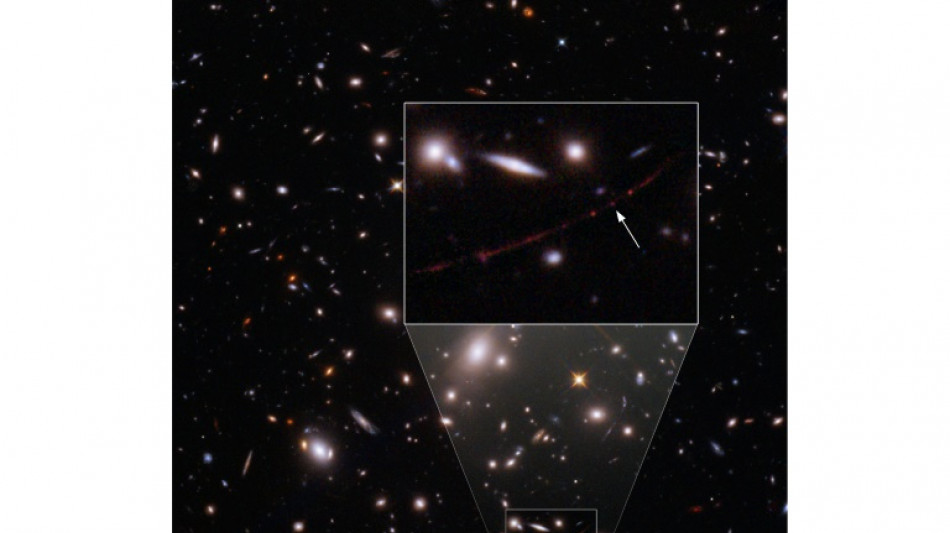
Hubble telescope spots most distant star ever seen

 Wildfires push endangered Sumatran elephants to brink: Indonesian NGO

 Bank of Japan set to raise rates under pressure from inflation, US

 EU chief to unveil social media, gaming curbs for under-15s

 'Resident Evil' film brings video game's ethos to the big screen

 i-payout Expands U.S. Money Transmitter Licensing Footprint and Advances European EMI Strategy

 US Senate crypto bill collapses amid partisan deadlock

 OpenAI, Anthropic and Google are working to create an AI standards body

 Protesting shepherds, farmers clash with Romanian police

 Foundation Lets Ledger Users Switch to Open Source Without Starting Over

 EU to propose curbing social media, online games for under 15s

 FX Junction Reaches 40,600 Members and 26 Million Trades

 'We unleashed the beast': the world's fears and hopes about AI

 Hospitality leaders ask Burnham to halve VAT amid rising costs

 Worcestershire invited to nominate groups for 2027 King’s volunteer award

 Berlin's run-down public spaces at heart of election campaign

 'Widow's Bay' and 'The Pitt' win big at Emmy Awards

 Most markets drop as oil extends gains ahead of expected US rate hike

 Sri Lanka's famed beach shack battles demolition

 Vserv targets ₹1,000 crore revenue by 2030 through AI expansion
 India prohibits bank fees on UPI payments up to ₹2,000

 Brazil's Amazon defender Raoni has cancer

 Trump rejects AI slowdown concerns as UN urges coordinated controls

 Higher wages draw migrant workers to Kashmir despite attacks

 Oil supply concerns and AI warnings weigh on global markets

 'I am the hoax buster': Trump rejects AI danger warnings

The Hubble space telescope has peered back to the dawn of cosmic time and detected light from a star that existed within the first billion years after the Big Bang -- a new record, astronomers said Wednesday.
The newly discovered star, called "Earendel," is so far away its light has taken 12.9 billion years to reach Earth, when the universe was seven percent its current age.
"We almost didn't believe it at first, it was so much farther than the previous most distant," said astronomer Brian Welch of Johns Hopkins University in Baltimore, lead author of a paper in Nature describing the discovery.
The previous record holder was detected in 2018 when the universe was four billion years old.
Because the universe is expanding, by the time light from distant stars reaches us it is stretched to longer, redder wavelengths, a phenomenon called "redshift."
Earendel's light came from an era called redshift 6.2.
"Normally at these distances, entire galaxies look like small smudges, the light from millions of stars blending together," said Welch in a statement.
The galaxy hosting the star has been naturally magnified and distorted by an effect called gravitational lensing.
This is when a massive object in between the observer and the thing they're looking at bends the fabric of space-time, so that rays of light coming from the target object that were diverging are bent back towards the observer.
The cosmic magnifying glass in this case is a huge galaxy cluster known as WHL0137-08, which, thanks to a rare alignment, provides maximum magnification and brightening.
"The galaxy hosting this star has been magnified and distorted by gravitational lensing into a long crescent that we named the Sunrise Arc," said Welch.
After he studied the galaxy in detail, Welch found that one feature is an extremely magnified star that he called Earendel, which means "morning star" in Old English.
Earendel existed so long ago that it may not have had the same raw materials as the stars that exist today, added Welch.
"It's like we've been reading a really interesting book, but we started with the second chapter, and now we will have a chance to see how it all got started," he said.
Astronomers intend to gaze at the star using the James Webb Space Telescope, Hubble's successor, which is highly sensitive to infrared light from the oldest celestial bodies, in order to confirm Earendel's age, mass and radius.
It has been hypothesized that primordial stars were made solely from the elements forged after the Big Bang: hydrogen, helium and trace amounts of lithium, and should be more massive than stars that exist today.
It remains to be seen if Earendel belongs to these so-called "Population III" stars, but while the probability is small, it is enticing, said Welch.
Webb, which should go online this summer, is expected to break Hubble's records and peer even further back in time.
M.P.Jacobs--CPN