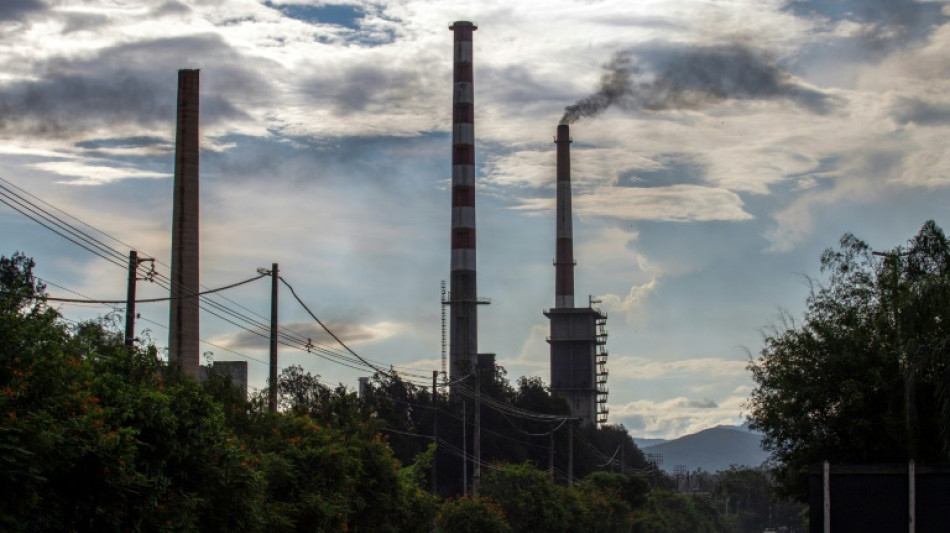
New US rule requires publicly-listed firms to disclose emissions

 Wildfires push endangered Sumatran elephants to brink: Indonesian NGO

 Bank of Japan set to raise rates under pressure from inflation, US

 EU chief to unveil social media, gaming curbs for under-15s

 'Resident Evil' film brings video game's ethos to the big screen

 i-payout Expands U.S. Money Transmitter Licensing Footprint and Advances European EMI Strategy

 US Senate crypto bill collapses amid partisan deadlock

 OpenAI, Anthropic and Google are working to create an AI standards body

 Protesting shepherds, farmers clash with Romanian police

 Foundation Lets Ledger Users Switch to Open Source Without Starting Over

 EU to propose curbing social media, online games for under 15s

 FX Junction Reaches 40,600 Members and 26 Million Trades

 'We unleashed the beast': the world's fears and hopes about AI

 Hospitality leaders ask Burnham to halve VAT amid rising costs

 Worcestershire invited to nominate groups for 2027 King’s volunteer award

 Berlin's run-down public spaces at heart of election campaign

 'Widow's Bay' and 'The Pitt' win big at Emmy Awards

 Most markets drop as oil extends gains ahead of expected US rate hike

 Sri Lanka's famed beach shack battles demolition

 Vserv targets ₹1,000 crore revenue by 2030 through AI expansion

 India prohibits bank fees on UPI payments up to ₹2,000

 Brazil's Amazon defender Raoni has cancer

 Trump rejects AI slowdown concerns as UN urges coordinated controls

 Higher wages draw migrant workers to Kashmir despite attacks

 Oil supply concerns and AI warnings weigh on global markets

 'I am the hoax buster': Trump rejects AI danger warnings

Publicly-traded US companies would be required to disclose their greenhouse gas emissions and their approach to managing climate change risks under a proposed rule approved by Washington Monday.
The measure, which now goes for public comment following a vote by the Securities and Exchange Commission (SEC), follows similar steps by regulators in Japan and Europe, and aims to standardize emissions reporting.
"Climate risks can pose significant financial risks to companies," said SEC Chair Gary Gensler, an appointee of President Joe Biden.
Gensler argued the measure would provide "reliable information about climate risks to make informed investment decisions."
Companies would be required to report emissions from their own activities, known as Scope 1, and indirect emissions from purchased energy, known as Scope 2.
Firms would also need to disclose Scope 3 emissions, which are indirectly incurred in the value chain. These include energy sold to another company if these emissions are consequential to its finances or if they have set targets for these emissions.
The rules would take effect between 2024 and 2026. Smaller firms would be exempt from the measure.
"This is a watershed moment," said Allison Herren Lee, a Democratic commissioner who backed the change.
But Hester Peirce, the lone Republican member of the SEC and the only one of four commissioners to vote against the proposal, argued current rules sufficiently account for climate risk and that the measure distorts the regulatory agency's mission.
"It forces investors to view companies through the eyes of a vocal set of stakeholders, for whom a company's climate reputation is of equal or greater importance than a company's financial performance," Peirce said.
The rule comes as environmentalist shareholder groups and increasing numbers of mainstream investors press companies for action on climate change.
The SEC proposal has also been slammed by leading Republican lawmakers as an overreach at a time when Biden's attempted to curb climate change via legislation are stalled in Congress.
A.Samuel--CPN