New microscopic organisms found in deep sea trench baffle Chile scientists

 Wildfires push endangered Sumatran elephants to brink: Indonesian NGO

 Bank of Japan set to raise rates under pressure from inflation, US

 EU chief to unveil social media, gaming curbs for under-15s

 'Resident Evil' film brings video game's ethos to the big screen

 i-payout Expands U.S. Money Transmitter Licensing Footprint and Advances European EMI Strategy

 US Senate crypto bill collapses amid partisan deadlock

 OpenAI, Anthropic and Google are working to create an AI standards body

 Protesting shepherds, farmers clash with Romanian police

 Foundation Lets Ledger Users Switch to Open Source Without Starting Over

 EU to propose curbing social media, online games for under 15s

 FX Junction Reaches 40,600 Members and 26 Million Trades

 'We unleashed the beast': the world's fears and hopes about AI

 Hospitality leaders ask Burnham to halve VAT amid rising costs

 Worcestershire invited to nominate groups for 2027 King’s volunteer award

 Berlin's run-down public spaces at heart of election campaign
 'Widow's Bay' and 'The Pitt' win big at Emmy Awards

 Most markets drop as oil extends gains ahead of expected US rate hike

 Sri Lanka's famed beach shack battles demolition

 Vserv targets ₹1,000 crore revenue by 2030 through AI expansion

 India prohibits bank fees on UPI payments up to ₹2,000

 Brazil's Amazon defender Raoni has cancer

 Trump rejects AI slowdown concerns as UN urges coordinated controls

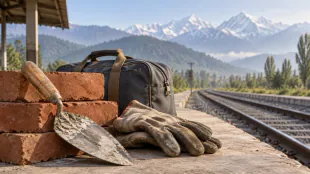 Higher wages draw migrant workers to Kashmir despite attacks

 Oil supply concerns and AI warnings weigh on global markets

 'I am the hoax buster': Trump rejects AI danger warnings

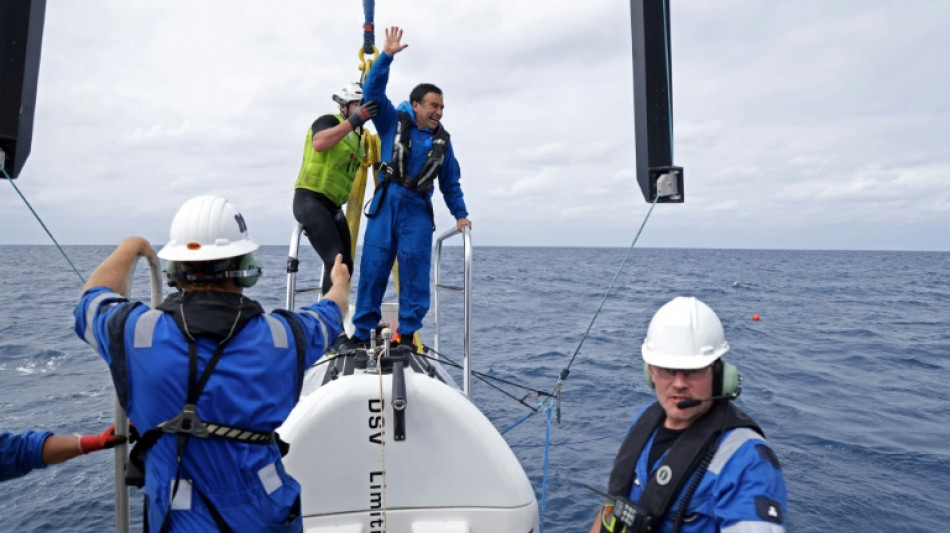
When Chilean scientist Osvaldo Ulloa led an expedition 8,000 meters under the sea to an area where no human had ever been, his team discovered microscopic organisms that generated more questions than answers.
The January submarine expedition dove into the Atacama Trench, created by the meeting of two tectonic plates in the eastern Pacific Ocean.
"We pulled off the feat of taking humans into the trench where no other human being had been before," Ulloa, the director of the Millennium Institute of Oceanography at the University of Concepcion, told AFP.
He was joined by American explorer Victor Vescovo and Millennium assistant director Ruben Escribano on the 12-week journey off Chile's northern coast in the 5,900-kilometer (3,650-mile) long trench that extends up to Ecuador.
By the time the expedition, named Atacama Hadal, reached a depth of 100 meters it was already in pitch black darkness, with the crew members' vision limited to what the submarine's powerful LED light could capture.
Further down out of the darkness emerged remarkable examples of deep sea life.
"We came across geological structures and there we saw a type of holothurians or translucent sea cucumbers, like jelly, that we had not recorded and were most probably new species," said Ulloa.
"We also discovered bacterial communities that had filaments that we did not even know existed in the Atacama Trench and which feed on chemical and inorganic compounds.
"That opened up a huge number of questions: What are those compounds? What type of bacteria are they? We have no idea, we're going to have to go back there."
The expedition also found species of amphipods, a type of crustacean closely related to shrimp, which were scavenging crustaceans, segmented worms and translucent fish. They were discovered in the same place in an unmanned expedition in 2018.
- 'Incredibly ambitious' –
The Atacama Trench -- also known as the Peru-Chile Trench -- lies where the Nazca and South American tectonic plates converge.
It is an area that has produced many earthquakes and tsunamis.
"We will put three sensors on the South American Plate and two on the Nazca Plate to see how the oceanic floor is deformed," said Ulloa.
For the moment, "these types of sensors only exist on land."
The devices will allow scientists to observe where energy is building in areas that have not had an earthquake, thus helping predict where the next temblor will take place.
"It is an incredibly ambitious project," said Ulloa, adding that it is "the largest experiment that has been done in underwater geology here in Chile."
The sensors are due to be placed during the second half of this year.
"There is a lot of interest from the international community to put more sensors in this region to study all the processes associated with the collision of these two plates."
Ng.A.Adebayo--CPN