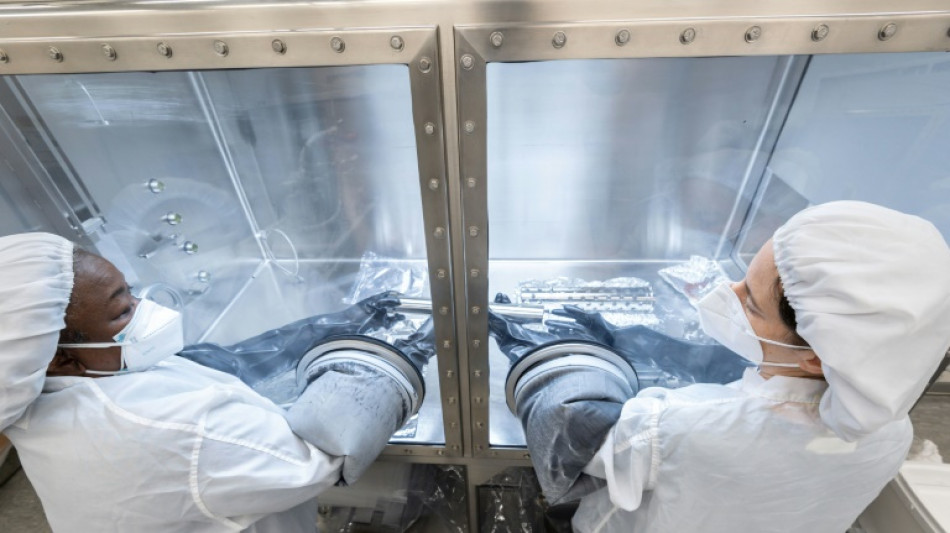
NASA opens sample taken from the Moon 50 years on

 Wildfires push endangered Sumatran elephants to brink: Indonesian NGO

 Bank of Japan set to raise rates under pressure from inflation, US

 EU chief to unveil social media, gaming curbs for under-15s

 'Resident Evil' film brings video game's ethos to the big screen

 i-payout Expands U.S. Money Transmitter Licensing Footprint and Advances European EMI Strategy

 US Senate crypto bill collapses amid partisan deadlock

 OpenAI, Anthropic and Google are working to create an AI standards body

 Protesting shepherds, farmers clash with Romanian police

 Foundation Lets Ledger Users Switch to Open Source Without Starting Over

 EU to propose curbing social media, online games for under 15s

 FX Junction Reaches 40,600 Members and 26 Million Trades

 'We unleashed the beast': the world's fears and hopes about AI

 Hospitality leaders ask Burnham to halve VAT amid rising costs

 Worcestershire invited to nominate groups for 2027 King’s volunteer award

 Berlin's run-down public spaces at heart of election campaign

 'Widow's Bay' and 'The Pitt' win big at Emmy Awards

 Most markets drop as oil extends gains ahead of expected US rate hike

 Sri Lanka's famed beach shack battles demolition

 Vserv targets ₹1,000 crore revenue by 2030 through AI expansion

 India prohibits bank fees on UPI payments up to ₹2,000

 Brazil's Amazon defender Raoni has cancer

 Trump rejects AI slowdown concerns as UN urges coordinated controls

 Higher wages draw migrant workers to Kashmir despite attacks

 Oil supply concerns and AI warnings weigh on global markets

 'I am the hoax buster': Trump rejects AI danger warnings

The Apollo missions to the Moon brought a total of 2,196 rock samples to Earth. But NASA has only just started opening one of the last ones, collected 50 years ago.
For all that time, some tubes were kept sealed so that they could be studied years later, with the help of the latest technical breakthroughs.
NASA knew "science and technology would evolve and allow scientists to study the material in new ways to address new questions in the future," Lori Glaze, director of the Planetary Science Division at NASA Headquarters, said in a statement.
Dubbed 73001, the sample in question was collected by astronauts Eugene Cernan and Harrison Schmitt in December 1972, during the Apollo 17 mission -- the last of the program.
The tube, 35 cm long and 4 cm (13.8 inches by 1.6 inches) wide, had been hammered into the ground of the Moon's Taurus-Littrow valley to collect the rocks.
Of the only two samples to have been vacuum sealed on the Moon, this is the first to be opened.
It could as such contain gases or volatile substances (water, carbon dioxide, etc.)
And the aim is to extract these gases, which are probably only present in very small quantities, to be able to analyze them using spectrometry techniques that have become extremely precise in recent years.
In early February, the outer protective tube was first removed.
It was not itself revealed to contain any lunar gas, indicating that the sample it contained remained sealed.
Then on February 23, scientists began a weeks-long process aimed at piercing the main tube and harvesting the gas contained inside.
In the spring, the rock will then be carefully extracted and broken up so that it can be studied by different scientific teams.
The extraction site of this sample is particularly interesting because it is the site of a landslide.
"Now we don't have rain on the Moon," said Juliane Gross, deputy Apollo curator. "And so we don't quite understand how landslides happen on the Moon."
Gross said researchers hope to study the sample to understand what causes landslides.
After 73001, there will be only three lunar samples still sealed. When will they in turn be opened?
"I doubt we'll wait another 50 years," said senior curator Ryan Zeigler.
"Particularly once they get Artemis samples back, it might be nice to do a direct comparison in real time between whatever's coming back from Artemis, and with one of these remaining unopened core, sealed cores," he said.
Artemis is NASA's next moon mission; the agency wants to send humans back to the Moon in 2025.
Large amounts of gas should then be collected, and the experiment currently being conducted helps to better prepare for it.
P.Kolisnyk--CPN