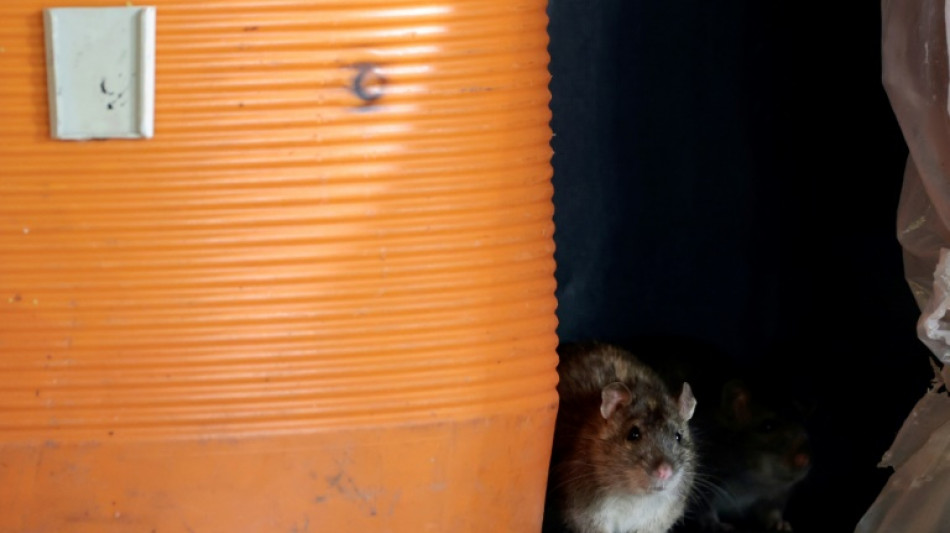
Forget mammoths, study shows how to resurrect Christmas Island rats

 Wildfires push endangered Sumatran elephants to brink: Indonesian NGO

 Bank of Japan set to raise rates under pressure from inflation, US

 EU chief to unveil social media, gaming curbs for under-15s

 'Resident Evil' film brings video game's ethos to the big screen

 i-payout Expands U.S. Money Transmitter Licensing Footprint and Advances European EMI Strategy

 US Senate crypto bill collapses amid partisan deadlock

 OpenAI, Anthropic and Google are working to create an AI standards body

 Protesting shepherds, farmers clash with Romanian police

 Foundation Lets Ledger Users Switch to Open Source Without Starting Over

 EU to propose curbing social media, online games for under 15s

 FX Junction Reaches 40,600 Members and 26 Million Trades

 'We unleashed the beast': the world's fears and hopes about AI

 Hospitality leaders ask Burnham to halve VAT amid rising costs

 Worcestershire invited to nominate groups for 2027 King’s volunteer award

 Berlin's run-down public spaces at heart of election campaign

 'Widow's Bay' and 'The Pitt' win big at Emmy Awards

 Most markets drop as oil extends gains ahead of expected US rate hike

 Sri Lanka's famed beach shack battles demolition

 Vserv targets ₹1,000 crore revenue by 2030 through AI expansion

 India prohibits bank fees on UPI payments up to ₹2,000

 Brazil's Amazon defender Raoni has cancer

 Trump rejects AI slowdown concerns as UN urges coordinated controls

 Higher wages draw migrant workers to Kashmir despite attacks

 Oil supply concerns and AI warnings weigh on global markets

 'I am the hoax buster': Trump rejects AI danger warnings

Ever since the movie Jurassic Park, the idea of bringing extinct animals back to life has captured the public's imagination -- but what might scientists turn their attention towards first?
Instead of focusing on iconic species like the woolly mammoth or the Tasmanian tiger, a team of paleogeneticists have studied how, using gene editing, they could resurrect the humble Christmas Island rat, which died out around 120 years ago.
Though they did not follow through and create a living specimen, they say their paper, published in Current Biology on Wednesday, demonstrates just how close scientists working on de-extinction projects could actually get using current technology.
"I am not doing de-extinction, but I think it's a really interesting idea, and technically it's really exciting," senior author Tom Gilbert, an evolutionary geneticist at the University of Copenhagen, told AFP.
There are three pathways to bringing back extinct animals: back-breeding related species to achieve lost traits; cloning, which was used to create Dolly the sheep in 1996; and finally genetic editing, which Gilbert and colleagues looked at.
The idea is to take surviving DNA of an extinct species, and compare it to the genome of a closely-related modern species, then use techniques like CRISPR to edit the modern species' genome in the places where it differs.
The edited cells could then be used to create an embryo implanted in a surrogate host.
Gilbert said old DNA was like a book that has gone through a shredder, while the genome of a modern species is like an intact "reference book" that can be used to piece together the fragments of its degraded counterpart.
His interest in Christmas Island rats was piqued when a colleague studied their skins to look for evidence of pathogens that caused their extinction around 1900.
It's thought that black rats brought on European ships wiped out the native species, described in an 1887 entry of the Proceedings of the Zoological Society of London as a "fine new Rat," large in size with a long yellow-tipped tail and small rounded ears.
- Key functions lost -
The team used brown rats, commonly used in lab experiments, as the modern reference species, and found they could reconstruct 95 percent of the Christmas Island rat genome.
That may sound like a big success, but the five percent they couldn't recover was from regions of the genome that controlled smell and immunity, meaning that the recovered rat might look the same but would lack key functionality.
"The take home is, even if we have basically the perfect ancient DNA situation, we've got a really good sample, we've sequenced the hell out of it, we're still lacking five percent of it," said Gilbert.
The two species diverged around 2.6 million years ago: close in evolutionary time, but not close enough to fully reconstruct the lost species' full genome.
This has important implications for de-extinction efforts, such as a project by US bioscience firm Colossal to resurrect the mammoth, which died out around 4,000 years ago.
Mammoths have roughly the same evolutionary distance from modern elephants as brown rats and Christmas Island rats.
Teams in Australia meanwhile are looking at reviving the Tasmanian tiger, or thylacine, whose last surviving member died in captivity in 1936.
Even if gene-editing were perfected, replica animals created with the technique would thus have certain critical deficiencies.
"Let's say you're bringing back a mammoth solely to have a hairy elephant in a zoo to raise money or get conservation awareness -- it doesn't really matter," he said.
But if the goal is to bring back the animal in its exact original form "that's never going to happen," he said.
Gilbert admitted that, while the science was fascinating, he had mixed feelings on de-extinction projects.
"I'm not convinced it is the best use of anyone's money," he said. "If you had to choose between bringing back something or protecting what was left, I'd put my money into protection."
A.Samuel--CPN