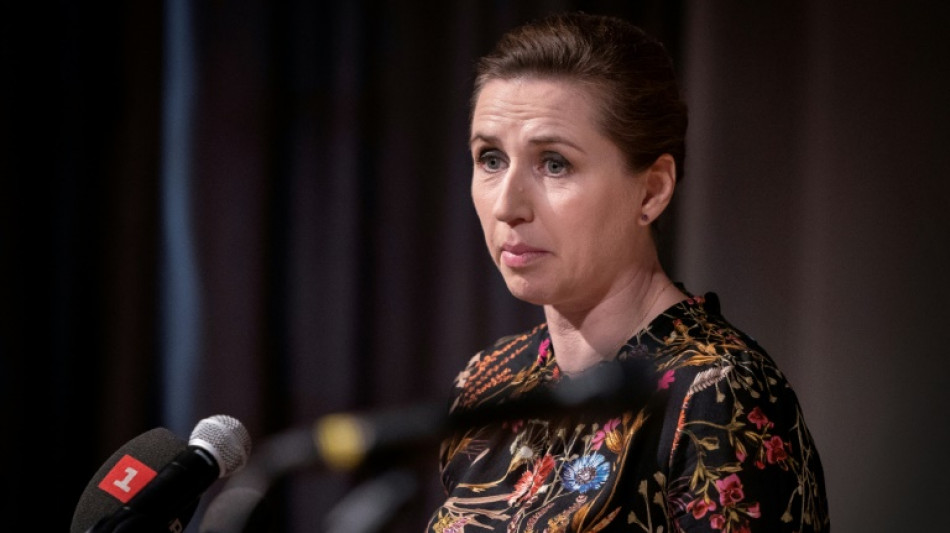
Danish PM says sorry to Inuits forcibly moved to Denmark

 Wildfires push endangered Sumatran elephants to brink: Indonesian NGO

 Bank of Japan set to raise rates under pressure from inflation, US

 EU chief to unveil social media, gaming curbs for under-15s

 'Resident Evil' film brings video game's ethos to the big screen

 i-payout Expands U.S. Money Transmitter Licensing Footprint and Advances European EMI Strategy

 US Senate crypto bill collapses amid partisan deadlock

 OpenAI, Anthropic and Google are working to create an AI standards body

 Protesting shepherds, farmers clash with Romanian police

 Foundation Lets Ledger Users Switch to Open Source Without Starting Over

 EU to propose curbing social media, online games for under 15s

 FX Junction Reaches 40,600 Members and 26 Million Trades

 'We unleashed the beast': the world's fears and hopes about AI

 Hospitality leaders ask Burnham to halve VAT amid rising costs

 Worcestershire invited to nominate groups for 2027 King’s volunteer award

 Berlin's run-down public spaces at heart of election campaign

 'Widow's Bay' and 'The Pitt' win big at Emmy Awards

 Most markets drop as oil extends gains ahead of expected US rate hike

 Sri Lanka's famed beach shack battles demolition

 Vserv targets ₹1,000 crore revenue by 2030 through AI expansion

 India prohibits bank fees on UPI payments up to ₹2,000

 Brazil's Amazon defender Raoni has cancer

 Trump rejects AI slowdown concerns as UN urges coordinated controls

 Higher wages draw migrant workers to Kashmir despite attacks

 Oil supply concerns and AI warnings weigh on global markets

 'I am the hoax buster': Trump rejects AI danger warnings
Denmark's prime minister apologised in person Wednesday to six Greenlandic Inuits removed from their families and taken to Copenhagen more than 70 years ago as part of an experiment to create a Danish-speaking elite.
"What you were subjected to was terrible. It was inhumane. It was unfair. And it was heartless", Mette Frederiksen told the six at an emotional ceremony in the capital.
"We can take responsibility and do the only thing that is fair, in my eyes: to say sorry to you for what happened," she said.
In the summer of 1951, 22 Inuit children between the ages of five and eight were sent to Denmark, which was Greenland's colonial power at the time but has since gained autonomy.
The parents had been promised their children would have a better life, learn Danish and return to Greenland one day as the future elite, in a deal between authorities in Copenhagen and Nuuk, the Greenland capital.
In Denmark, the children were not allowed to have any contact with their own families. After two years, 16 of the group were sent home to Greenland, but placed in an orphanage.
The others were adopted by Danish families. Several of the children never saw their real families again.
An inquiry into their fate concluded more than half were very negatively affected by the experiment.
Only six of the 22 are alive today.
"It was a big surprise for me when I realised that there were only six of them left, because they were not that old," their lawyer Mads Pramming told AFP.
"They told me that the others had died of sorrow," he added.
The PM's apology is "a big success for them", he said, two weeks after they each received financial compensation of 250,000 kroner (33,600 euros, $37,200).
"First they got an apology in writing, and then the compensation for the violation of their human rights, and now they will have a face-to-face," with the prime minister, Pramming said.
"Nothing had happened until now and it's you, Mette, who took the initiative to set up a commission two years ago", one of the six, Eva Illum, said.
In December 2020, the prime minister offered the six an official apology.
M.García--CPN