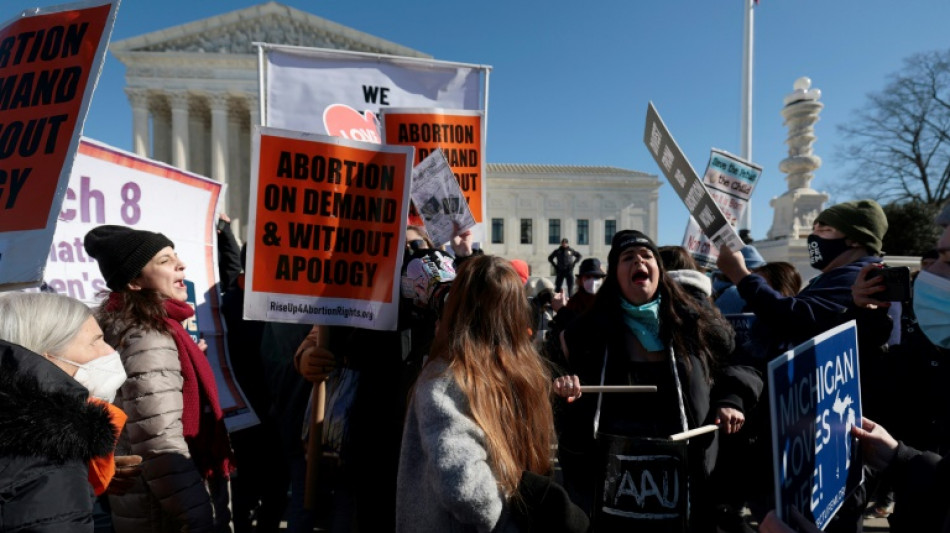
Many anti-abortion Americans would still help friends and family seeking one

 Wildfires push endangered Sumatran elephants to brink: Indonesian NGO

 Bank of Japan set to raise rates under pressure from inflation, US

 EU chief to unveil social media, gaming curbs for under-15s

 'Resident Evil' film brings video game's ethos to the big screen

 i-payout Expands U.S. Money Transmitter Licensing Footprint and Advances European EMI Strategy

 US Senate crypto bill collapses amid partisan deadlock

 OpenAI, Anthropic and Google are working to create an AI standards body

 Protesting shepherds, farmers clash with Romanian police

 Foundation Lets Ledger Users Switch to Open Source Without Starting Over

 EU to propose curbing social media, online games for under 15s

 FX Junction Reaches 40,600 Members and 26 Million Trades

 'We unleashed the beast': the world's fears and hopes about AI

 Hospitality leaders ask Burnham to halve VAT amid rising costs

 Worcestershire invited to nominate groups for 2027 King’s volunteer award

 Berlin's run-down public spaces at heart of election campaign

 'Widow's Bay' and 'The Pitt' win big at Emmy Awards

 Most markets drop as oil extends gains ahead of expected US rate hike

 Sri Lanka's famed beach shack battles demolition

 Vserv targets ₹1,000 crore revenue by 2030 through AI expansion

 India prohibits bank fees on UPI payments up to ₹2,000

 Brazil's Amazon defender Raoni has cancer

 Trump rejects AI slowdown concerns as UN urges coordinated controls

 Higher wages draw migrant workers to Kashmir despite attacks

 Oil supply concerns and AI warnings weigh on global markets

 'I am the hoax buster': Trump rejects AI danger warnings

Almost half of Americans morally opposed to abortion would help a friend or family member with arrangements to get one, and a majority would offer emotional support, a new study said Friday.
The authors of the paper, which appeared in the journal Science Advances, wrote the finding showed that people are willing to cross ideological and partisan lines to help others in their personal networks, something they referred to as "discordant benevolence."
"At first blush, these people may appear as hypocrites. They are not," said Sarah Cowan, a sociologist at New York University and the lead author of the article, in a statement.
"They are at a moral crossroads, pulled by their opposition to abortion and by their inclination to support people they care about."
The study was drawn from surveys and interviews conducted in 2018 and 2019 respectively, and comes after Texas passed a law allowing residents of the state to sue others who "aided or abetted" abortions performed after six weeks of pregnancy.
The Supreme Court could soon roll back decades of precedent by ruling abortion is not a constitutional right. The issue is deeply contentious and divides the public along political lines between Democrats and Republicans.
The new study was based on survey responses from more than 1,574 people, and separately 74 in-depth interviews.
Of those morally opposed, 76 percent said they would offer emotional support —- compared to 96 percent of those who are not morally opposed, or whose view depended on circumstances.
But the type of support varied greatly, reflecting the social meaning of money and the view that spending money is a means to enact one's values, the authors said.
Just six percent of those morally opposed would directly help a friend or relative pay for the procedure, compared to the 45 percent who said they would help with ancillary costs.
Among those not morally opposed, 54 percent would help pay for the procedure, which typically costs $500 in the first trimester.
- Moral conflict -
Social scientists have long been interested in what explains helpful behavior.
Factors are thought to range from the act of kindness causing a person to feel good about themselves, to a sense of duty to their kinship networks and expectation of reciprocity in future.
But the authors said scenarios where rendering help placed the helper in a moral conflict were less studied.
Based on their in-depth interviews, they found people who were willing to help despite their inner opposition relied on three main rationalizations.
The first was "commiseration," or reasoning that people are worthy of care despite their imperfections in an imperfect world.
The second was "exemption" -- carving out an exception for their loved ones in particular, while the third was "discretion," -- the idea that what is right or wrong is inherently personal, not universal.
"If it were my sister...I would want to talk to her to make sure she's thinking about every possible thing," said Ryan, a person interviewed in the survey.
"But if, ultimately, she's like 'No, (Ryan), I can handle this,' then, 'Ok, do what you gotta do,' you know? But it's just because you love someone."
C.Peyronnet--CPN