
Mexico's 'Black Panther' star fights racism at home / Photo: CLAUDIO CRUZ - AFP

 Kenya's economy faces climate change risks: World Bank

 Deja vu? Trump accused of economic denial and physical decline

 Hungary winemakers fear disease may 'wipe out' industry

 'Stop the slaughter': French farmers block roads over cow disease cull

 Why SpaceX IPO plan is generating so much buzz
 World stocks mostly slide, consolidating Fed-fuelled gains

 UK's king shares 'good news' that cancer treatment will be reduced in 2026

 Salah admired from afar in his Egypt home village as club tensions swirl

 Iran frees child bride sentenced to death over husband's killing: activists

 France updates net-zero plan, with fossil fuel phaseout

 EU agrees recycled plastic targets for cars

 British porn star fined, faces imminent Bali deportation
 Indonesia floods were 'extinction level' for rare orangutans
 Japan bear victim's watch shows last movements

 French indie 'Clair Obscur' dominates Game Awards

 Asian markets track Wall St record after Fed cut
 Vaccines do not cause autism: WHO

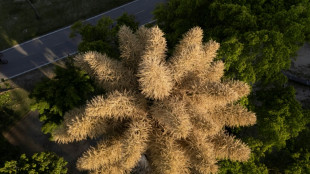 'In her prime': Rare blooming of palm trees in Rio

 OpenAI beefs up GPT models in AI race with Google

 Cyclone causes blackout, flight chaos in Brazil's Sao Paulo

 US bringing seized tanker to port, as Venezuela war threats build

 Time magazine names 'Architects of AI' as Person of the Year

 OpenAI, Disney to let fans create AI videos in landmark deal

 Thyssenkrupp pauses steel production at two sites citing Asian pressure

 Stocks mixed as US rate cut offset by Fed outlook, Oracle earnings

In Hollywood, he's the rising star of the sequel to "Black Panther," the first major Black superhero movie. In his homeland Mexico, Tenoch Huerta is leading a fight against racism on the screen.
The 41-year-old aims to use his growing fame to break the tradition of Mexican actors of Indigenous origin being cast in the roles of thieves and villains.
Playing the character of Namor the Sub-Mariner in Marvel Studios' "Black Panther: Wakanda Forever," Huerta joins a small club of international Mexican stars such as Salma Hayek, Gael Garcia Bernal and Diego Luna.
The path to Hollywood was strewn with pitfalls for Huerta, who hails from a working-class suburb of Mexico City.
"Like thousands of dark-skinned people, I've been called names" such as "dirty Indian," he wrote in his new book "Orgullo Prieto" (Brown Pride).
"Mexico is a country that's racist and denies it," he added.
Huerta said it is a myth that Mexico today is a mixed-race country where skin color is unimportant.
"This is how we deny the cultural and linguistic diversity of all Indigenous nations, Afro-descendant communities, Asians," he wrote.
Huerta, who also played infamous drug trafficker Rafael Caro Quintero in the Netflix hit "Narcos: Mexico," criticized the way of thinking "that places white, modern, Western, on a higher level."
- 'Racist narratives' -
Even before "Black Panther," Huerta was the figurehead of "Poder Prieto" (Brown Power), a collective of actresses and actors who feel discriminated against because of their origin and their skin color.
"We're only given characters of delinquents, domestic workers, or the poor," said Christel Klitbo, 40, who is of Danish, African and Lebanese descent.
Aware of the powerful influence of the media, Huerta said he and the other group members see a "compelling need to change racist narratives and practices, which have been normalized, reproduced and perpetuated in the audiovisual industry."
Huerta hopes that his appearance in "Black Panther" -- which also stars Oscar winner Lupita Nyong'o, who was born in Mexico to Kenyan parents -- will help their struggle.
"The perception changes if we have these dark-skinned actors, of clearly Indigenous descent, in positions of power and influence, who are kings and great warriors," he said.
Huerta also wants to see changes in wider Mexican customs, such as the popular saying still heard in some homes that daughters should marry a white man to "improve the race."
While he is in favor of laws against racism, Huerta avoids commenting on the policies of Mexican President Andres Manuel Lopez Obrador's party, which has pledged to "restore the dignity" of Indigenous peoples.
"I believe that the demands of the Indigenous peoples have not been met. But this is a subject that does not concern me, because I am not Indigenous," he said Friday at his book launch.
"As a simple external observer, I believe that we could do more and better," he added.
Mexico is home to 23.2 million people over the age of three who identify as Indigenous, representing 19.4 percent of the population, according to national statistics agency INEGI.
Around one in five Mexican adults said they had experienced discrimination over the past year, mainly because of their skin color, in the first national survey on the subject in 2O17.
And three-quarters of Indigenous people felt undervalued by Mexican society.
"We are a new link in a chain that dates back 500 years. All the struggles have been the same for 500 years," Huerta concluded, referring to the Spanish conquest and fall of the Aztec empire in 1521.
M.García--CPN