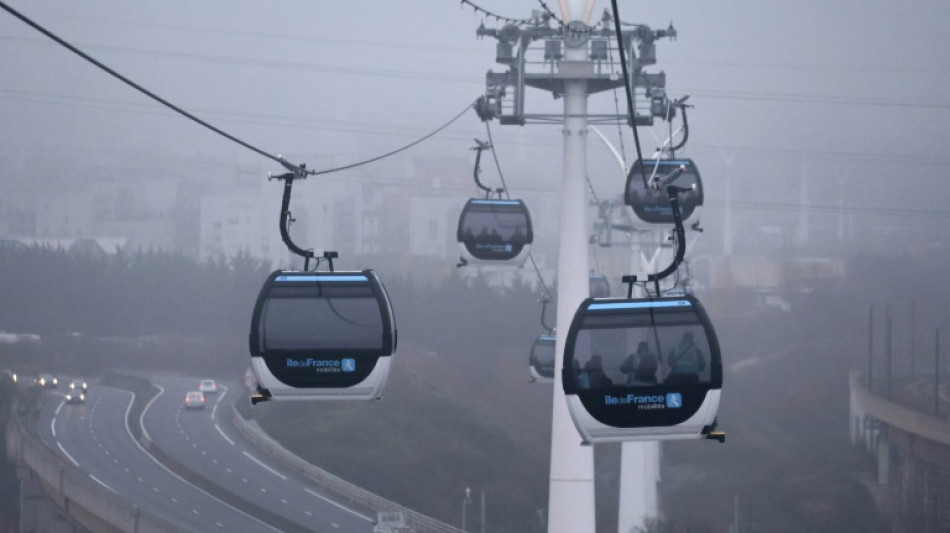
First urban cable car unveiled outside Paris / Photo: Thomas SAMSON - AFP

 France's Macron, Canada's Carney announce closer ties
 AI 'warning shots' focus Beijing on national security risks

 Philippine tribe in limbo over US-led tech hub

 Saudi-led coalition says Houthis fired ballistic missile at Riyadh

 Cuba works to restore power after another blackout

 Brigitte Bardot widower slams sale of star's belongings

 Indonesia accepts Malaysia's help to tackle wildfires

 Nvidia, OpenAI CEOs to attend Xi dinner at White House

 Cuba hit with seventh major blackout of the year
 Nigeria miners struggled to breathe in cell before 37 died: survivors

 Warren Buffett steps down as Berkshire Hathaway chairman

 Isolated Syrian-Druze city blames Damascus for shortages

 Kerry James Marshall: American 'blackness' painter celebrated in Europe

 Infantino 'must go', says German FA vice-president

 Japan's busiest rail station tests robot bins

 Backpackers fret over Australian visa crackdown

 Bank of Japan hikes rates to 31-year high to battle inflation

 AI doomsday warnings unlikely to slow IPOs but questions linger

 In Brazil's Amazon, the hunt for oil fuels hopes and fears

 Baby orangutans in India expose 'frightening' scale of trafficking

 Oversight Board blasts 'inadequate' Meta safeguards for AI deepfakes

 Harry makes first public appearance since return to UK

 Princess Diana's brother makes new explosive claims against Charles

 Trump admin overhauls key protection for endangered species

 Mbappe draws political fire over Ceuta t-shirt controversy

Gondolas floated above a cityscape in the southeastern suburbs of Paris Saturday as the first urban cable car in the French capital's region was unveiled.
Officials inaugurated the C1 line in the suburb of Limeil-Brevannes in the presence of Valerie Pecresse, the head of the Ile-de-France region, and the mayors of the towns served by the cable car.
The 4.5-kilometre route connects Creteil to Villeneuve-Saint-Georges and passes through Limeil-Brevannes and Valenton.
The cable car will carry some 11,000 passengers per day in its 105 gondolas, each able to accommodate ten seated passengers.
The total journey will take 18 minutes, including stops along the way, compared to around 40 minutes by bus or car, connecting the isolated neighbourhoods to the Paris metro's line 8.
The 138-million-euro project was cheaper to build than a subway, officials said.
"An underground metro would never have seen the light of day because the budget of more than billion euros could never have been financed," said Gregoire de Lasteyrie, vice-president of the Ile-de-France regional council in charge of transport.
It is France's seventh urban cable car, with aerial tramways already operating in cities including Brest, Saint-Denis de La Reunion and Toulouse.
Historically used to cross rugged mountain terrain, such systems are increasingly being used to link up isolated neighbourhoods.
France's first urban cable car was built in Grenoble, nestled at the foot of the Alps, in 1934. The iconic "bubbles" have become one of the symbols of the southeastern city.
bur-rr-im-as/gv
L.K.Baumgartner--CPN