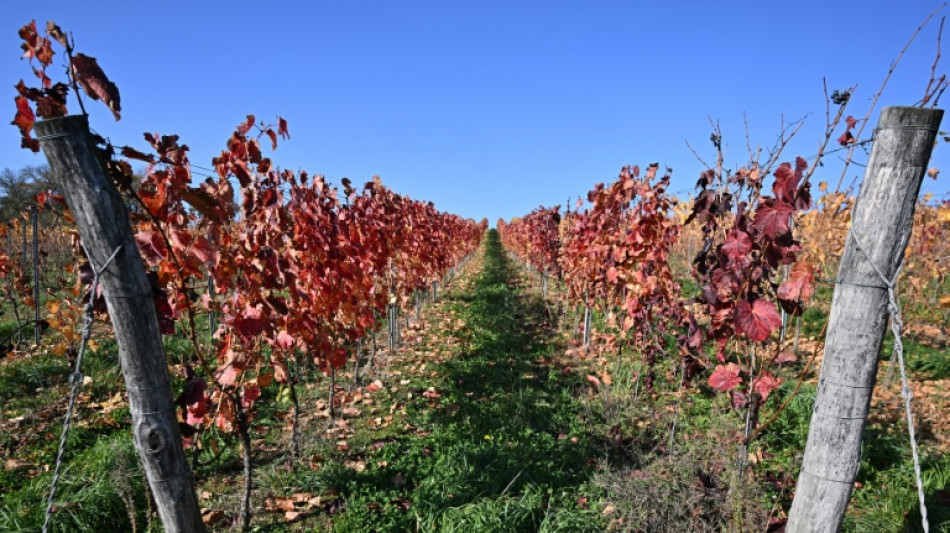
Hungary winemakers fear disease may 'wipe out' industry / Photo: Attila KISBENEDEK - AFP

 France's Macron, Canada's Carney announce closer ties

 AI 'warning shots' focus Beijing on national security risks

 Philippine tribe in limbo over US-led tech hub

 Saudi-led coalition says Houthis fired ballistic missile at Riyadh

 Cuba works to restore power after another blackout

 Brigitte Bardot widower slams sale of star's belongings

 Indonesia accepts Malaysia's help to tackle wildfires

 Nvidia, OpenAI CEOs to attend Xi dinner at White House

 Cuba hit with seventh major blackout of the year

 Nigeria miners struggled to breathe in cell before 37 died: survivors

 Warren Buffett steps down as Berkshire Hathaway chairman

 Isolated Syrian-Druze city blames Damascus for shortages

 Kerry James Marshall: American 'blackness' painter celebrated in Europe

 Infantino 'must go', says German FA vice-president

 Japan's busiest rail station tests robot bins

 Backpackers fret over Australian visa crackdown

 Bank of Japan hikes rates to 31-year high to battle inflation

 AI doomsday warnings unlikely to slow IPOs but questions linger

 In Brazil's Amazon, the hunt for oil fuels hopes and fears

 Baby orangutans in India expose 'frightening' scale of trafficking

 Oversight Board blasts 'inadequate' Meta safeguards for AI deepfakes

 Harry makes first public appearance since return to UK

 Princess Diana's brother makes new explosive claims against Charles

 Trump admin overhauls key protection for endangered species

 Mbappe draws political fire over Ceuta t-shirt controversy

Hungarian winemaker Viktor Keszler had to rip out young vines after only three harvests -- when they should last at least 25 years -- after they were infected by flavescence doree disease that is threatening Europe's wine regions.
"We spray our vineyard to protect it, but it is futile: the leafhoppers carrying the disease move to untreated vineyards or wild vines nearby and return infected," the 45-year-old told AFP.
Hungary, the world's 14th-largest wine producer, according to the International Organisation of Vine and Wine (OIV), is renowned for such regions as the UNESCO-recognised Tokaj.
Flavescence doree (FD) is "one of the most dangerous diseases" threatening vineyards today, according to OIV.
FD is transmitted primarily by the American grapevine leafhopper insect, a pest that has spread across central Europe in recent years.
Experts blame neglected vines, warmer winters due to climate change, and the discontinuation of hazardous pesticides in the EU for its proliferation.
Infection -- usually indicated by discoloured leaves -- greatly reduces vine productivity, and there is no known cure, although it is not harmful to humans.
In Hungary, the disease was first detected in 2013.
But critics say most winemakers and the government have not taken FD seriously enough until this year, when it was detected in 21 out of 22 of the country's wine regions.
- 'Not alarmed enough' -
The latest outbreak especially hurts smaller producers like Keszler, who turned his family's vineyards on the rolling hills of the town of Zalaszentgrot into a business supplying other winemakers with young vines in 2010.
He was forced to uproot half a hectare in his four-hectare vineyard this year due to the high infection rate.
Keszler and fellow winemakers united this summer to raise the alarm.
"If we don't take this seriously, it could effectively wipe out Hungarian grape production," Janos Frittmann, head of the National Council of Wine Communities representing producers, warned at last month's annual conference of winemakers.
According to him, the outbreak caught the industry off-guard.
"Previously winemakers were probably not alarmed enough, many did not even know the symptoms," he told AFP.
The government allocated about 10 million euros ($12 million) in September to detect and protect against the disease's spread.
In recent months, inspectors have checked close to 8,700 hectares of vineyards and collected thousands of samples, the agriculture ministry told AFP.
The ministry insisted that faced with an "escalating epidemic", the government responded quickly, while measures already in place "slowed down" the spread of the disease over the past 12 years.
- 'Too late to eradicate it' -
But some claim the government did not provide enough resources for prevention, leaving the food safety authority NEBIH's plant protection department "understaffed and underfunded", according to plant protection specialist Gergely Gaspar.
Around Monor, a town close to Budapest, the authorities did not carry out random inspections in vineyards for six years, while evaluation of samples can drag on due to the lack of laboratory capacity, Gaspar told AFP.
A lack of scientific groundwork also led to "disastrous consequences", said Gaspar, who produces grapevines himself and lost all his vines to FD.
"Popular grape varieties in Hungary do not show textbook symptoms," added the expert, who also works for a company specialising in the development and distribution of fertilisers and other products.
"My biggest gripe is that we just learned this now in the midst of the crisis... What were researchers doing for the past 12 years?"
Hungary's wineries need to learn how to live with FD, just like their peers in France and Italy, Elisa Angelini, a researcher at the Italian Centre for Research in Viticulture and Enology, told AFP.
Angelini said outbreaks have mainly to be controlled rather than prevented.
"The disease is usually discovered in a new area four years after the infection on average, when it is already too late to eradicate it," she said.
Winemaker Keszler said at times he feels combating the disease is "hopeless".
"But if the state and local municipalities become involved, then we can be successful," he said.
St.Ch.Baker--CPN