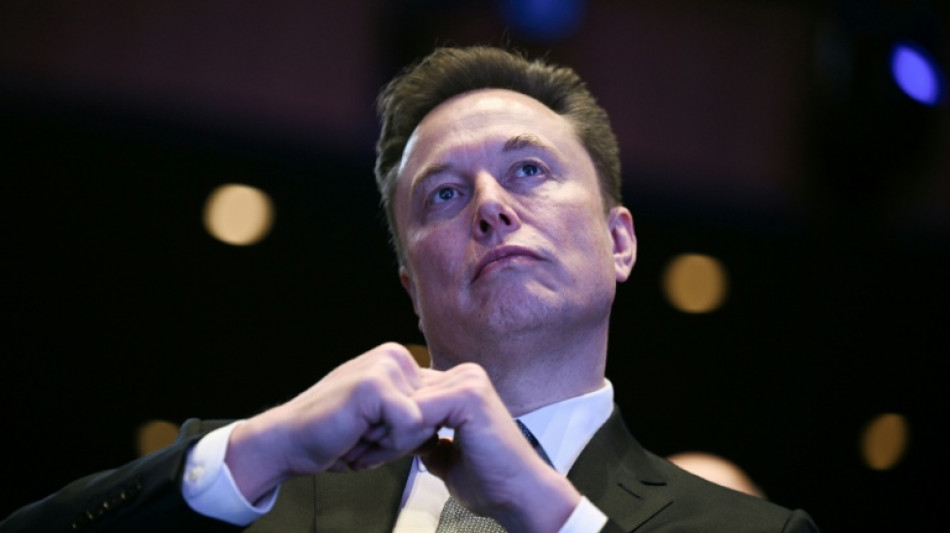
Why SpaceX IPO plan is generating so much buzz / Photo: Brendan SMIALOWSKI - AFP

 US House faces test on sweeping Russia sanctions bill

 British PM says to make 'difficult decisions' as inflation rises

 Global fuel price demos: a round-up

 Leverate Launches MCP for Traders to Connect AI Assistants With Trading Platforms

 MEXC Launches $1M "Discover Your Wall Street DNA" Campaign to Help Traders Find Their Market Fit

 Stocks edge higher ahead of US Fed rate call

 BASIS.pro Expands On-Chain Infrastructure with XDC Network Partnership and Zypher DAO as Auto Earn Goes Live

 Pickle-flavoured tart? AI inspires Japan's convenience stores

 EU chief hosts Canada's Carney in push to 'deepen' alliance

 Meta chief pushes back on AI slowdown calls

 US Fed to deliver rate decision with markets betting on hike

 Sanders, Bannon warn of AI dangers in rare US left-right alignment

 Empty benches as schools reopen in Venezuela's quake-hit Guaira

 Tiny English village holds 'independence' vote over asylum seeker housing

 US Treasury chief says to meet Chinese counterpart at weekend

 BingX Evolves into a Multi-Asset Trading Platform, Connecting Users to Global Opportunities

 International Trading Institute Expands Professional Trader Development Beyond the Master’s in Trading

 Lake Energy Secures $80 Million for U.S. Renewable Energy Expansion

 Stocks drop, oil climbs and Treasury yields hit 19-year high

 SkySail Strategies Outperforms Wall Street's 30-Year Risk Standard With Proprietary AI Inference Model

 Just add fish: Scientists pursue more rice, less disease in Senegal paddies

 Belgium completes outer structure of offshore energy island

 China retail sales growth weakens further in August

 In Kashmir, lake weeds mix with traditional art

 'Widow's Bay' and 'The Pitt' take key Emmy awards

More than 20 years after founding SpaceX, the record-breaking company that transformed the global space industry, Elon Musk is planning to take the enterprise public.
Here is a look at what is expected to be the largest IPO in history.
- What's at stake? -
SpaceX is owned by Elon Musk alongside several investment funds. Tech giant Alphabet, Google's parent company, is also among the space company's shareholders.
A public listing would open SpaceX to a broader and more diverse pool of investors, including individual buyers, while giving existing shareholders an easier path to cash out and realize substantial capital gains.
"This is a capital intensive business," Matthew Kennedy of Renaissance Capital investment management firm told AFP.
"SpaceX has never had any difficulty raising funds in the private market, but public markets are undoubtedly larger. Liquidity is important as well, it can help with making acquisitions."
According to Bloomberg and the financial data platform PitchBook, the IPO could raise more than $30 billion, an unprecedented sum for a deal of this kind and far more than the $10 billion the company has raised since its inception.
This would bring its total valuation to $1.5 trillion.
- Why so much money? -
The IPO comes amid a boom in the space industry.
Worth $630 billion in 2023, the sector is expected to triple in size by 2035, according to the consulting firm McKinsey and the World Economic Forum.
And SpaceX, which dominates the space launch market with its reusable rockets and owns the largest satellite constellation through Starlink, has a unique appeal.
It's "kind of a black swan event and unique so that we can't draw too many parallels across the whole space economy," Clayton Swope of the Center for Strategic and International Studies (CSIS) told AFP.
Its unique status is also tied to its CEO Musk, the world's richest person, who is also the CEO of Tesla and xAI.
Musk has already pushed Tesla's valuation far beyond that of Toyota and Volkswagen despite selling five to six times fewer vehicles.
- Why now? -
This is the question on everyone's mind, as the billionaire had long dismissed such a possibility. Since its founding in 2002, SpaceX has held a special place for the billionaire, given his ambition to colonize Mars.
This goal reflects the company's priorities, which include developing Starship, the largest rocket ever built for missions to the Moon and Mars, as well as plans to build space-based data centers for artificial intelligence (AI).
A stock market listing could provide new liquidity that would support all of these projects.
"The answer is pretty straightforward," said Swope. "He wants to accelerate the flywheel for his vision of humanity on Mars."
- What next? -
The influx of capital from an IPO will come at a price: going public will require SpaceX and Elon Musk to maintain greater transparency, particularly about its revenues, and could increase pressure to deliver profits.
"I speculate that would ground SpaceX somewhat in the near term," said Mason Peck, an astronautical engineering professor at Cornell University.
The company's risk-taking approach of experimenting with unproven technologies and frequent prototype launches to learn from mistakes could be constrained by the expectations of new shareholders.
"Will they become the same as any other aerospace company and ultimately mired in conservatism and legacy solutions?" Peck said. "That's entirely possible. I hope it doesn't happen."
Swope, however, sees such a scenario as unlikely.
"I think they are willing to take that risk and willing to let Elon Musk and SpaceX have this vision, because that is integral to what makes SpaceX also a successful business," he said.
H.Meyer--CPN

