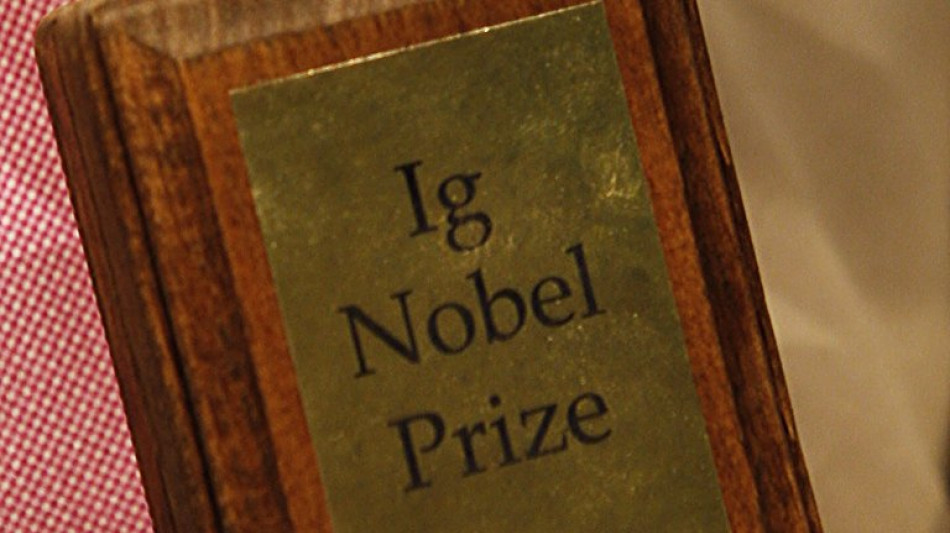
Laughing about science more important than ever: Ig Nobel founder / Photo: mkwajafa - afp.com/File

 US House faces test on sweeping Russia sanctions bill

 British PM says to make 'difficult decisions' as inflation rises

 Global fuel price demos: a round-up

 Leverate Launches MCP for Traders to Connect AI Assistants With Trading Platforms

 MEXC Launches $1M "Discover Your Wall Street DNA" Campaign to Help Traders Find Their Market Fit

 Stocks edge higher ahead of US Fed rate call

 BASIS.pro Expands On-Chain Infrastructure with XDC Network Partnership and Zypher DAO as Auto Earn Goes Live

 Pickle-flavoured tart? AI inspires Japan's convenience stores

 EU chief hosts Canada's Carney in push to 'deepen' alliance

 Meta chief pushes back on AI slowdown calls

 US Fed to deliver rate decision with markets betting on hike

 Sanders, Bannon warn of AI dangers in rare US left-right alignment

 Empty benches as schools reopen in Venezuela's quake-hit Guaira

 Tiny English village holds 'independence' vote over asylum seeker housing

 US Treasury chief says to meet Chinese counterpart at weekend

 BingX Evolves into a Multi-Asset Trading Platform, Connecting Users to Global Opportunities

 International Trading Institute Expands Professional Trader Development Beyond the Master’s in Trading

 Lake Energy Secures $80 Million for U.S. Renewable Energy Expansion

 Stocks drop, oil climbs and Treasury yields hit 19-year high

 SkySail Strategies Outperforms Wall Street's 30-Year Risk Standard With Proprietary AI Inference Model

 Just add fish: Scientists pursue more rice, less disease in Senegal paddies

 Belgium completes outer structure of offshore energy island

 China retail sales growth weakens further in August

 In Kashmir, lake weeds mix with traditional art

 'Widow's Bay' and 'The Pitt' take key Emmy awards

With science increasingly coming under attack, using humour as a way to get people interested in scientific research is more important than ever, the founder of the satirical Ig Nobel prizes said.
But not to be too serious, AFP's interview with the founder Marc Abrahams also included a callout for public donations of pubic lice -- and the sudden, unexpected appearance of a taxidermy duck.
Since 1991, the Ig Nobel prizes have celebrated the sillier side of science, handing out awards -- and 10-trillion-Zimbabwean-dollar notes -- at often-raucous ceremonies in Boston every year for genuine research projects that inadvertently have an absurd side.
The research "has to make people laugh and then think", explained Abrahams, who is also the editor of the Annals of Improbable Research magazine which organises the prizes.
As the serious Nobel prizes were awarded in Stockholm this week, several events were held in Paris featuring Ig Nobel laureates presenting their work while paper airplanes rained down -- a long-running Ig Nobel gag.
Among those speaking were French physicist Marc-Antoine Fardin, who investigated whether cats can be both solids and liquids, and Italy's Daniel Maria Busiello for his research about avoiding clumpiness while making the iconic Italian pasta dish cacio e pepe.
"If you're laughing at something, you are paying attention," Abrahams said.
The idea of the Ig Nobels is to capture a person's attention -- even if just for three seconds, he said. Then maybe when they are telling their friends about it later they might realise it is actually "really interesting".
- Science 'threatened and destroyed' -
At a time when scientific research is being "threatened and actively destroyed", particularly under the administration of US President Donald Trump, many people "have been telling us that now what we're doing has become much more important", Abrahams said.
Several of this year's prize winners decided not to attend the ceremony in September out of concern about travelling to the US under Trump, the mathematician added.
At first some scientists were suspicious of the gag prize, but the Ig Nobels have now become something of an institution -- few refuse the honour, Abrahams said.
There is little antagonism with the real Nobel prizes. In fact, Nobel laureates hand out Ig Nobels every year -- often wearing funny hats. One of them, British physicist Andre Geim, has even won both prizes.
Each year's 10 winners are chosen from thousands of nominees sent into Abrahams.
An increasing number -- over 10 percent -- are researchers nominating themselves. "They almost never win," Abrahams said.
Indeed, the phone call when he tells scientists they have won is often "the first moment any of them realised that what they had done is funny", he said with a laugh.
- Pubic lice needed -
Dutch biologist and Ig Nobel laureate Kees Moeliker said the prizes award scientists for doing their job: being curious, discovering what is happening, then publishing what they found.
For example, Moeliker's prize-winning research -- the first documented case of homosexual necrophilia in a mallard -- started when an unlucky duck crashed into his office window.
At this point in the interview, Moeliker pulled the duck in question -- which is now stuffed -- out of his bag, prompting the waiter at the restaurant to ask whether it was real.
When the waiter was gone, Moeliker said: "I have a little request."
He is looking for some pubic lice, and is hoping AFP's readers can help.
The insect's numbers are thought to be dwindling because of the modern tendency to trim pubic hair, Moeliker said, comparing the phenomenon to how deforestation has threatened pandas.
But he needs more samples to research the subject, so he is asking the public to send any specimens they have to the Natural History Museum in Rotterdam. One helpful person has already sent in lice sticky-taped to the back of a postcard.
But it might not be all bad news for pubic lice.
"I've heard stories from people in the fashion industry that pubic hair is coming back," Moeliker said.
Y.Tengku--CPN

