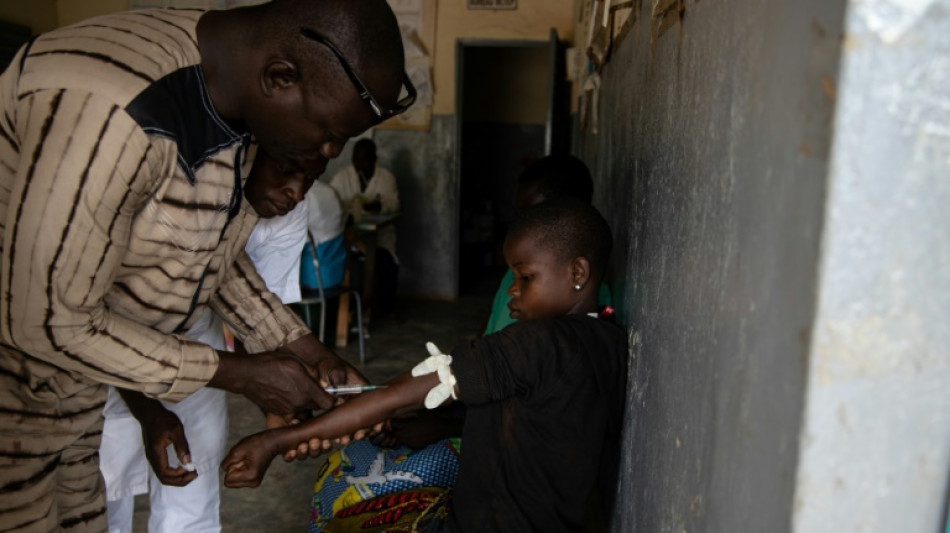
New malaria vaccine results raise hopes of mass rollout / Photo: Olympia DE MAISMONT - AFP/File

 Kenya's economy faces climate change risks: World Bank

 EU-Mercosur trade deal faces bumpy ride to finish line

 France's Bardella slams 'hypocrisy' over return of brothels

 Deja vu? Trump accused of economic denial and physical decline

 Hungary winemakers fear disease may 'wipe out' industry

 'Stop the slaughter': French farmers block roads over cow disease cull

 Why SpaceX IPO plan is generating so much buzz

 World stocks mostly slide, consolidating Fed-fuelled gains

 UK's king shares 'good news' that cancer treatment will be reduced in 2026

 Salah admired from afar in his Egypt home village as club tensions swirl

 Iran frees child bride sentenced to death over husband's killing: activists

 France updates net-zero plan, with fossil fuel phaseout

 EU agrees recycled plastic targets for cars

 British porn star fined, faces imminent Bali deportation

 Indonesia floods were 'extinction level' for rare orangutans
 Japan bear victim's watch shows last movements

 French indie 'Clair Obscur' dominates Game Awards

 Asian markets track Wall St record after Fed cut

 Vaccines do not cause autism: WHO

 'In her prime': Rare blooming of palm trees in Rio

 OpenAI beefs up GPT models in AI race with Google

 Cyclone causes blackout, flight chaos in Brazil's Sao Paulo

 US bringing seized tanker to port, as Venezuela war threats build

 Time magazine names 'Architects of AI' as Person of the Year

 OpenAI, Disney to let fans create AI videos in landmark deal
A booster dose of a new malaria vaccine maintains a high level of protection against the disease, researchers said Thursday, expressing hopes the cheap jab could be produced on a massive scale in a matter of years.
The international research team suggested the vaccine, developed by Britain's Oxford University, could represent a turning point in the fight against the mosquito-borne parasitic disease, which killed 627,000 people -- mostly African children -- in 2020 alone.
Last year a different vaccine produced by British pharmaceutical giant GSK became the first to be recommended for widespread use against malaria by the World Health Organization, and has now been administered to more than a million children in Africa.
However research has found that the effectiveness of GSK's vaccine is around 60 percent, and significantly wanes over time even with a booster dose.
Oxford's R21/Matrix-M vaccine meanwhile was found to be 77 percent effective at preventing malaria in research published last year -- the first time the WHO's roadmap goal of 75 percent had been met.
- 'Fantastic' -
For the research, 450 children aged five to 17 months in Burkina Faso -- where malaria accounts for around 22 percent of all deaths -- were given three doses in 2019.
They were split into three groups, two receiving different doses of the Matrix-M adjuvant, a vaccine ingredient patented by Novavax also used in the US biotech firm's Covid jab. The third control group received a rabies vaccine.
Ahead of the 2020 rainy season -- when malaria cases surge -- 409 children returned to get a booster shot.
For the group that received the higher dose of adjuvant, the booster rose the protection level to 80 percent, according to the results of a phase 2b trial published in The Lancet Infectious Diseases journal on Thursday. The lower dose had 70 percent efficacy.
And crucially, the booster returned antibody levels to a similar level seen after the first round of doses, the study said.
The study's lead investigator Halidou Tinto of the Burkina Faso health research institute IRSS said, "It is fantastic to see such high efficacy again after a single booster dose."
Tinto, who was involved in trialling both malaria vaccines, said GSK's vaccine had an optimal efficacy of around 60 percent. "So I can confirm that R21 is doing much better," he told a press conference.
- 70% reduction in deaths? -
Oxford vaccinologist and study co-author Adrian Hill said the vaccine meant "We really could be looking at a very substantial reduction in that horrendous burden of malaria, deaths and disease in the coming years, certainly by 2030."
A 70 percent reduction in deaths from malaria could be feasible in that time, he said, partly because of the vast number of vaccine doses that could be quickly produced.
Oxford has partnered with the world's largest vaccine manufacturer, the Serum Institute of India.
The institute is "willing and able to manufacture 200 million doses a year starting next year," Hill said.
The six to 10 million doses that GSK can produce a year is "not enough for 40 million children who need four doses in the first year," Hill added.
And the Oxford vaccine would likely cost a few US dollars a dose, less than half the $9 for GSK's version, he said.
The challenge of getting those doses into arms would require more funding, he added.
Results from a phase three trial involving 4,800 participants across four countries are expected later this year, which could potentially lead to approval.
Azra Ghani, an epidemiologist at Imperial College London not involved in the research, welcomed the results, saying it was "particularly encouraging" the booster dose restored protective antibodies.
Gareth Jenkins of the charity Malaria No More UK said the results were "another encouraging signal that, with the right support, the world could end child deaths from malaria in our lifetimes".
Jenkins said in a statement that new British Prime Minister Liz Truss' "first foreign policy test" was to ensure continued funding at the replenishment conference for the Global Fund to Fight AIDS, Tuberculosis and Malaria being held in the US this month.
M.Mendoza--CPN