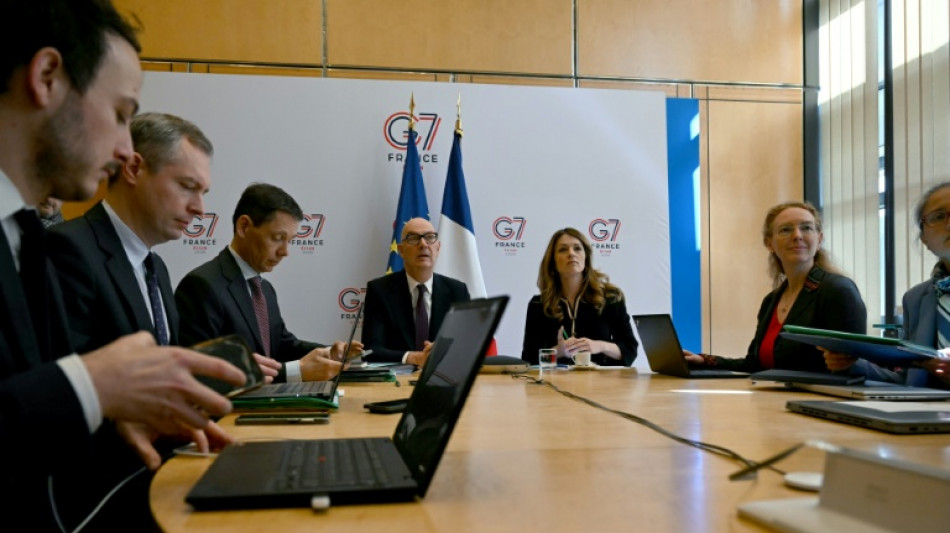
G7 ministers tackle economic fallout of Mideast war / Photo: Anna KURTH - AFP

 Oversight Board blasts 'inadequate' Meta safeguards for AI deepfakes

 Harry makes first public appearance since return to UK

 Princess Diana's brother makes new explosive claims against Charles

 Trump admin overhauls key protection for endangered species

 Mbappe draws political fire over Ceuta t-shirt controversy

 Third malaria death in Germany from outbreak tied to Frankfurt airport

 AtlasClear Holdings Reports Preliminary Fiscal 2026 Revenue of Approximately $20.1 Million, Up 85%; Revenue Plus Interest Income of Approximately $21.9 Million

 'Another arrow to the quiver': World Bank posts record private capital mobilization

 Ireland to boycott Eurovision 2027 over Gaza

 India's Tata Sons reappoints N. Chandrasekaran as chairman

 Germany urges EU action against China to defend carmakers

 Japan eyes changing prostitution law to punish sex buyers

 Modi pitches India as global chipmaking hub

 Ukraine plans record defence spending in 2027

 NASA scan discovers new, 'once in a century' Moon crater

 Most stocks rise as Fed hikes and indicates drive to curb inflation

 UK-Sudanese author pens book to give children 'African history of Africa'

 Argentine judge orders suspension of Falklands oil project

 US Fed raises rates to tackle 'too high' inflation, irking Trump

 Turkey releases 106 protesters, jails more LGBTQ activists

 Candidate for UN chief calls for AI regulation akin to nuclear weapons

 'We're losing control,' AI pioneer Yoshua Bengio tells AFP

 IR-MED and Dice Technologies Announce collaboration to Evaluate and Advance Pressure-Injury Prevention Platform in Japan

 Watts, Pitt, Cruz to light up Spain's top film festival

 Toogood Gold's Table Mountain Sits in the Shadow of a Nevada Gold Rush

G7 ministers and central bank officials gathered Monday to tackle the economic consequences of the war in the Middle East that has sent energy prices soaring and has triggered fears for the world economy.
The United States and Israel launched strikes on Iran in late February, and Tehran has hit back by targeting crude-exporting countries in the region and halting most shipments through the Gulf.
The squeeze on supply has pushed oil and natural gas prices higher, with drastic knock-on effects for supply chains in multiple industries.
French Finance Minister Roland Lescure said the G7 was convening finance ministers, energy ministers, and central bank officials, the first gathering in that format since the G7 was established in 1975.
"We know that what's happening now in the Gulf is having energy consequences, economic consequences, financial market consequences and potentially inflation consequences," he told reporters ahead of the meeting.
"The idea is to monitor developments, to exchange diagnoses especially on potential disruptions."
Representatives of the International Energy Agency (IEA), the Organisation for Economic Co-operation and Development (OECD), the International Monetary Fund (IMF) and the World Bank were present at the meeting held by video link.
The G7, an informal grouping of the United States, Canada, Britain, France, Germany, Italy and Japan, helps shape policy debates in the world's wealthiest nations.
France currently holds the rotating presidency of the G7 advanced economies.
The United States has sought support from the group to help halt Iran's blockade of the Strait of Hormuz shipping route.
After a meeting last week, G7 foreign ministers said it was an "absolute necessity" for Iran to re-establish free passage through the strait and called for an end to attacks on civilian infrastructure.
- 'Act quickly' -
Under increasing pressure, many governments have rolled out measures to limit the impact of supply difficulties and soaring energy prices.
On Friday, the French government announced it would spend 70 million euros ($80 million) to help the fishing, agriculture and transport industries in April.
Lescure said on Monday that measures of support should be targeted and rapid.
"This is a crisis that affects all of us and that will result in costs for the nation," Lescure told reporters.
We need to "act quickly and act fairly," he said.
US officials, including President Donald Trump, have said their goals in the war are almost achieved, but thousands of US personnel have been sent to the region in an unprecedented military build-up.
Activists based outside Iran say the US-Israeli campaign has killed more than 3,000 people in the country, over half of them civilians, while Lebanese officials have said more than 1,000 have been killed there since Israel began attacking its territory in retaliation for Hezbollah attacks on March 2.
Officials in Israel and countries across the Gulf have also reported much smaller numbers of casualties.
M.P.Jacobs--CPN