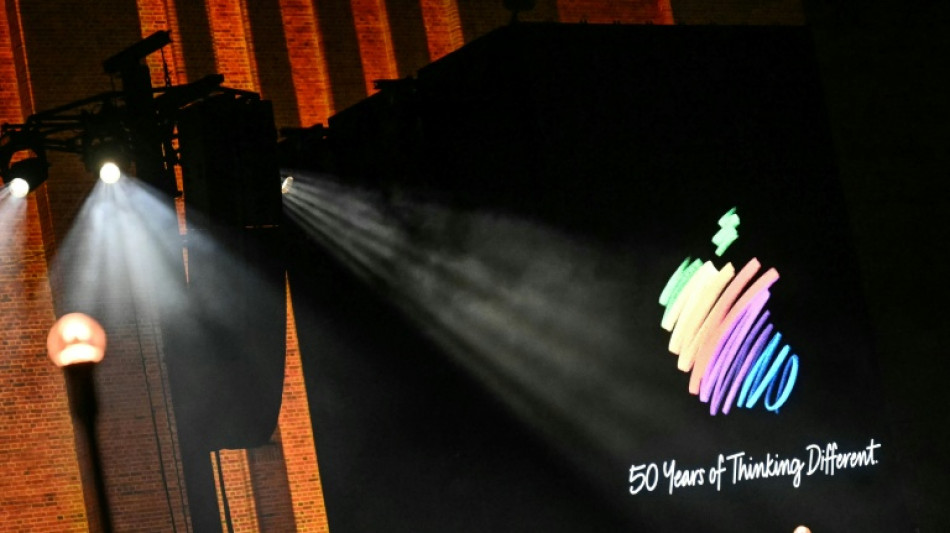
At 50, Apple confronts its next big challenge: AI / Photo: JUSTIN TALLIS - AFP/File

 Prized Mexican relic returns on loan, two centuries on

 'In our lane': Fed's Warsh defies Trump but still fighting for credibility

 Trump admin makes major cut to endangered species protections

 GM delivers first components for US interceptor missiles

 Travis Scott and Keith Richards feature on GTA VI soundtrack

 King Charles warns tech bosses of 'existential dangers' of AI

 French fishermen block ports over petrol prices

 Micron's Taiwan workers say 68 months' bonus not enough

 Canada's Carney pushes 'new alliance' with EU despite Trump threats

 Beyond Investment Returns: Families Are Measuring Wealth by Freedom, Continuity, and Legacy, According to Nour Private Wealth

 King Charles disputes claims in book by Princess Diana's brother

 Nepal floods among 'most challenging' disasters: WFP

 Kids and social media: what would change under new EU law

 King Charles to call on tech giants for 'reassurances' over AI

 STARPRIME Responds to Diverging Gold Market Demand with AM/PM Fixing and XAU24/7

 Where the US-China tariff row stands ahead of White House summit

 Indonesia cash-for-photos scheme turns animal hunters into protectors

 Bayer to Present How it Rebuilt Global Planning with OMP at Gartner Supply Chain Planning Summit 2026

 US Congress passes sweeping Russia sanctions bill

 US stocks fall, dollar gains after Fed lifts interest rates

 US Fed raises rates to tackle 'too high' inflation in move sure to rile Trump

 US Fed raises rates to battle inflation in move likely to rile Trump

 US House faces test on sweeping Russia sanctions bill

 British PM says to make 'difficult decisions' as inflation rises

 Global fuel price demos: a round-up

Apple celebrates its 50th anniversary as artificial intelligence challenges the Silicon Valley legend to prove it can deliver yet another culture-changing innovation.
Steve Jobs, a driven marketing genius, and Steve Wozniak, who invented the Apple computer, revolutionized how people use technology in the internet age and built a company now worth more than $3.6 trillion.
The two college dropouts changed the way people use computers, listen to music and communicate on the go, giving rise to lifestyles revolving around smartphone apps.
Apple's hit products — the Mac, the iPhone, the Apple Watch and the iPad — command a cult-like following, long after the company's humble beginnings on April 1, 1976 in Jobs' Cupertino, California garage.
Apple has sold more than 3.1 billion iPhones since the handsets debuted in 2007, generating about $2.3 trillion in revenue, according to Counterpoint Research.
For Counterpoint analyst Yang Wang, the iPhone is the most successful consumer electronics product ever, reshaping human communication while becoming "a global fashion and status symbol."
Before the iPhone, Apple shook up home computing with the 1984 Macintosh, whose icon-based interface and mouse made computing accessible beyond specialists -- and sparked a legendary rivalry between Jobs and Microsoft's Bill Gates.
"Apple was founded on the simple notion that technology should be personal, and that belief -- radical at the time -- changed everything," chief executive Tim Cook said in an anniversary letter posted online.
- 'Cult of Apple' -
Apple transformed the music market with the iPod and iTunes, made the smartphone a mass-market staple with the iPhone, and took tablets mainstream with the iPad.
The Apple Watch quickly seized the lead in the smartwatch market, despite debuting later than its rivals.
While not an inventor, Jobs -- who died in 2011 at age 56 -- was renowned for his uncompromising drive to marry technology with design to create products that were intuitive and hassle-free.
Apple marketed the Macintosh as the "computer for the rest of us," but it was the iPhone that fulfilled that promise, said David Pogue, author of the recently released "Apple: The First 50 Years."
The iPhone's dominance reshaped Apple's business model. With the premium smartphone market widely seen as saturated, Cook has increasingly turned to selling digital content and services to the company's vast existing base of users.
Central to that strategy is the App Store, which Apple made the sole gateway to software on its devices, taking a cut of transactions -- and thereby drawing accusations of monopoly abuse, regulatory scrutiny in Europe and court orders in the United States to open up its platform.
- 'China factor' -
No country has been more central to Apple's rise -- or more fraught for its future -- than China, with Cook cementing ties to the Asian superpower through regular appearances at local Apple stores and official visits.
Cook was the mastermind of the strategy that made China the primary manufacturing base for Apple devices, with the vast majority of iPhones assembled by contractor Foxconn and other suppliers in Chinese factories.
It is also one of Apple's largest consumer markets, generating tens of billions of dollars in annual revenue.
But the company faces mounting pressure on both fronts: trade tensions and tariffs have accelerated efforts to diversify manufacturing to India and Vietnam, while competition from domestic rivals such as Huawei has eaten into Apple's Chinese market share.
- 'AI challenge' -
A concern haunting investors is that Apple appears to be easing into generative AI while rivals Google, Microsoft and OpenAI race ahead.
A promised upgrade to its Siri digital assistant was delayed, in what analysts called a rare stumble for the company.
And rather than relying on its own engineers to overhaul Siri, Apple has turned to Google for AI capability.
But whether built in-house or outsourced, Apple's obsession with user privacy and its premium hardware could position it to drive widespread adoption of personalized AI -- and make it profitable, a goal that has proved elusive for much of the AI industry.
Already, Apple's AirPods are being steadily improved with sensors and smart software, and lessons learned from the Vision Pro could feed into AI smart glasses to rival Meta's.
"They are the ones that always seem able to create something so simple that users just fall in love with it," said Carolina Milanesi, an analyst at Creative Strategies.
A.Mykhailo--CPN