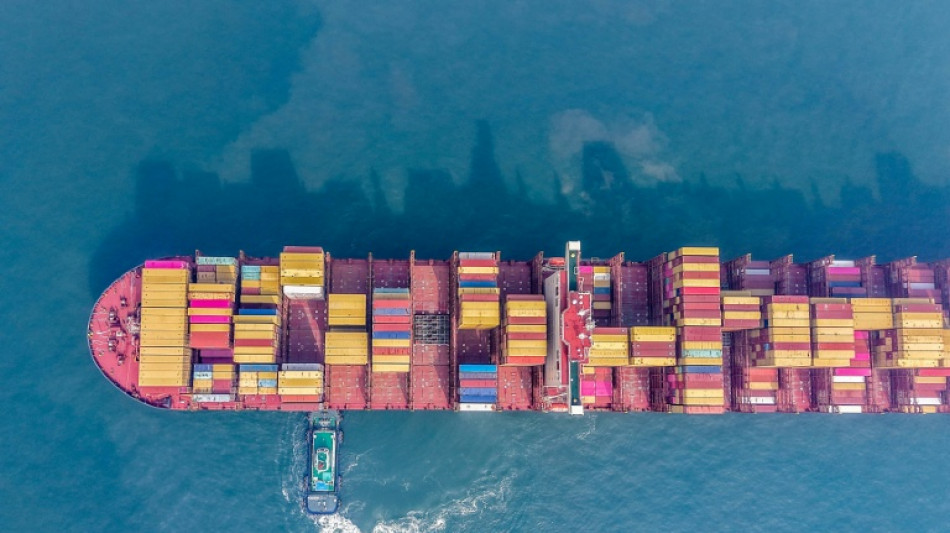
Helplines buzz with alerts from seafarers trapped in war / Photo: - - CN-STR/AFP

 Oversight Board blasts 'inadequate' Meta safeguards for AI deepfakes

 Harry makes first public appearance since return to UK

 Princess Diana's brother makes new explosive claims against Charles

 Trump admin overhauls key protection for endangered species

 Mbappe draws political fire over Ceuta t-shirt controversy

 Third malaria death in Germany from outbreak tied to Frankfurt airport

 AtlasClear Holdings Reports Preliminary Fiscal 2026 Revenue of Approximately $20.1 Million, Up 85%; Revenue Plus Interest Income of Approximately $21.9 Million

 'Another arrow to the quiver': World Bank posts record private capital mobilization

 Ireland to boycott Eurovision 2027 over Gaza

 India's Tata Sons reappoints N. Chandrasekaran as chairman

 Germany urges EU action against China to defend carmakers

 Japan eyes changing prostitution law to punish sex buyers

 Modi pitches India as global chipmaking hub

 Ukraine plans record defence spending in 2027

 NASA scan discovers new, 'once in a century' Moon crater

 Most stocks rise as Fed hikes and indicates drive to curb inflation

 UK-Sudanese author pens book to give children 'African history of Africa'

 Argentine judge orders suspension of Falklands oil project

 US Fed raises rates to tackle 'too high' inflation, irking Trump

 Turkey releases 106 protesters, jails more LGBTQ activists

 Candidate for UN chief calls for AI regulation akin to nuclear weapons

 'We're losing control,' AI pioneer Yoshua Bengio tells AFP

 IR-MED and Dice Technologies Announce collaboration to Evaluate and Advance Pressure-Injury Prevention Platform in Japan

 Watts, Pitt, Cruz to light up Spain's top film festival

 Toogood Gold's Table Mountain Sits in the Shadow of a Nevada Gold Rush

Seafarers' helplines say they are overwhelmed with messages from crews stuck in the Gulf by the Middle East war, desperately seeking repatriation, compensation and onboard supplies.
"Writing to urgently inform you that our vessel is currently facing a critical situation regarding provisions and one crew health conditions," read an email from one seafarer on March 24 to the International Transport Workers' Federation (ITF)'s Seafarer Support team.
"Immediate supply of food, drinking water, basic necessities is required to sustain the crew," said the message to the team's helpline.
The ITF said it had received more than 1,000 emails and messages from seafarers stuck around the Strait of Hormuz and the wider region since the war erupted with US-Israeli strikes on Iran on February 28.
- Bomb strikes -
Some sought to clarify what their rights are while navigating a war zone, while others sent videos of bombings striking next to their ship and asked the federation for help to get off board, according to ITF documents seen by AFP.
"It is an extraordinary situation, there is a lot of panic," Mohamed Arrachedi, ITF's Network Coordinator for the Arab World and Iran, in charge of handling requests from seafarers in the region, told AFP, describing the situation as "really shocking".
"I get calls from seafarers at two o'clock, three o'clock in the morning. They call me the minute they have access to the internet," Arrachedi said on Wednesday by telephone from Spain.
"One seafarer called in a panic, saying: 'We are here bombed. We don't want to die. Please help me, sir. Please get us from here."
About 20,000 seafarers are currently stuck in the Gulf, according to the UN's maritime body, known as the IMO, and at least eight seafarers or dock workers have died in incidents in the region since February 28.
All correspondence was shared with AFP on condition of anonymity, as the helpline guarantees confidentiality to seafarers.
- War zone rights -
The International Bargaining Forum (IBF), a global maritime labour body, has declared the area a war zone.
This normally gives seafarers exceptional rights, including repatriation at the company's cost and double pay for those working on ships covered by IBF agreements -- around 15,000 vessels worldwide, according to the ITF.
Despite this, many seafarers -- especially on ships without such labour agreements -- are reporting difficulties with getting repatriated.
In one email sent to the ITF on March 18, a seafarer said the ship's operator was ignoring crews' requests to leave, arguing that there were no flights from Iraq and refusing alternative routes.
"They are forcing us to continue to do cargo operations and STS (ship-to-ship operations) even (when) we raise our concerns about our safety and we are in war like area. They are keeping us in a position with no options," read the email seen by AFP.
The International Seafarers' Welfare and Assistance Network (ISWAN), another organisation operating a helpline, told AFP on Wednesday that it had seen "a 15-20 percent increase in calls and messages" since the start of the war, with a third relating to repatriation difficulties.
- $16 a day -
Another major concern is compensation.
"About 50 percent of emails we receive concern pay," Lucian Craciun, one of five members of ITF's support team processing requests at the organisation's headquarters in London, told AFP.
He said many seafarers choose to stay on board despite the dangerous conditions because they cannot afford to leave.
One email seen by AFP came from a seafarer asking to confirm whether his salary would go from $16 a day to $32 because he was in a designated war zone.
The ITF says such low salaries indicate that the shipowners do not have labour agreements in place to ensure decent pay.
Seafarers working under such arrangements are particularly at risk because their contracts often do not cover operations in war zones, and owners tend not to respond to requests from organisations such as the ITF, according to the support team.
When that happens, the ITF reaches out to the flag states and, if that does not work, to the state port authority where the vessel is located.
Arrachedi said that many such cases in the Gulf are still unresolved, with seafarers desperately awaiting responses from operators.
U.Ndiaye--CPN