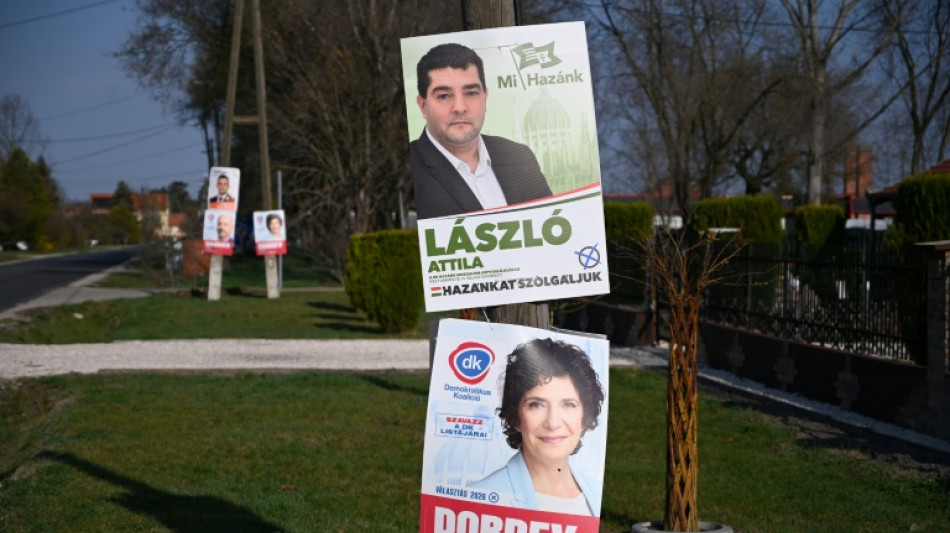
Hungary's anxious rural voters will decide Orban's fate / Photo: Attila KISBENEDEK - AFP

 Oversight Board blasts 'inadequate' Meta safeguards for AI deepfakes

 Harry makes first public appearance since return to UK

 Princess Diana's brother makes new explosive claims against Charles

 Trump admin overhauls key protection for endangered species

 Mbappe draws political fire over Ceuta t-shirt controversy

 Third malaria death in Germany from outbreak tied to Frankfurt airport

 AtlasClear Holdings Reports Preliminary Fiscal 2026 Revenue of Approximately $20.1 Million, Up 85%; Revenue Plus Interest Income of Approximately $21.9 Million

 'Another arrow to the quiver': World Bank posts record private capital mobilization

 Ireland to boycott Eurovision 2027 over Gaza

 India's Tata Sons reappoints N. Chandrasekaran as chairman

 Germany urges EU action against China to defend carmakers

 Japan eyes changing prostitution law to punish sex buyers

 Modi pitches India as global chipmaking hub

 Ukraine plans record defence spending in 2027

 NASA scan discovers new, 'once in a century' Moon crater

 Most stocks rise as Fed hikes and indicates drive to curb inflation

 UK-Sudanese author pens book to give children 'African history of Africa'

 Argentine judge orders suspension of Falklands oil project

 US Fed raises rates to tackle 'too high' inflation, irking Trump

 Turkey releases 106 protesters, jails more LGBTQ activists

 Candidate for UN chief calls for AI regulation akin to nuclear weapons

 'We're losing control,' AI pioneer Yoshua Bengio tells AFP

 IR-MED and Dice Technologies Announce collaboration to Evaluate and Advance Pressure-Injury Prevention Platform in Japan

 Watts, Pitt, Cruz to light up Spain's top film festival

 Toogood Gold's Table Mountain Sits in the Shadow of a Nevada Gold Rush

In the village of Pusztavacs in central Hungary, election posters on electricity poles remind voters of a looming poll, where nationalist Prime Minister Viktor Orban's future is on the line.
Small towns, villages and hamlets -- home to around half of the central European nation's 9.5 million people -- have long been the bastion of the ruling Fidesz party. And analysts say the April 12 election will be decided in the countryside.
But the rise of charismatic challenger Peter Magyar -- whose party is leading in opinion polls -- has shaken Orban's hold on the countryside in what has been dubbed a rural "political awakening" against a backdrop of economic stagnation and high-profile scandals.
"I'm really worried about which one would be better... I'll keep racking my brain about it," Eva Batta told AFP near the grocery store at the edge of Pusztavacs.
The 71-year-old, who can no longer work to supplement her pension after surgery, said she feels the economy has worsened during Orban's latest term.
She is also "afraid of (the) war" raging in neighbouring Ukraine since the Russian invasion in 2022.
Orban campaigned to galvanise such fears, flooding the media, which is largely controlled by his business allies, with claims that the European Union and his rival want to drag Hungary into the conflict.
Both deny this.
- 'Orban provides' -
Orban has repeatedly made overtures to rural communities, claiming that for his government "the village is not the past, but the future".
Pusztavacs, which has 1,300 inhabitants, received state support to renovate its cemetery and church and got its first automatic cash machine last year as part of a government law to install machines in all villages.
Locals like Zsolt Szarnya are grateful to Orban. The 48-year-old firefighter, who is serving in the army, felt both the village and the whole country stagnated before the nationalist leader returned to power in 2010.
"Construction has been booming," he told AFP before withdrawing cash, crediting various family support programmes introduced for the upswing.
"Orban does not take away, but provides," said 86-year-old Maria Balogh.
She was afraid that Magyar's Tisza party would tax her pension, echoing a claim reported in pro-Fidesz media but ruled by courts to be groundless and defamatory.
- 'Screwed up' -
The election will be "100 percent" decided in the countryside, according to Matyas Bodi, an analyst at the Electoral Geography website.
He compared Magyar's stated goal of "system change" to a "Himalaya expedition", where urban constituencies constitute just the "base camp" and rural constituencies are needed for victory.
Aware of this, Magyar has been highlighting the "conservative and nationalist elements" of his party's values attractive to rural voters, said sociologist Imre Kovach from the ELTE University's Centre for Social Sciences, observing a "political awakening" on the countryside.
Magyar's main message of wanting to fight what he claims is endemic corruption by the Orban government and its allies also resonates.
"I had voted for Fidesz before and I regretted it," said a middle-aged volunteer reserve soldier in Pusztavacs, declining to give his full name for fear of reprisal.
He added that local support for the opposition has "surged". Several other residents also told AFP they plan to vote for Tisza.
Laszlo Budavari, 69, a pensioner, said he will vote for Tisza because Magyar "wants to do things differently in this corrupt country".
He said the "worst thing" was that his three daughters have all said they plan to emigrate if Orban is elected next month for a fifth consecutive term.
"Viktor," Budavari said, feigning to address the prime minister, "my daughters are leaving me here all alone.
"You guys really screwed this up."
Ch.Lefebvre--CPN