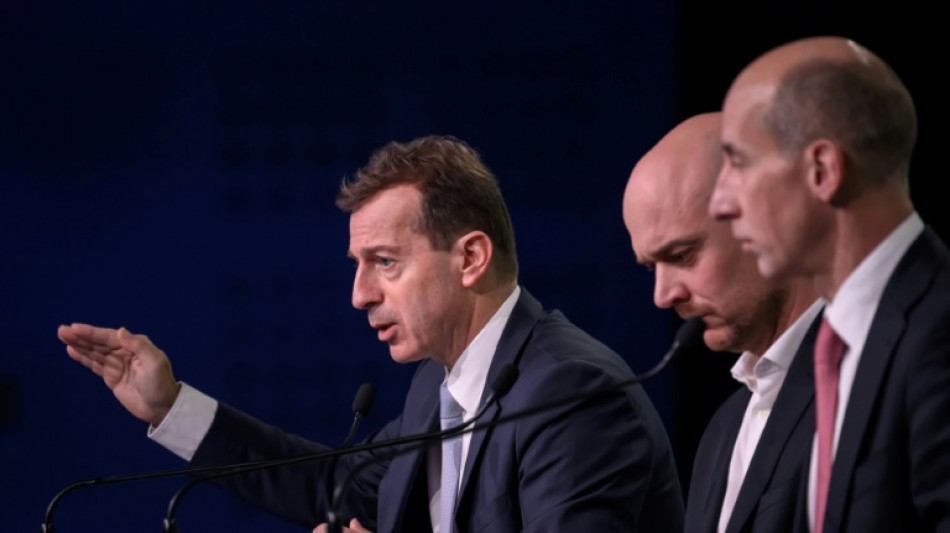
Airbus ready to build two new European fighter jets if 'customers' ask / Photo: Ed JONES - AFP

 France's debt climbs to highest since 1978: ministry

 Thousands protest inaction over climate crisis in Switzerland

 UK actor Naomi Watts honoured at Spain film festival
 Trump signs bill authorizing sweeping Russia sanctions

 Anthropic picks Accenture for in-house AI safety evaluation

 Hushing and hedging: US companies retreat on climate
 Crisis-wracked Volkswagen warns of 10-bn-euro hit to profits

 Shakira to cap off world tour with Madrid 12-gig run

 Isolated Syrian-Druze city shortages

 UNESCO can be 'moderator' in AI debate: chief to AFP

 Russia seizes assets of Nestle, French firms

 Anthropic says AI systems moving towards building themselves

 Asian stocks boosted by falling oil, yen weakens after BoJ rate hike

 Afghan medical students in Pakistan hope court stops college expulsions

 Australia to detain tourists who overstay visa, minister says

 Asian stocks track Wall St rally as oil prices drop

 Prized Mexican relic returns on loan, two centuries on

 'In our lane': Fed's Warsh defies Trump but still fighting for credibility

 Trump admin makes major cut to endangered species protections

 GM delivers first components for US interceptor missiles

 Travis Scott and Keith Richards feature on GTA VI soundtrack

 King Charles warns tech bosses of 'existential dangers' of AI

 French fishermen block ports over petrol prices

 Micron's Taiwan workers say 68 months' bonus not enough

 Canada's Carney pushes 'new alliance' with EU despite Trump threats

Airbus, which represents Germany and Spain in the multibillion-euro FCAS warplane programme, will support a proposal to instead build two separate jets if the countries participating in the project request it, chief executive Guillaume Faury said Thursday.
"If mandated by our customers, we would support a two-factor solution and are committed to playing a leading role," Faury told a news conference.
"But the deadlock of a single pillar should not jeopardise the entire future of this high-tech European capability which will bolster our collective defence," he said.
The Future Combat Air System (FCAS) programme was launched in 2017 to replace France's Rafale jet and the Eurofighter planes used by Germany and Spain.
But the scheme, jointly developed by the three countries, has stalled as disagreements persist between Dassault and Airbus.
On Wednesday, German Chancellor Friedrich Merz signalled that Berlin could abandon the project, saying Germany does not need the same type of fighter jets as France.
Failure to get FCAS off the ground would be a blow to broader efforts by European NATO allies to demonstrate tight defence cooperation in the face of threats from Russia and doubts about American security commitments.
German industrial interests and some politicians have bristled at Dassault's alleged efforts to revise FCAS agreements and take greater control of the aircraft portion of the project.
In September 2025, the head of Dassault Aviation, Eric Trappier, said his firm could build the future European fighter jet by itself.
"I don't mind if the Germans are complaining. If they want to do it on their own, let them do it on their own," he said at the time.
Faury said Thursday that Airbus believed the program "as a whole makes sense".
"We've spent a lot of time and energy to support this program that has a number of pillars," he said.
However, "On the next-generation fighter, there is a deadlock that is linked to expectations of the governance that differ between partners on what leadership means, what cooperation means."
He said he other aspects of FCAS, such as an interlinked drone swarm and a digital cloud communication system, were "making good progress".
- 'Incomprehensible' -
Faury said that if a two‑fighter‑jet solution were possible, it could be an opportunity for other partners to join the programme.
"But it belongs to our customers to decide with whom they want to join forces," he added.
Analysts estimate it will cost 100 billion euros ($118 billion) to develop the new jet and its cutting-edge technologies.
French President Emmanuel Macron's office said Wednesday that he remained "committed to the success of the FCAS project" and considered it "incomprehensible" that the disagreements have not been overcome at a time when Europe must "show unity and performance".
Spain said Thursday that it remained committed to the development of the European combat aircraft.
In a brief statement responding to questions from AFP, Spain's defence ministry said the country "remains fully committed to the program based on the principles established by the countries (Germany, France, Spain)" in the framework agreement signed in 2019.
M.García--CPN