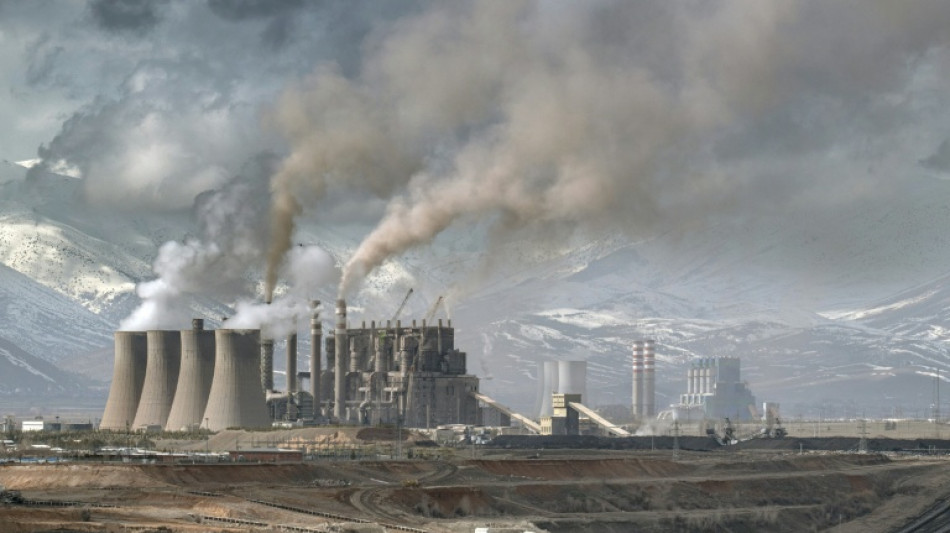
Turkey fires up coal pollution even as it hosts COP31 / Photo: Ozan KOSE - AFP

 Saudi-led coalition says Houthis fired ballistic missile at Riyadh

 Cuba works to restore power after another blackout
 Brigitte Bardot widower slams sale of star's belongings

 Indonesia accepts Malaysia's help to tackle wildfires
 Nvidia, OpenAI CEOs to attend Xi dinner at White House

 Cuba hit with seventh major blackout of the year

 Nigeria miners struggled to breathe in cell before 37 died: survivors

 Warren Buffett steps down as Berkshire Hathaway chairman

 Isolated Syrian-Druze city blames Damascus for shortages

 Kerry James Marshall: American 'blackness' painter celebrated in Europe

 Infantino 'must go', says German FA vice-president

 Japan's busiest rail station tests robot bins

 Backpackers fret over Australian visa crackdown

 Bank of Japan hikes rates to 31-year high to battle inflation

 AI doomsday warnings unlikely to slow IPOs but questions linger

 In Brazil's Amazon, the hunt for oil fuels hopes and fears

 Baby orangutans in India expose 'frightening' scale of trafficking

 Oversight Board blasts 'inadequate' Meta safeguards for AI deepfakes

 Harry makes first public appearance since return to UK

 Princess Diana's brother makes new explosive claims against Charles

 Trump admin overhauls key protection for endangered species

 Mbappe draws political fire over Ceuta t-shirt controversy

 Third malaria death in Germany from outbreak tied to Frankfurt airport

 AtlasClear Holdings Reports Preliminary Fiscal 2026 Revenue of Approximately $20.1 Million, Up 85%; Revenue Plus Interest Income of Approximately $21.9 Million

 'Another arrow to the quiver': World Bank posts record private capital mobilization

Kaddafi Polat rarely mentions his own health after decades of breathing the polluted air blanketing his village beneath the towering chimneys of a coal‑fired power plant in southern Turkey. What troubles him most is his children.
Fine dust settles on cars, laundry and the narrow streets of Cogulhan, a village in the Afsin district of Kahramanmaras province, leaving a grey film over daily life -- and over the now-rotting playground where his kids once played.
Afsin‑Elbistan is one of the country's most polluting power plants, environmentalists say, but the government is planning to expand it, even as Turkey prepares to host the COP31 UN climate summit next November.
"In the mornings, when the school bus comes, dust rises everywhere," Polat, 52, told AFP at a local coffeehouse.
"Children breathe this in, what will happen when they're 30 or 40? As a father, you worry."
Once home to 10,000 people, most of the village's residents have fled because of the pollution, locals say. Only a few hundred are left.
Crumbling houses line the streets, watched over by a solitary clock tower. The chimneys of the power plant dominate the skyline, pumping plumes of ash and smoke.
"Living here is like suicide," Polat sighs, saying some stay because they are poor, others because they have land here.
"I've watched pollution change everything: people, animals, the soil, even the trees."
- A genuine climate leader? -
One of Turkey's largest thermal power facilities, the plant generates 2,795 megawatts of power from highly polluting lignite, or brown coal, mined in the Afsin‑Elbistan basin that holds 40 percent of the country's reserves.
Opened in 1984, the eight-unit complex comprises privately-run Afsin-Elbistan A, and the state‑run plant B.
But plans to expand Plant A by two units have alarmed environmentalists, especially with Turkey preparing to host COP31, where the shift away from fossil fuels will be a central theme.
"If Turkey is pursuing the COP31 presidency with a claim to being a genuine climate leader yet continues to insist on fossil fuel investments, particularly coal, then this is a paradox it must resolve," said Emel Turker Alpay of Greenpeace Turkey.
Turkey aims to reach net-zero emissions by 2053, but coal still accounted for 33.6 percent of the resources used in electricity generation last year, official data shows.
Last week, Environment Minister Murat Kurum tried to dismiss a question about hosting COP31 and Turkey's increasing reliance on coal.
"We cannot reduce the matter solely to fossil fuels," he told a news conference alongside UN climate chief Simon Stiell.
But Alpay said expanding one of the country's most polluting plants contradicts both "Turkey's climate goals and the state's responsibility to protect public health".
Activists link the complex and its emissions of particulate matter and sulphur dioxide to an estimated 16,530 premature deaths.
Adding two more units could cause a further 2,268 deaths and impose 88.4 billion lira ($2.6 billion) in health costs, even with improved filtration technology, they warn.
Contacted by AFP, the plant declined to comment on the expansion plans.
- Government 'must choose' -
Lutfi Tiyekli, who heads the Kahramanmaras doctors' association, said the government "must choose between energy from this power plant and public health".
"We are knowingly sacrificing people here to cancer, chronic obstructive pulmonary disease and asthma," he told AFP.
A local environmental activist, Mehmet Dalkanat, said sickness was widespread.
"People are dying. There isn't a single household in this village without cancer," said Dalkanat, who suffers chronic respiratory problems.
His son, Ali, said he worked as a security guard at the plant but left in 2020 with severe bronchitis.
"Had I kept working there, my health would have taken an irreversible path," he said.
- Danger levels -
Air pollution in the Elbistan district remains far above World Health Organization and Turkish safety thresholds, said Deniz Gumusel of the Right to Clean Air Platform.
Under Turkish limits annual PM10 particulate matter should be capped at 40 micrograms per cubic meter, she said, but Elbistan has levels of up to three times higher.
And the daily average of PM10 particle levels reached 128.3 micrograms per cubic meter in Elbistan last year -- over eight times the WHO guideline of 15 micrograms.
For Dalkanat, expansion would be the final blow.
"While the world is phasing out coal, building a new power plant here means this region is being written off," he said.
In Cogulhan, residents have largely given up.
"Look where I walked, my footprints show like walking on snow," said 62‑year‑old Eyup Kisa of the ash that constantly falls on the village.
"If they expand this plant, we'll all die".
M.P.Jacobs--CPN