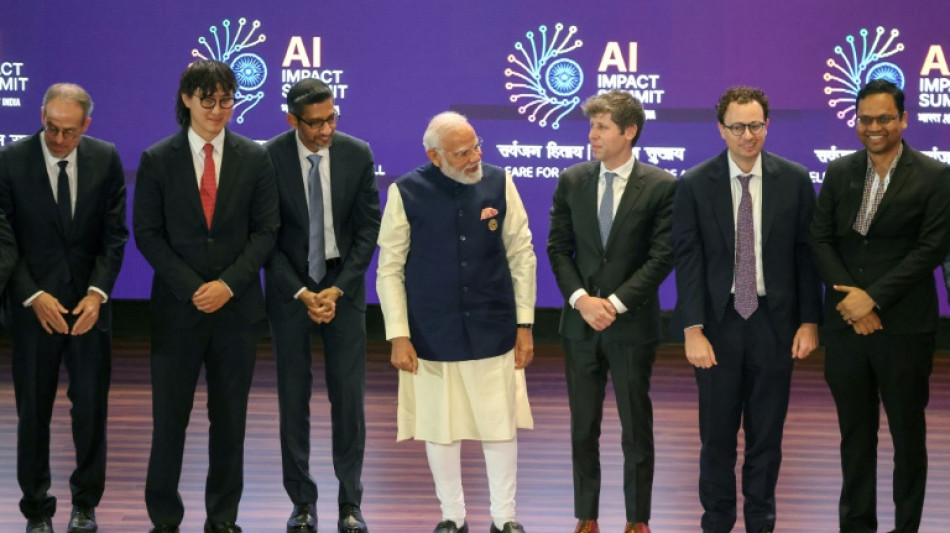
OpenAI's Altman says at India summit regulation 'urgently' needed / Photo: Ludovic MARIN - AFP

 France's debt climbs to highest since 1978: ministry

 Thousands protest inaction over climate crisis in Switzerland

 UK actor Naomi Watts honoured at Spain film festival

 Trump signs bill authorizing sweeping Russia sanctions

 Anthropic picks Accenture for in-house AI safety evaluation

 Hushing and hedging: US companies retreat on climate

 Crisis-wracked Volkswagen warns of 10-bn-euro hit to profits

 Shakira to cap off world tour with Madrid 12-gig run

 Isolated Syrian-Druze city shortages

 UNESCO can be 'moderator' in AI debate: chief to AFP

 Russia seizes assets of Nestle, French firms

 Anthropic says AI systems moving towards building themselves

 Asian stocks boosted by falling oil, yen weakens after BoJ rate hike

 Afghan medical students in Pakistan hope court stops college expulsions

 Australia to detain tourists who overstay visa, minister says

 Asian stocks track Wall St rally as oil prices drop

 Prized Mexican relic returns on loan, two centuries on

 'In our lane': Fed's Warsh defies Trump but still fighting for credibility

 Trump admin makes major cut to endangered species protections

 GM delivers first components for US interceptor missiles

 Travis Scott and Keith Richards feature on GTA VI soundtrack

 King Charles warns tech bosses of 'existential dangers' of AI

 French fishermen block ports over petrol prices

 Micron's Taiwan workers say 68 months' bonus not enough

 Canada's Carney pushes 'new alliance' with EU despite Trump threats

The world urgently needs to regulate artificial intelligence, OpenAI head Sam Altman said on Thursday at a summit in New Delhi on the risks and opportunities posed by the fast-evolving technology.
Frenzied demand for generative AI has turbocharged profits for companies while fuelling anxiety about the impact on society and the planet.
"Centralisation of this technology in one company or country could lead to ruin," Altman said.
"This is not to suggest that we won't need any regulation or safeguards. We obviously do, urgently, like we have for other powerful technologies."
The AI Impact Summit is the fourth annual gathering to discuss how to handle advanced computing power.
It is the largest yet and the first in a developing country, with India taking the opportunity to push its ambitions to catch up with the United States and China in the AI race.
"We must democratise AI. It must become a medium for inclusion and empowerment," Prime Minister Narendra Modi told the gathering on Thursday.
"We are entering an era where humans and intelligence systems co-create, co-work and co-evolve," he said. "We must resolve that AI is used for the global common good."
- Gates cancels -
Modi's comments were echoed by UN Secretary-General Antonio Guterres, who called on tech tycoons to support a $3 billion global fund to ensure open access to AI.
"AI must belong to everyone," Guterres said.
"The future of AI cannot be decided by a handful of countries -- or left to the whims of a few billionaires," he said.
Researchers and campaigners say stronger action is needed to combat emerging issues, from job disruption to online abuse and the huge electricity demands from data centres.
But the broad focus of the New Delhi event, and vague promises made at previous summits, could make concrete commitments unlikely.
Google's Sundar Pichai and Anthropic's Dario Amodei were among the other tech CEOs to speak, but Microsoft founder Bill Gates cancelled just hours before his appearance.
Gates, facing questions over his ties to late sex offender Jeffrey Epstein, withdrew to "ensure the focus remains on the AI Summit's key priorities", the Gates Foundation said.
The billionaire said this month he regrets "every minute" he spent with Epstein. The mere mention of someone's name in the Epstein files does not in itself imply any wrongdoing by that person.
- Big deals -
World leaders have joined tens of thousands of people from across the sector at the summit.
French President Emmanuel Macron, last year's host, said he was determined to ensure safe oversight of AI.
"Europe is not blindly focused on regulation -- Europe is a space for innovation and investment, but it is a safe space," he said.
US Vice President JD Vance warned in Paris last year against "excessive regulation" that "could kill a transformative sector".
However, this year's US government delegation has kept a low profile.
India expects more than $200 billion in investments over the next two years, and US tech titans have unveiled new deals and infrastructure projects this week.
OpenAI and Indian IT giant Tata Consultancy Services (TCS) announced on Thursday they would build hyperscale AI data centre capacity in India.
Google said on Wednesday it planned to lay subsea cables from India as part of an existing $15 billion AI infrastructure investment.
US chip behemoth Nvidia -- the world's most valuable company -- also said it was teaming up with Indian cloud computing firms to provide advanced processors for data centres that can train and run AI systems.
Power-hungry AI data centres are under construction worldwide on a massive scale as companies race to develop super-intelligent systems.
The increased demand for electricity and water to cool hot servers have sparked alarm at a time when nations have pledged to decarbonise grids to tackle climate change.
- Long way to go -
India leapt to third place last year in an annual global ranking of AI competitiveness calculated by Stanford researchers, although experts say it has a long way to go before it can rival the United States and China.
Brazil's President Luiz Inacio Lula da Silva is also due to hold talks with Modi, including on rare earths.
Leaders are expected to deliver a statement on Friday about how they plan to handle AI technology.
One fear is disruption to the job market -- especially in India, where millions of people are employed in call centres and tech support services.
"We will prove that AI does not take away jobs. Rather, it will create new high-skilled work opportunities," Mukesh Ambani, head of India's Reliance Group, said on Thursday.
M.García--CPN
