Greece airspace shutdown exposes badly outdated systems / Photo: Sakis Mitrolidis - AFP

 AI 'warning shots' focus Beijing on national security risks

 Philippine tribe in limbo over US-led tech hub

 Saudi-led coalition says Houthis fired ballistic missile at Riyadh

 Cuba works to restore power after another blackout

 Brigitte Bardot widower slams sale of star's belongings

 Indonesia accepts Malaysia's help to tackle wildfires
 Nvidia, OpenAI CEOs to attend Xi dinner at White House

 Cuba hit with seventh major blackout of the year

 Nigeria miners struggled to breathe in cell before 37 died: survivors

 Warren Buffett steps down as Berkshire Hathaway chairman

 Isolated Syrian-Druze city blames Damascus for shortages

 Kerry James Marshall: American 'blackness' painter celebrated in Europe

 Infantino 'must go', says German FA vice-president

 Japan's busiest rail station tests robot bins

 Backpackers fret over Australian visa crackdown

 Bank of Japan hikes rates to 31-year high to battle inflation

 AI doomsday warnings unlikely to slow IPOs but questions linger

 In Brazil's Amazon, the hunt for oil fuels hopes and fears

 Baby orangutans in India expose 'frightening' scale of trafficking

 Oversight Board blasts 'inadequate' Meta safeguards for AI deepfakes

 Harry makes first public appearance since return to UK

 Princess Diana's brother makes new explosive claims against Charles

 Trump admin overhauls key protection for endangered species

 Mbappe draws political fire over Ceuta t-shirt controversy

 Third malaria death in Germany from outbreak tied to Frankfurt airport

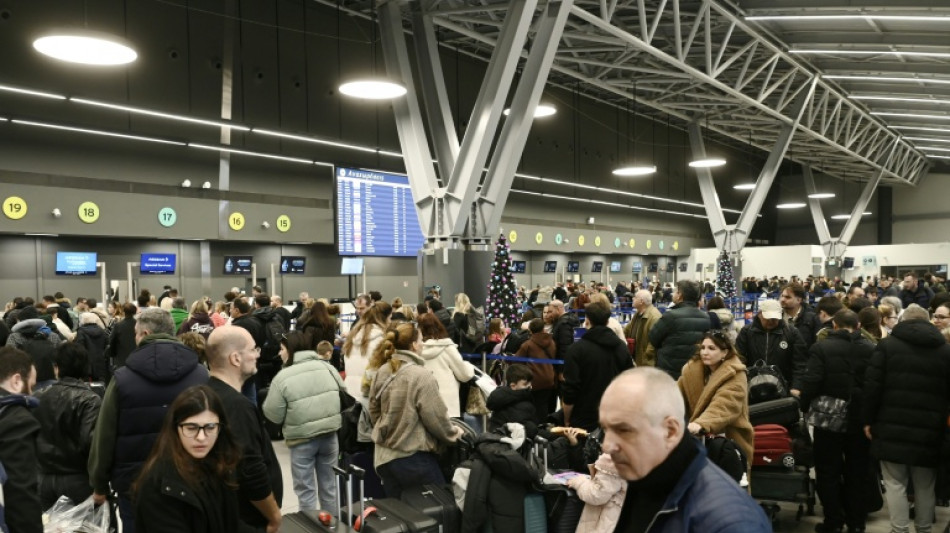
A deeply embarrassing systems failure which forced Greece to close its airspace for several hours with pilots unable to speak to air traffic control, has exposed badly outdated communication systems at Athens International Airport -- one of the world's top travel destinations.
Flights had to be diverted to neighbouring countries with thousands of travellers hit after the "unprecedented" technical malfunction on January 4, which baffled experts.
Even more than a week after the chaos, questions as to what sparked the glitch -- and how the system returned online -- remain unanswered, with a report expected this week.
According to the Greek civil aviation authority, the YPA, the malfunction began at 8:59 am (0659 GMT) when multiple radio frequencies serving Athens airspace were hit by continuous "noise" interference.
The agency's transmitters began sending out "involuntary signal emissions", YPA said.
As technicians raced to radio relay stations on top of mountains near Athens and further afield to locate the problem, planes were essentially flying blind, experts said -- unable to communicate with air traffic controllers -- until the incident began to gradually abate four hours later.
"Hundreds of flights were directly affected -- those in contact with air traffic control or already in the air that changed their route," Foivos Kaperonis, a board member of the Greek air traffic controllers association (EEEK), told AFP.
Athens International Airport handled over 280,000 flights last year, an average of over 760 a day.
Officials have insisted that Athens airspace was quickly cleared of traffic, and that flight safety was not compromised.
The system returned to full operation at 5 pm (1500 GMT), with flights restored 45 minutes later, the YPA said.
No signs of a cyberattack or intentional sabotage were detected, YPA said. And nothing suspicious was found at the relay stations.
Government spokesman Pavlos Marinakis later confirmed there was "no sign" of a cyberattack.
- 'Flying deaf' -
"We have an exact picture of what happened. What we don't yet know is how it happened," Michael Bletsas, one of Greece's top computer engineers and head of the Greek cybersecurity authority, told state TV ERT.
Planes "may have flown 'deaf' for a short while... but under no circumstances was there a flight safety problem," he said, with pilots still having their radar.
"Every system fails at some point," said Bletsas, who is on the committee investigating the incident.
Kaperonis is much less sanguine.
"Air traffic controllers could see the aircraft on the radar display, but they could neither hear the pilots nor speak to them," he said.
"In other words, if two aircraft had been on a collision course, controllers would not have been able to give them instructions," he said.
George Saounatsos, the head of the YPA, said a report on the incident by a hurriedly-convened investigative committee would likely be delivered this week.
"It was a rare event -- it's hard for this to happen again, even statistically," he told Open TV.
A major infrastructure overhaul costing 300 million euros ($350 million) is currently underway, which includes digital transmitters that will be delivered this year, Saounatsos said.
- 'Outdated' systems -
Greece's junior transport minister has admitted the airport's communications systems should have been upgraded "decades" earlier.
"These are systems we know are outdated," Konstantinos Kyranakis told Action24 TV.
The Athens airport tower radar dates from 1999, air traffic controllers note.
"Clearly, systems that should have been replaced decades ago, cannot be replaced in nine months," Kyranakis said, who was appointed in March.
Four different transport ministers have held the portfolio since 2019 when conservative Prime Minister Kyriakos Mitsotakis came to power.
Bertrand Vilmer, an aeronautics expert and consultant at Paris-based Icare Aeronautique, said Athens' largely analog-based systems "are robust, but ones for which there's no longer really any possible maintenance because they're old."
Last month the European Commission referred Greece to the EU Court of Justice for failing to put in place measures to design and publish performance-based navigation (PBN) procedures at Greek airports that should have been in place five years ago.
Air traffic controllers, who have clashed with YPA for years over staff and infrastructure shortages, insist that the January 4 incident was a debacle waiting to happen.
They say that the incident is particularly concerning in a country heavily reliant on tourism that has seen record visitor numbers in recent years.
"The air traffic control unit where the problem appeared handles up to nearly 5,000 flights per day during the summer season," Kaperonis said.
Air traffic controllers require "long rest periods" due to the difficulty of their job, Vilmer said.
YPA and the transport minister's office did not respond to questions.
Athens International Airport last year handled nearly 34 million passengers, an increase of 6.7 percent over the previous year.
Critics have also noted that Greece's worst rail disaster, when two trains collided in 2023, killing 57 people -- which brought hundreds of thousands onto the streets to protest -- was also partly caused by chronic infrastructure and staffing failings.
T.Morelli--CPN