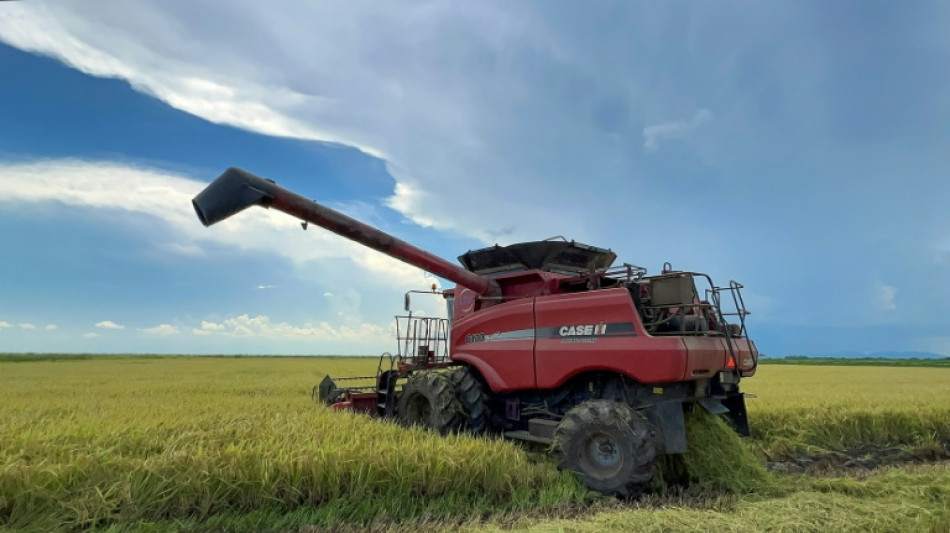
Vietnamese rice grower helps tackle Cuba's food shortage / Photo: Adalberto ROQUE - AFP/File

 Archaeological 'breakthrough' could confirm origins of Paris

 Australian PM says OpenAI hacked government health website

 Rio breaks record for rainiest September amid powerful El Nino
 Mandela Digital Extends Early Access Programme to 11 February 2027 Following Strong Response

 McDonald's to boost franchisees as inflation weighs on consumers
 Archaelogical 'breakthrough' could confirm origins of Paris
 Fendi brings disco bling, Italian style, to Milan Fashion Week

 アレックス・ボディ氏とシュテファン・ハウプト教授、ルーマニアの伝説的な美術コレクションをめぐり提携に合意

 Stocks dip, oil rises as traders eye chances of Iran deal

 Oil falls, stocks steady as Trump hails 'good' Iran talks

 Canada judge to decide prison term for suicide poison seller

 Meta leans into AI, smart glasses amid privacy pushback
 Oil prices fall after Trump hails 'good' talks with Iran

 AI political ads warp reality ahead of US midterms

 Oil prices retreat as markets welcome US-Iran talks
 French prosecutors probe secret filming of women with smart glasses

 Trump renames AI "super intelligence," rejects international oversight

 How is the EU approaching record fuel prices?

 11 hurt as teen opens fire outside school in western Turkey

 UN chief says 'Big Oil' treats atmosphere as open sewer
 Memoir by Diana's brother goes on sale after rocking UK monarchy

 Stocks climb as oil slides, AI buzz returns

 MEXC Launches “Real Stocks, Real Friends” with Rewards for Bringing Friends to Wall Street

 Stocks rise on AI buzz, oil prices cool
 In Bangladesh, Pakistan's Jinnah photo stirs anger

Outside Havana, a combine belonging to a private Vietnamese company is harvesting rice, directly farming Cuban land -- in a first -- to help address acute food shortages in the country.
The Cuban government has granted Agri VAM, a subsidiary of Vietnam's Fujinuco Group, 1,000 hectares (2,470 acres) of arable land in Los Palacios, 118 kilometers (73 miles) west of the capital.
Vietnam has advised Cuba on rice cultivation in the past but this is the first time a private firm has done the farming itself.
The government approved the move after a 52 percent plunge in overall agricultural production between 2018 and 2023, according to data from the Center for the Study of the Cuban Economy at the University of Havana.
The rice numbers are even worse. Total rice production dropped from 300,000 tons in 2018 to 55,000 tons in 2021, in the depths of the COVID pandemic. The number is slowly recovering, authorities say.
Rice is a staple of the local diet, with Cubans consuming 60 kilos (132 pounds) of rice per person per year.
- Promising yields and daunting obstacles -
During a media visit to its rice fields in May, an Agri VAM representative said the harvest yield to date is seven tons per hectare, "but we want more."
That number dwarfs the ton and a half yield-per-hectare of Cuban growers.
Vietnam experienced the kind of food shortages that Cuba is going through now, in the 1980s. Today, the Southeast Asian country is the world's third exporter of rice and a valued consultant to other rice-growing nations.
"The climate and the temperature are very good for agriculture," but Cuban growers lack necessary farming products such as fertilizers, the Agri VAM representative told reporters.
Though Agri VAM can import some materials, it faces other obstacles such as fuel shortages, transportation problems and frozen assets, Cuban economist Omar Everleny Perez and other sources with knowledge of the situation told AFP.
Agri VAM and other foreign firms in Cuba may be making profits but "they cannot transfer them abroad because the banks have no liquidity, no foreign currency," Perez said.
An independent Cuban media outlet, 14ymedio, recently published excerpts of a letter dated in May, in which Agri VAM asked the Cuban government to unfreeze $300,000 in its account at state-owned International Financing Bank.
Vietnam's state press in May quoted deputy agriculture minister Nguyen Quoc Tri asking the government in Havana "to eliminate investment barriers that Vietnamese companies encounter."
AFP contacted Agri VAM and Cuban officials but got no response.
- Foreign investment: badly needed -
Cuba is mired in an acute economic crisis and desperately in need of foreign investment. Vietnam and other allies have shown interest.
In July, Cuban Prime Minister Manuel Marrero Cruz announced that Havana was taking measures "to energize foreign investment" as he authorized "wholly foreign-owned companies" in the hotel sector.
After three years of promises, Russia's deputy prime minister Dmitry Chernyshenko announced in May that Russian businesses want to invest $1 billion in Cuba. Moscow will give them preferential financing rates, he said.
But he cautioned that there is "still hard work to be done" and said it is "impossible to achieve things immediately, as if by magic."
P.Kolisnyk--CPN