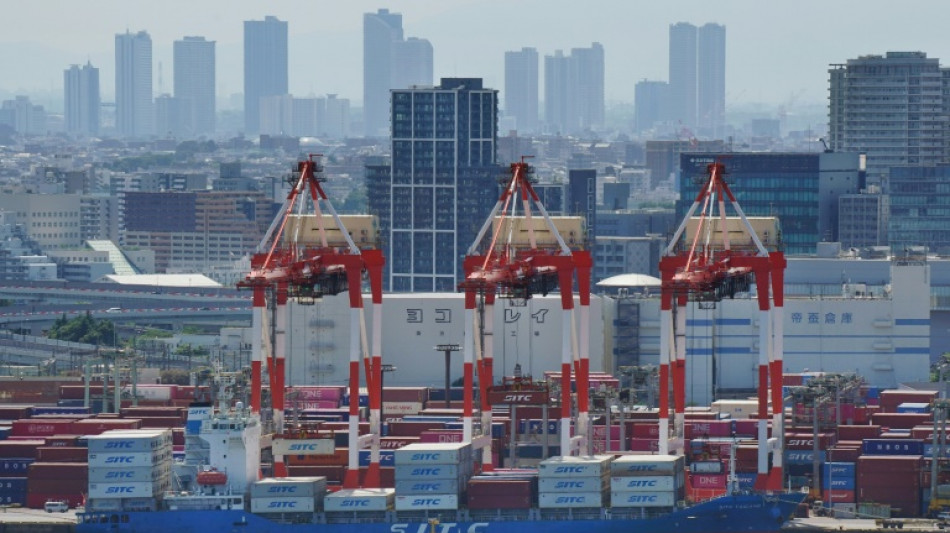
Japan posts modest growth despite US tariffs / Photo: Kazuhiro NOGI - AFP

 Markets mixed as China's Xi arrives for US talks

 Archaeological 'breakthrough' could confirm origins of Paris

 Australian PM says OpenAI hacked government health website

 Rio breaks record for rainiest September amid powerful El Nino

 Mandela Digital Extends Early Access Programme to 11 February 2027 Following Strong Response

 McDonald's to boost franchisees as inflation weighs on consumers
 Archaelogical 'breakthrough' could confirm origins of Paris
 Fendi brings disco bling, Italian style, to Milan Fashion Week

 アレックス・ボディ氏とシュテファン・ハウプト教授、ルーマニアの伝説的な美術コレクションをめぐり提携に合意

 Stocks dip, oil rises as traders eye chances of Iran deal

 Oil falls, stocks steady as Trump hails 'good' Iran talks

 Canada judge to decide prison term for suicide poison seller

 Meta leans into AI, smart glasses amid privacy pushback

 Oil prices fall after Trump hails 'good' talks with Iran

 AI political ads warp reality ahead of US midterms

 Oil prices retreat as markets welcome US-Iran talks

 French prosecutors probe secret filming of women with smart glasses

 Trump renames AI "super intelligence," rejects international oversight
 How is the EU approaching record fuel prices?

 11 hurt as teen opens fire outside school in western Turkey

 UN chief says 'Big Oil' treats atmosphere as open sewer
 Memoir by Diana's brother goes on sale after rocking UK monarchy

 Stocks climb as oil slides, AI buzz returns

 MEXC Launches “Real Stocks, Real Friends” with Rewards for Bringing Friends to Wall Street

 Stocks rise on AI buzz, oil prices cool

Japan eked out modest growth in the second quarter despite painful US tariffs, official data showed Friday, in welcome news to embattled Prime Minister Shigeru Ishiba.
A preliminary estimate showed gross domestic product (GDP) in the world's number four economy growing 0.3 percent in the three months to June, above market forecasts of 0.1 percent.
The cabinet office data also saw a revision upwards for its reading for the previous quarter to show an expansion of 0.1 percent.
On an annualised basis, GDP grew 1.0 percent, beating market forecasts of 0.4 percent and following 0.6 percent in the last quarter.
The previous estimate was for a contraction and, without the revision, a second negative reading would have put Japan in technical recession.
The new figures are a fillip for Ishiba, whose future has been uncertain since the disastrous upper house elections in July.
With voters angry about the cost of living, his coalition lost its majority months after it suffered a similar catastrophe in the lower chamber.
An opinion poll this week by broadcaster NHK suggested, however, that more people want Ishiba to stay than to quit.
There is also no obvious successor to the 68-year-old leader, who took office in October, while the opposition is likely too fragmented to form an alternative government.
- Trade deal -
The economic growth came despite tariffs imposed by US President Donald Trump being applied to Japanese imports into the United States.
Causing particular pain are levies of 27.5 percent on Japanese cars, a sector that accounts for eight percent of all jobs in Japan.
Japan last month secured a trade deal that cut a threatened 25 percent "reciprocal" tariffs on other Japanese goods to 15 percent.
The rate on Japanese cars was also cut to 15 percent, although to Tokyo's consternation, this has yet to take effect.
Toyota this month cut its annual net income forecast by 14 percent, projecting a $9.5 billion hit from the tariffs this year.
First-quarter profits halved at Honda, but the firm lowered its forecast for the tariff impact, as did electronics giant Sony.
Economist Yoshiki Shinke at Dai-ichi Life Research Institute said that Japan's economy still faces "many downside risks", with exports the major concern.
Automakers "are expected to rethink their pricing strategies, and there is a possibility they may move to raise prices in the future," Shinke said in a note.
"In such a case, sales volumes in the US are likely to decrease, and export volumes could also be pressured downward," Shinke said before the release of the data.
- 'Behind the curve' -
Trump's administration, meanwhile, is seen as pressuring the Bank of Japan (BoJ) to hike interest rates, which could put a brake on growth.
The BoJ has been reluctant to raise borrowing costs, seeing above-target inflation as caused by temporary factors.
"The Japanese have an inflation problem," US Treasury Secretary Scott Bessent told Bloomberg TV after speaking to the BoJ governor.
"They are behind the curve, so they are going to be hiking," Bessent said.
Experts said the comments were likely driven by the Trump administration's desire to weaken the dollar and address rising yields on US long-term bonds.
Marcel Thieliant at Capital Economics said that despite the better-than-expected GDP figures, growth will "slow a bit over the coming quarters."
"Nonetheless, with inflation set to remain far above the BoJ's 2-percent target, we're increasingly confident in our forecast that the Bank will resume its tightening cycle in October," Thieliant said.
Ng.A.Adebayo--CPN