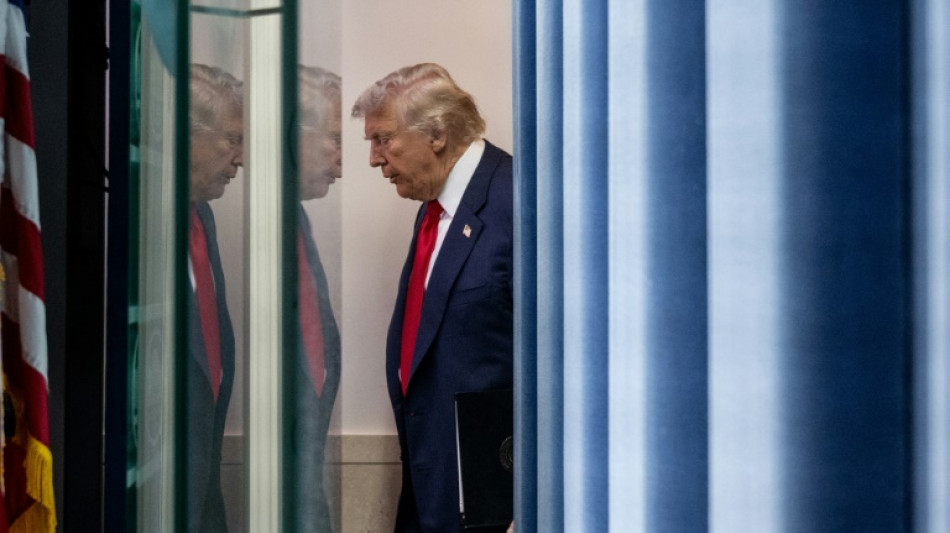
US, China extend tariff truce for 90 days / Photo: ANDREW CABALLERO-REYNOLDS - AFP

 Markets mixed as China's Xi arrives for US talks

 Archaeological 'breakthrough' could confirm origins of Paris

 Australian PM says OpenAI hacked government health website

 Rio breaks record for rainiest September amid powerful El Nino
 Mandela Digital Extends Early Access Programme to 11 February 2027 Following Strong Response

 McDonald's to boost franchisees as inflation weighs on consumers
 Archaelogical 'breakthrough' could confirm origins of Paris
 Fendi brings disco bling, Italian style, to Milan Fashion Week

 アレックス・ボディ氏とシュテファン・ハウプト教授、ルーマニアの伝説的な美術コレクションをめぐり提携に合意

 Stocks dip, oil rises as traders eye chances of Iran deal

 Oil falls, stocks steady as Trump hails 'good' Iran talks

 Canada judge to decide prison term for suicide poison seller

 Meta leans into AI, smart glasses amid privacy pushback

 Oil prices fall after Trump hails 'good' talks with Iran

 AI political ads warp reality ahead of US midterms

 Oil prices retreat as markets welcome US-Iran talks

 French prosecutors probe secret filming of women with smart glasses

 Trump renames AI "super intelligence," rejects international oversight
 How is the EU approaching record fuel prices?

 11 hurt as teen opens fire outside school in western Turkey

 UN chief says 'Big Oil' treats atmosphere as open sewer

 Memoir by Diana's brother goes on sale after rocking UK monarchy
 Stocks climb as oil slides, AI buzz returns

 MEXC Launches “Real Stocks, Real Friends” with Rewards for Bringing Friends to Wall Street

 Stocks rise on AI buzz, oil prices cool

China and the United States delayed higher tariffs on each other's imports for 90 days, hours before a trade truce between the world's two largest economies was due to expire Tuesday.
US President Donald Trump signed an executive order on Monday that will "extend the Tariff Suspension on China for another 90 days," according to a post on his Truth Social platform.
The White House said its halt on steeper tariffs will be in place until November 10.
China also said it would continue suspending its earlier tariff hike for 90 days, starting August 12, while retaining a 10-percent duty, according to a joint statement.
While the United States and China slapped escalating tariffs on each other's products this year, bringing them to prohibitive triple-digit levels and snarling trade, both countries in May agreed to temporarily lower them.
As part of their truce that month, fresh US tariffs targeting China were reduced to 30 percent and the corresponding level from China was cut to 10 percent.
Those rates will now hold until November -- or whenever a deal is cut before then.
In the executive order posted Monday to its website, the White House reiterated its position that there are "large and persistent annual US goods trade deficits" and they "constitute an unusual and extraordinary threat to the national security and economy of the United States."
The order acknowledged Washington's ongoing discussions with Beijing "to address the lack of trade reciprocity in our economic relationship" and noted that China has continued to "take significant steps toward remedying" the US complaints.
Beijing, meanwhile, said it would "take or maintain necessary measures to suspend or remove non-tariff countermeasures against the United States," as agreed in Geneva in May.
- Trump-Xi summit? -
In Shanghai, China's commercial capital, residents welcomed the extended trade truce on Tuesday.
"I feel that negotiations will definitely steer the two countries toward a better direction," said Zhang Xuan, a 25-year-old postgraduate student.
Lin Peng, a commercial property leasing agent, told AFP he felt there would be more negotiations between the two nations as Trump is a "businessman" and an escalated trade war would "hurt his own interests too."
"Beijing will be happy to keep the US-China negotiation going, but it is unlikely to make concessions," warned William Yang, an analyst at the International Crisis Group.
He believes China sees its leverage over rare earth exports as strong, and that Beijing will likely use it to pressure Washington.
US-China Business Council president Sean Stein said the extension was "critical to give the two governments time to negotiate an agreement," providing much-needed certainty for companies to make plans.
Since Trump took office in January, China's tariffs have essentially boomeranged, from the initially modest 10 percent hike in February, followed by repeated surges as Beijing and Washington clashed, until it hit a high of 145 percent in April.
Now the tariff has been pulled back to 30 percent, a negotiated truce rate.
A trade deal would "pave the way for a Trump-Xi summit this fall," said Asia Society Policy Institute senior vice president Wendy Cutler.
But Cutler, herself a former US trade official, said: "This will be far from a walk in the park."
Even as both countries reached a pact to cool tensions after high level talks in Geneva in May, the de-escalation has been shaky.
Key economic officials convened in London in June as disagreements emerged and US officials accused their counterparts of violating the pact. Policymakers met again in Stockholm last month.
- 'Reciprocal' tariffs -
Trump said in a social media post Sunday that he hoped China will "quickly quadruple its soybean orders," adding this would be a way to balance trade with the United States.
China's exports reached record highs in 2024, and Beijing reported that their exports exceeded expectations in June, climbing 5.8 percent year-on-year, as the world's number-two economy works to sustain growth.
Since returning to the presidency, Trump has separately slapped a 10 percent "reciprocal" tariff on almost all trading partners, aimed at addressing trade practices Washington has deemed unfair.
This surged to varying steeper levels last Thursday for dozens of economies.
Major partners like the European Union, Japan and South Korea now see a 15 percent US duty on many products, while the level went as high as 41 percent for Syria.
The "reciprocal" tariffs exclude sectors that have been targeted individually, such as steel and aluminum, and those that are being investigated like pharmaceuticals and semiconductors.
U.Ndiaye--CPN