Trump targets tariff evasion, with eye on China / Photo: Brendan SMIALOWSKI - AFP/File

 As Moscow steps up attacks, Kyiv residents brace for harsh winter

 Markets mixed as China's Xi arrives for US talks

 Archaeological 'breakthrough' could confirm origins of Paris

 Australian PM says OpenAI hacked government health website

 Rio breaks record for rainiest September amid powerful El Nino
 Mandela Digital Extends Early Access Programme to 11 February 2027 Following Strong Response

 McDonald's to boost franchisees as inflation weighs on consumers
 Archaelogical 'breakthrough' could confirm origins of Paris
 Fendi brings disco bling, Italian style, to Milan Fashion Week

 アレックス・ボディ氏とシュテファン・ハウプト教授、ルーマニアの伝説的な美術コレクションをめぐり提携に合意

 Stocks dip, oil rises as traders eye chances of Iran deal

 Oil falls, stocks steady as Trump hails 'good' Iran talks

 Canada judge to decide prison term for suicide poison seller

 Meta leans into AI, smart glasses amid privacy pushback

 Oil prices fall after Trump hails 'good' talks with Iran

 AI political ads warp reality ahead of US midterms

 Oil prices retreat as markets welcome US-Iran talks

 French prosecutors probe secret filming of women with smart glasses

 Trump renames AI "super intelligence," rejects international oversight
 How is the EU approaching record fuel prices?

 11 hurt as teen opens fire outside school in western Turkey

 UN chief says 'Big Oil' treats atmosphere as open sewer

 Memoir by Diana's brother goes on sale after rocking UK monarchy

 Stocks climb as oil slides, AI buzz returns

 MEXC Launches “Real Stocks, Real Friends” with Rewards for Bringing Friends to Wall Street

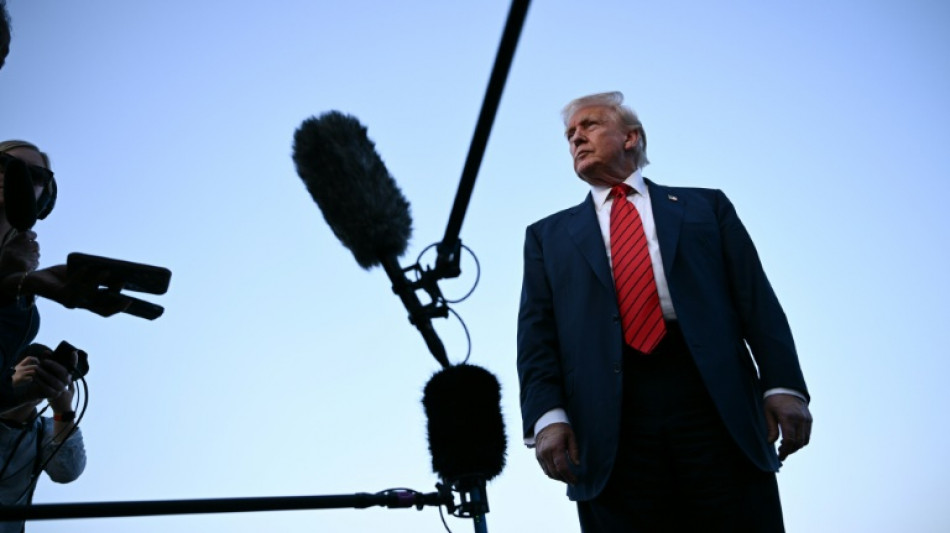
As the United States ramps up tariffs on major trading partners globally, President Donald Trump is also disrupting strategies that could be used -- by Chinese companies or others -- to circumvent them.
Goods deemed to be "transshipped," or sent through a third country with lower export levies, will face an additional 40-percent duty under an incoming wave of Trump tariffs Thursday.
The latest tranche of "reciprocal" tariff hikes, taking aim at what Washington deems unfair trade practices, impacts dozens of economies from Taiwan to India.
The transshipment rule does not name countries, but is expected to impact China significantly given its position as a manufacturing powerhouse.
Washington likely wants to develop supply chains that are less reliant on China, analysts say, as tensions simmer between the world's two biggest economies and the US sounds the alarm on Beijing's excess industrial capacity.
But "it's a little more about the short-term effect of strengthening the tariff regime than it is about a decoupling strategy," said Josh Lipsky, chair of international economics at the Atlantic Council.
"The point is to make countries worried about it and then have them err on the side of not doing it, because they know that Trump could then jack up the tariff rates higher again," he added, referring to tariff evasion.
The possibility of a sharply higher duty is a "perpetual stick in the negotiations" with countries, said Richard Stern, a tax and budget expert at the conservative Heritage Foundation.
He told AFP that expanding penalties across the globe takes the focus away from Beijing alone.
- Alternative supplies -
Experts have noted that Vietnam was the biggest winner from supply chain diversions from China since the first Trump tariffs around 2018, when Washington and Beijing engaged in a trade war.
And Brookings Institution senior fellow Robin Brooks pointed to signs this year of significant transshipments of Chinese goods.
He noted in a June report that Chinese exports to certain Southeast Asian countries started surging "anomalously" in early 2025 as Trump threatened widespread levies.
While it is unclear if all these products end up in the United States, Brooks cast doubt on the likelihood that domestic demand in countries like Thailand and Vietnam rocketed right when Trump imposed duties.
"One purpose of the transshipment provisions is to force the development of supply chains that exclude Chinese inputs," said William Reinsch, senior adviser at the Center for Strategic and International Studies.
"The other purpose is to push back on Chinese overcapacity and force them to eat their own surpluses," he added.
But Washington's success in the latter goal depends on its ability to get other countries on board.
"The transshipment penalties are designed to encourage that," Reinsch said.
Lipsky added: "The strategy that worked in the first Trump term, to try to offshore some Chinese manufacturing to other countries like Vietnam and Mexico, is going to be a much more difficult strategy to execute now."
- China response? -
Lipsky noted that Beijing could see the transshipment clause as one targeting China on trade, "because it is."
"The question is, how China takes that in the broader context of what had been a thawing relationship between the US and China over the past two months," he added.
While both countries temporarily lowered triple-digit tariffs on each other's exports, that truce expires August 12.
The countries are in talks to potentially extend the de-escalation, although the final decision lies with Trump.
It will be tough to draw a line defining product origins, analysts say.
Customs fraud has been illegal for some time, but it remains unclear how Washington will view materials from China or elsewhere that have been significantly transformed.
The burden lies with customs authorities to identify transshipment and assess the increased duties.
"That will be difficult, particularly in countries that have close relations with China and no particular incentive to help US Customs and Border Protection," Reinsch added.
J.Bondarev--CPN