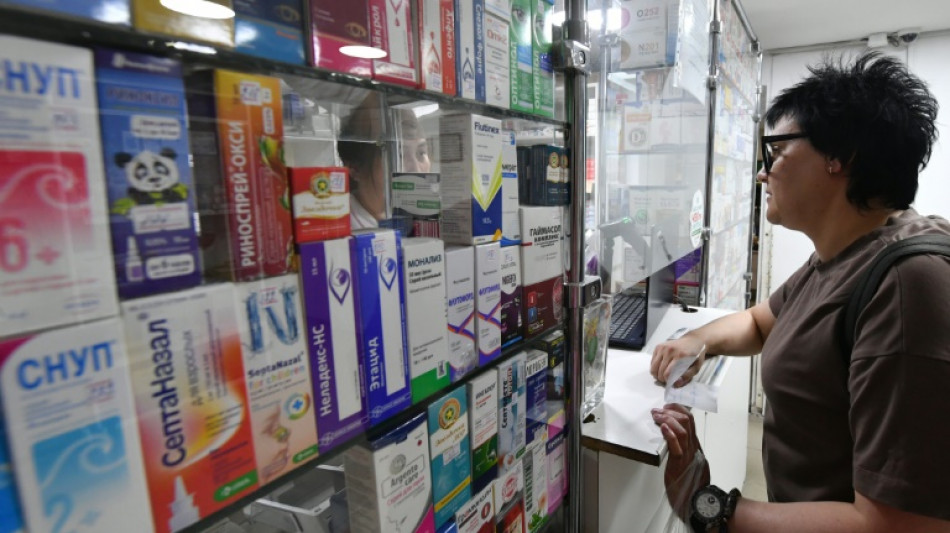
Kyrgyzstan struggles with deadly shortages of medicine / Photo: VYACHESLAV OSELEDKO - AFP

 Hungary detects invasive spotted lanternfly for first time in EU

 Forex Expo Dubai 2026 Breaks Guinness World Record Again With 23,816 Attendees

 Asian markets fall on US-China jitters as leaders meet
 As Moscow steps up attacks, Kyiv residents brace for harsh winter
 Markets mixed as China's Xi arrives for US talks

 Archaeological 'breakthrough' could confirm origins of Paris

 Australian PM says OpenAI hacked government health website

 Rio breaks record for rainiest September amid powerful El Nino
 Mandela Digital Extends Early Access Programme to 11 February 2027 Following Strong Response

 McDonald's to boost franchisees as inflation weighs on consumers
 Archaelogical 'breakthrough' could confirm origins of Paris
 Fendi brings disco bling, Italian style, to Milan Fashion Week
 アレックス・ボディ氏とシュテファン・ハウプト教授、ルーマニアの伝説的な美術コレクションをめぐり提携に合意
 Stocks dip, oil rises as traders eye chances of Iran deal

 Oil falls, stocks steady as Trump hails 'good' Iran talks

 Canada judge to decide prison term for suicide poison seller

 Meta leans into AI, smart glasses amid privacy pushback
 Oil prices fall after Trump hails 'good' talks with Iran

 AI political ads warp reality ahead of US midterms

 Oil prices retreat as markets welcome US-Iran talks
 French prosecutors probe secret filming of women with smart glasses

 Trump renames AI "super intelligence," rejects international oversight
 How is the EU approaching record fuel prices?

 11 hurt as teen opens fire outside school in western Turkey

 UN chief says 'Big Oil' treats atmosphere as open sewer
Like many people affected by serious illness in ex-Soviet Central Asia, Almagul Ibrayeva is having trouble finding medicine in her native Kyrgyzstan.
"Women are dying because of a lack of medicine," Ibrayeva, who is in her 50s, told AFP.
In remission from breast cancer, Ibrayeva needs a hormone treatment called exemestane after having a mastectomy and her reproductive organs were removed.
She said she "often" faces difficulties.
"I order it from Turkey or Moscow, where my daughter lives," she said.
"There are many medicines that are simply unavailable here. The patient has to look themselves and buy them."
- 'Meagre' supply of medicine -
Shortages, high prices and the poor quality of medicine affect many of the region's 80 million inhabitants.
The five Central Asian countries are highly dependent on pharmaceutical imports and patients are often left to fend for themselves.
There are often cases of expired or adulterated medicine such as the cough syrup imported from India which killed 69 children in Uzbekistan in 2023.
The costs of high-quality medicine are often prohibitive.
"Some people sell their homes, their livestock, get into debt just to survive," said Shairbu Saguynbayeva, a uterine cancer survivor.
She created a centre called "Together to Live" in the Kyrgyz capital Bishkek which hosts women who have cancer, offering accommodation and help for treatment.
"Here they can get organised. When someone is receiving chemotherapy, they fall ill, not every loved one can handle it," Saguynbayeva said.
Women at the centre sew and sell traditional Kyrgyz ornaments -- funding the treatment of 37 patients since 2019.
Saguynbayeva says she is grateful to the Kyrgyz state for "finally" starting to supply more medicine but says the quantity is still "meagre".
One patient, Barakhat Saguyndykova, told AFP that she received "free anti-cancer medicine only three times between 2018 and 2025".
At the National Oncology and Haematology Centre, doctor Ulanbek Turgunbaev said that sourcing medicine was "a very serious problem for patients" even though medicine supply has increased.
He said the best way of reducing therapy costs was "early detection" of serious illnesses.
- 'Better to save a mother' -
Material deficits and a shortage of 5,000 health professionals in Kyrgyzstan mean that the most urgent needs have to be addressed first.
President Sadyr Japarov has promised to eliminate corruption in the medical sector, which cost the health minister his job last winter.
While medicine factories have finally been opened, the situation in the short term remains complicated.
The Kyrgyz Chamber of Commerce and Industry said that "around 6,000 medicines could disappear from the market by 2026" because of the need to "re-register under the norms of the Eurasian Economic Union" -- a gathering of former Soviet republics including Kyrgyzstan.
The government in 2023 created a state company called Kyrgyz Pharmacy which is supposed to centralise medicine requests and bring down prices, according to its head, Talant Sultanov.
But the organisation has been under pressure because of a lack of results.
Sultanov said he hoped medicine prices could be lowered "by signing more long-term agreements with suppliers through purchases grouped on a regional basis" with other Central Asian countries.
Kyrgyz Pharmacy has promised steady supplies soon but many women in Bishkek are still waiting for medicine ordered through the company months ago.
Recently a mother of three "died simply because she did not receive her medicine in time," Saguynbayeva said.
"It is better to save a mother than to build orphanages," she said.
L.Peeters--CPN