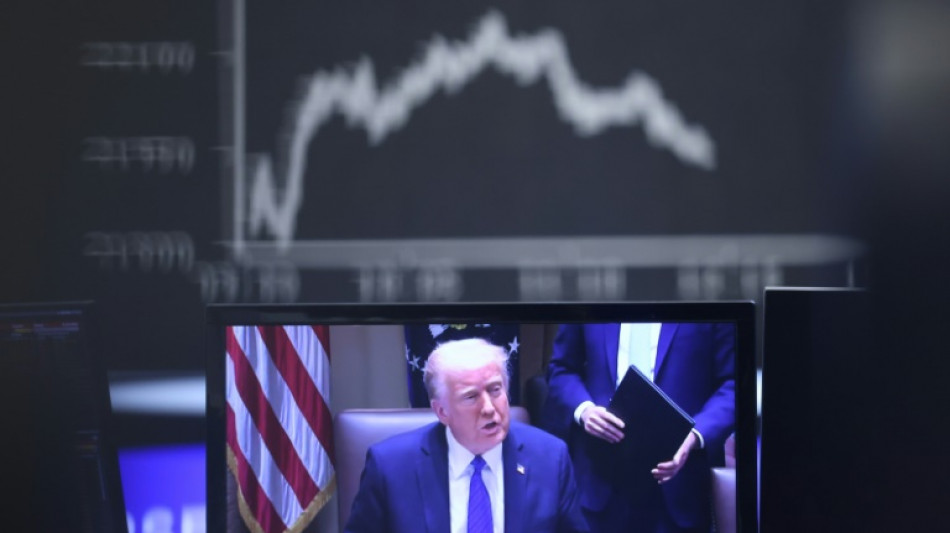
How can the EU respond to Trump tariffs? / Photo: Daniel ROLAND - AFP

 Kenya's economy faces climate change risks: World Bank

 AstraZeneca profit jumps as cancer drug sales grow

 Trump tariffs hurt French wine and spirits exports

 Back to black: Philips posts first annual profit since 2021

 'Family and intimacy under pressure' at Berlin film festival

 Unions rip American Airlines CEO on performance
 Three missing employees of Canadian miner found dead in Mexico
 Epstein accomplice Maxwell seeks Trump clemency before testimony

 Emergency measures kick in as Cuban fuel supplies dwindle under US pressure
 AI chatbots give bad health advice, research finds
 Bank of France governor Francois Villeroy de Galhau to step down in June

 Japan restarts world's biggest nuclear plant again
 'Want to go home': Indonesian crew abandoned off Africa demand wages
 Trump says China's Xi to visit US 'toward the end of the year'

 US astronaut to take her 3-year-old's cuddly rabbit into space

 Storm-battered Portugal votes in presidential election run-off

 De Beers sale drags in diamond doldrums

 Pakistan's capital picks concrete over trees, angering residents

 Chile's climate summit chief to lead plastic pollution treaty talks

 Opinions of Zuckerberg hang over social media addiction trial jury selection

 Dow surges above 50,000 for first time as US stocks regain mojo

 EU nations back chemical recycling for plastic bottles

 Stocks rebound though tech stocks still suffer

 German exports to US plunge as tariffs exact heavy cost

 'Mona's Eyes': how an obscure French art historian swept the globe

The EU has said "everything is on the table" as it readies its response -- including possibly targeting US Big Tech and taxing more American goods -- to President Donald Trump's sweeping new tariffs should talks with Washington fail.
The European Commission, in charge of the EU's trade policy, refuses to give any details on what its response to Trump's 20 percent tariffs starting April 9 could include.
But France, Germany and Austria have suggested targeting the biggest digital companies, including Google and Facebook owner Meta.
These are the options the 27-country European Union has been discussing:
- Tariffs -
When Trump hit steel and aluminium imports with a 25 percent tariff in March, the EU decided to take "an eye for an eye" approach.
Since his extra levies would affect around $28 billion of the EU's exports, Brussels opted to target US goods that are worth the same amount from mid-April, including Harley Davidson motorbikes as well as agricultural products like soybeans and meat.
Now the EU faces new tariffs of 20 percent announced by Trump this week, which has kickstarted another conversation inside the bloc about further retaliatory action.
"We will react in areas where it hurts the United States," a senior EU official said.
Officials have previously said the EU will target goods from politically important US states, including soybeans produced in Louisiana, the home of US Speaker Mike Johnson.
"We love soybeans, but we can get them from Brazil," the official said.
"We like Harley-Davidsons, but we also like MotoGuzzi. Or we can buy Yamaha. So, there are alternatives there and we are not hurting ourselves."
- Tech taxes? -
Although the commission has been coy about whether it has US Big Tech in its sights, France straight off the bat said the EU's targets could include American tech titans.
French government spokeswoman Sophie Primas said the EU could "attack" online services, "which are not taxed today but could be".
Economy Minister Robert Habeck echoed Primas, insisting "everything is on the table".
The United States had a surplus of 109 billion euros ($120 billion) in services in 2023 with the European Union.
US companies dominate in financial services including banks and card payment systems like Mastercard, and tech such as Amazon, Google, Meta and Microsoft.
"If they're going to go after our goods surplus, then we'll look at the services surplus," an EU official said.
Financial services could also be targeted, not just big tech, the official said.
"We're currently discussing it, and in such cases, the response must be made public as soon as it's decided," French Finance Minister Eric Lombard said on Friday.
"It's a signal to our American friends. But we're working on a package of responses that could go well beyond tariffs," he told France's BFMTV/RMC broadcaster.
- Trade tools -
An EU official refused to say what weapons Brussels would deploy against the United States but said the bloc is weighing whether to use the anti-coercion instrument.
First adopted in 2023 but never used, the weapon punishes any country using economic threats to exert pressure on the EU.
Initially created to counter any trade pressure from China, now it could help the EU with the United States.
And with this tool, the commission can act without the support of all EU states.
It would allow the EU to limit US companies' access to public procurement contracts in Europe, which France's Primas has already raised as a stick against Trump.
Officials believe targeting US firms with EU rules and taxation would not risk higher prices for the continent's consumers.
"We are prepared to implement firm, impactful but proportionate countermeasures," EU trade chief Maros Sefcovic said on Thursday.
The EU has so far maintained a unified stance against Trump's tariffs.
"Europe has everything it needs to make it through this storm. We are in this together," EU chief Ursula von der Leyen said.
A.Samuel--CPN