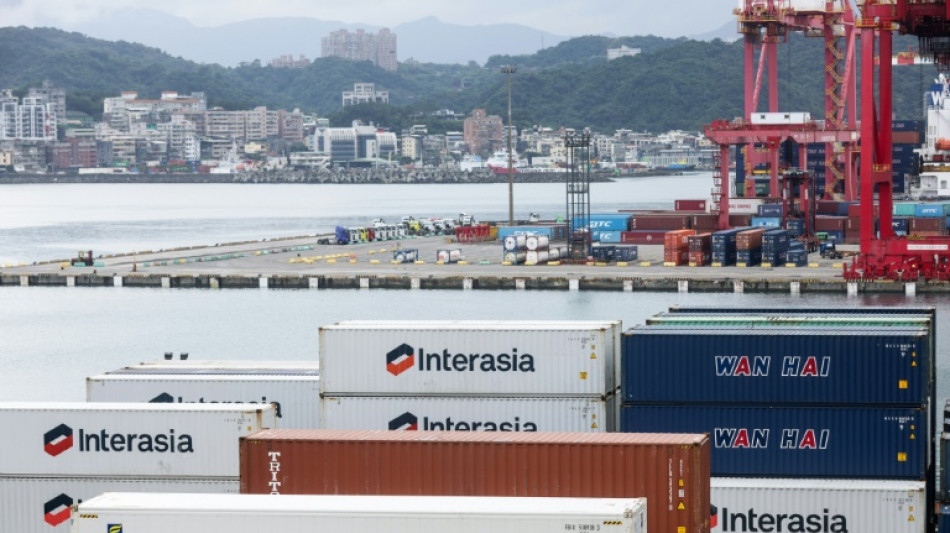
Taiwan earmarks $2.7 bn to help industries hit by US tariffs / Photo: I-Hwa CHENG - AFP

 Kenya's economy faces climate change risks: World Bank

 AstraZeneca profit jumps as cancer drug sales grow
 Trump tariffs hurt French wine and spirits exports

 Back to black: Philips posts first annual profit since 2021
 'Family and intimacy under pressure' at Berlin film festival
 Unions rip American Airlines CEO on performance
 Three missing employees of Canadian miner found dead in Mexico
 Epstein accomplice Maxwell seeks Trump clemency before testimony

 Emergency measures kick in as Cuban fuel supplies dwindle under US pressure
 AI chatbots give bad health advice, research finds
 Bank of France governor Francois Villeroy de Galhau to step down in June

 Japan restarts world's biggest nuclear plant again
 'Want to go home': Indonesian crew abandoned off Africa demand wages
 Trump says China's Xi to visit US 'toward the end of the year'

 US astronaut to take her 3-year-old's cuddly rabbit into space

 Storm-battered Portugal votes in presidential election run-off

 De Beers sale drags in diamond doldrums

 Pakistan's capital picks concrete over trees, angering residents
 Chile's climate summit chief to lead plastic pollution treaty talks
 Opinions of Zuckerberg hang over social media addiction trial jury selection
 Dow surges above 50,000 for first time as US stocks regain mojo

 EU nations back chemical recycling for plastic bottles
 Stocks rebound though tech stocks still suffer

 German exports to US plunge as tariffs exact heavy cost

 'Mona's Eyes': how an obscure French art historian swept the globe

Taiwan has earmarked $2.7 billion to help industries affected by US President Donald Trump's new tariffs, the government said Friday.
Taipei had sought to avoid Trump's threatened levies by pledging increased investment in the United States and more purchases of US energy, but it was still hit by a 32 percent tax on its imports, excluding semiconductor chips.
The government has described the tariffs as "unreasonable" and "extreme", and plans to seek negotiations with Washington in the hope of reducing their impact.
Announcing the NT$88 billion ($2.7 billion) assistance package, Premier Cho Jung-tai said the plan was to "address various needs of industries and society in the future."
Taiwan's trade surplus with the United States is the seventh highest of any country, reaching $73.9 billion in 2024.
Around 60 percent of Taiwan's exports to the United States are information and communications technology products, or ICT, which includes chips.
The government has argued that the surplus reflected soaring demand in the United States for Taiwan's semiconductors and other tech products, further driven by US tariffs and export controls targeting China that Trump imposed during his first term.
Cho told a news conference that the industrial and agricultural sectors would be the main targets of the assistance.
The funds will be used for financial support, reducing administrative costs, improving competitiveness, offering tax incentives and diversifying markets, he said.
Products expected to be hardest hit by Trump's tariffs include ICT, electronics, steel, metal and machinery, components and building materials.
Tea, orchids and fish are also likely to be hurt, Cho said, flagging a possible "shrinking consumer market or a weakening of our competitive advantage".
Vice Premier Cheng Li-chun told reporters the government had drawn up response measures based on a possible 25 percent tariff ahead of Trump's announcement.
"I must clarify that a 32 percent tariff falls under an extreme scenario," Cheng said.
"While we did run simulations based on it, that doesn't mean we consider it reasonable. In our view, it exceeds what would be a reasonable expectation -- it's neither reasonable nor fair."
Semiconductor chips, a sector that Taiwan dominates and has been a source of friction between Washington and Taipei, were excluded from Trump's levies.
However, analysts warned that tariffs on components would have a knock-on effect for the critical chip industry that is the lifeblood of the global economy.
Trump has accused Taiwan of stealing the US chip industry and recently threatened to impose tariffs of up to 100 percent on semiconductor imports from the island.
"Taiwan will lobby for exemption or at least see what Trump wants -- Trump wants something," Andrew Kam Jia Yi, an associate professor at the National University of Malaysia told AFP.
"(Trump) gives you the worst-case scenario then batters you down to a deal that you might not want but seems more reasonable than the original threat."
M.P.Jacobs--CPN