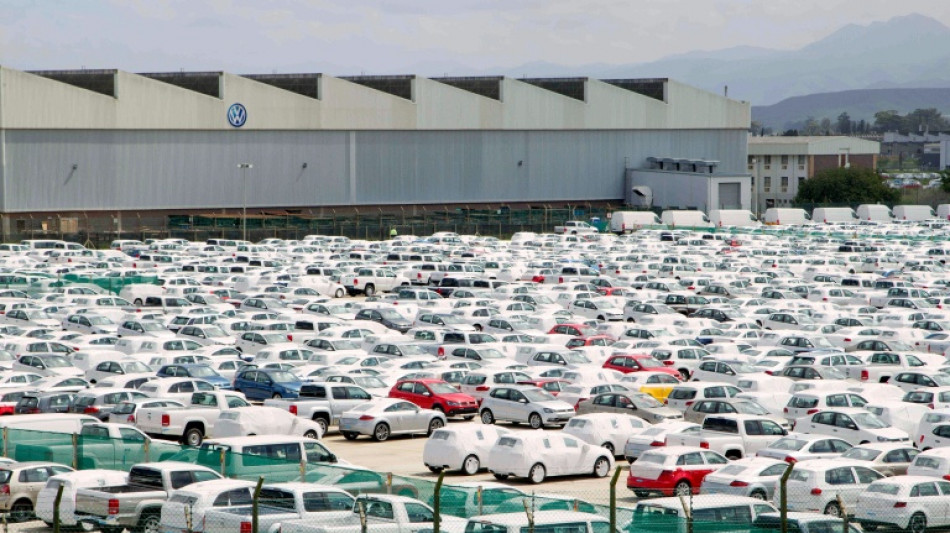
Trump threats to South Africa rattle automakers / Photo: Michael Sheehan - AFP/File

 Kenya's economy faces climate change risks: World Bank
 Deja vu? Trump accused of economic denial and physical decline
 Hungary winemakers fear disease may 'wipe out' industry

 'Stop the slaughter': French farmers block roads over cow disease cull
 Why SpaceX IPO plan is generating so much buzz
 World stocks mostly slide, consolidating Fed-fuelled gains

 UK's king shares 'good news' that cancer treatment will be reduced in 2026

 Salah admired from afar in his Egypt home village as club tensions swirl
 Iran frees child bride sentenced to death over husband's killing: activists
 France updates net-zero plan, with fossil fuel phaseout
 EU agrees recycled plastic targets for cars

 British porn star fined, faces imminent Bali deportation

 Indonesia floods were 'extinction level' for rare orangutans
 Japan bear victim's watch shows last movements
 French indie 'Clair Obscur' dominates Game Awards
 Asian markets track Wall St record after Fed cut

 Vaccines do not cause autism: WHO

 'In her prime': Rare blooming of palm trees in Rio

 OpenAI beefs up GPT models in AI race with Google

 Cyclone causes blackout, flight chaos in Brazil's Sao Paulo

 US bringing seized tanker to port, as Venezuela war threats build

 Time magazine names 'Architects of AI' as Person of the Year

 OpenAI, Disney to let fans create AI videos in landmark deal
 Thyssenkrupp pauses steel production at two sites citing Asian pressure

 Stocks mixed as US rate cut offset by Fed outlook, Oracle earnings

South Africa exports vehicles worth about $1.9 billion every year, many to the United States under a trade deal now in jeopardy as President Donald Trump piles pressure on the country.
"I don't think that South Africa has got a chance of the renewal" of the African Growth and Opportunity Act, said Neil Diamond, president of the South African Chamber of Commerce in the United States.
Known as AGOA, the trade deal offers preferential access to the US market for many African countries. The arrangement means Washington charges no tariffs on cars imported from South Africa.
That deal has bolstered the South African auto industry. Motor vehicles account for 22 percent of South Africa's exports to the United States, worth $1.88 billion -- behind only precious metals, according to government statistics.
Seven big automakers operate in South Africa: BMW, Ford, Isuzu, Mercedes-Benz, Nissan, Toyota and Volkswagen.
"It's half a million people that are employed in the industry, so right across the value chain," said Billy Tom, head of The Automotive Business Council, known as Naamsa.
AGOA is up for renewal in September 2025. If it lapses, the consequences in South Africa -- its biggest beneficiary -- could be disastrous.
"It would be a big impact in the sense that the United States is the third-biggest export market for us. And that market has grown over the years," Tom told AFP.
He estimates that 86,000 people have jobs thanks to AGOA, with another 125,000 people employed in related jobs as subcontractors or suppliers, often directly tied to auto plants.
"It will have a significantly detrimental effect on the supplier base, and over the long term, I think we could expect that the industry does not survive in South Africa," said Renai Moothilal, who heads the National Association of Automotive Component and Allied Manufacturers.
- Punitive measures -
South Africa has found itself in the White House's crosshairs, in part due to a recent land law.
Pretoria native Elon Musk, the world's richest man who's dominating Trump's inner circle, has lambasted "racist laws" and amplified conspiracy theories claiming -- without evidence -- that whites are being singled out for persecution.
South Africa's foreign policy has also pushed it away from Washington, as the country aligns with Russia and China and led the charges against Israel at the International Court of Justice.
"President Trump could cite the clause in the AGOA Act, which says that beneficiaries have to maintain, or their activities have to be in line with US security and foreign policy interests," said Richard Morrow, a researcher at the Brenthurst Foundation.
Former president Joe Biden, for example, removed the Central African Republic, Gabon, Niger and Uganda from AGOA benefits on January 1, 2024.
But Trump may just want to defend an industry that's close to his heart, Morrow said.
"Donald Trump has repeatedly used the automotive sector in America as a bellwether for the American economy," he told AFP. "It's traditionally a sector which is very blue-collar" and central to Trump's base.
It's not yet clear if Trump wants to "punish South Africa" or uses AGOA "as a means of threatening South Africa," Morrow said. Trump could also remove just the auto industry from AGOA benefits, while letting other industries benefit.
The irony is that most of the companies that would be affected are based in countries like Germany and Japan, close US allies, said Isaac Khambule, a professor of political economics at the University of Johannesburg.
The demographic of "people who own the majority of the businesses in South Africa" is largely aligned to the West, he told AFP.
The immediate damage from Trump's rhetoric is uncertainty, leaving businesses unsure of how or whether to invest, he said.
M.P.Jacobs--CPN