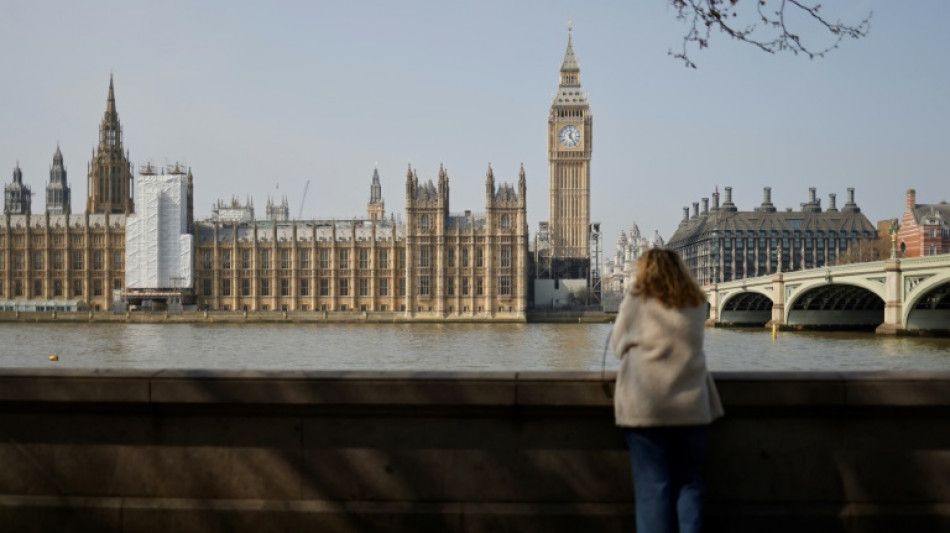
UK recession risk gathers pace as economy shrinks in March / Photo: Tolga Akmen - AFP/File

 Kenya's economy faces climate change risks: World Bank

 Deja vu? Trump accused of economic denial and physical decline

 Hungary winemakers fear disease may 'wipe out' industry

 'Stop the slaughter': French farmers block roads over cow disease cull

 Why SpaceX IPO plan is generating so much buzz
 World stocks mostly slide, consolidating Fed-fuelled gains

 UK's king shares 'good news' that cancer treatment will be reduced in 2026

 Salah admired from afar in his Egypt home village as club tensions swirl
 Iran frees child bride sentenced to death over husband's killing: activists
 France updates net-zero plan, with fossil fuel phaseout
 EU agrees recycled plastic targets for cars

 British porn star fined, faces imminent Bali deportation

 Indonesia floods were 'extinction level' for rare orangutans

 Japan bear victim's watch shows last movements

 French indie 'Clair Obscur' dominates Game Awards

 Asian markets track Wall St record after Fed cut

 Vaccines do not cause autism: WHO

 'In her prime': Rare blooming of palm trees in Rio

 OpenAI beefs up GPT models in AI race with Google

 Cyclone causes blackout, flight chaos in Brazil's Sao Paulo

 US bringing seized tanker to port, as Venezuela war threats build

 Time magazine names 'Architects of AI' as Person of the Year

 OpenAI, Disney to let fans create AI videos in landmark deal
 Thyssenkrupp pauses steel production at two sites citing Asian pressure
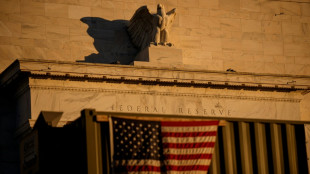 Stocks mixed as US rate cut offset by Fed outlook, Oracle earnings

Britain's economy shrank in March on fallout from soaring inflation, increasing the prospect of the country falling into recession.
Official first-quarter data on Thursday showed that following solid output in January, the UK economy posted zero growth the following month and contracted by 0.1 percent in March.
It comes after the Bank of England (BoE) last week warned that Britain risks falling into recession with UK inflation expected to top 10 percent, a four-decade high, by the end of the year.
Consumer prices are surging worldwide on supply strains as economies reopen from pandemic lockdowns -- and in the wake of the Ukraine war that is aggravating already high energy costs.
Britain's economy grew 0.8 percent overall in the January-March period, the slowest quarterly growth for a year, the Office for National Statistics (ONS) said in a statement.
It compared with gross domestic product expansion of 1.3 percent in the fourth quarter of last year.
- 'Russia disruption' -
Responding to Thursday's data, finance minister Rishi Sunak said Britain's economic recovery from the pandemic was "being disrupted by (Russian President Vladimir) Putin's barbaric invasion of Ukraine and other global challenges".
Sunak, however, added in a statement that UK "growth in the first few months of the year was strong, faster than the US, Germany and Italy".
The UK economy grew for a fourth quarter in a row, and is above pre-pandemic levels.
Prime Minister Boris Johnson said he expected British growth to "return very strongly in the next couple of years".
In an interview with LBC radio, he also refused to rule out a windfall tax on energy companies as surging oil and gas prices hit households hard.
"We'll have to look at it," said Johnson despite repeating his displeasure at such a levy.
"I don't like them... I don't think they're the right way forward," he said, adding that a windfall tax on the likes of BP and Shell would deter them from investing in greener energy.
Johnson's comments came one week after his Conservative party lost control of key councils in local elections -- an outcome blamed in part on the cost-of-living crisis.
Darren Morgan, director of economic statistics at the ONS, said declining output in the services and production sectors resulted in overall growth contracting in March.
- 'Recession risk' -
"The risk of recession has just risen," said Paul Dales, chief UK economist at Capital Economics.
He noted that the GDP figures "suggest the economy had less momentum than we thought even before the full hit from the cost-of-living crisis has been felt".
Dales said "strong price pressures will probably mean the BoE will raise interest rates further".
The central bank last week raised its main interest rate by a quarter point to one percent to tackle runaway UK inflation.
It was the fourth straight increase by the BoE, while its key rate now stands at the highest level since the global financial crisis in 2009.
Raised rates have lifted borrowing costs for consumers and businesses, further impacting spending.
D.Philippon--CPN