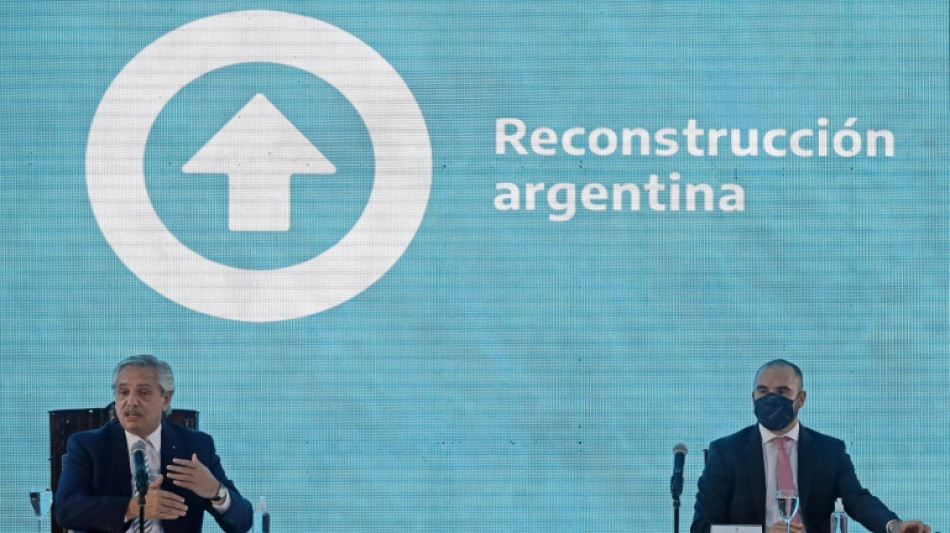
Argentina president announces new debt deal with IMF

 Lights out in Laos as electricity exports surge

 Steven Strogatz weighs AI mathematics advances and their consequences for researchers

 Anthropic boss calls for AI slowdown, Altman and Musk agree

 French IT giant Capgemini sells subsidiary after row over ICE links

 Quebec Brokerage Qubit Insurance Announces New Data on Coverage Shortfalls as Rebuilding Costs Rise

 Lady Gaga welcomes first child with fiance: US media

 Bhutan business bets on hazelnuts for farming future

 'Widow's Bay' and 'The Pitt' are favorites for Emmys night

 Coastal erosion forces cancellation of California music festival

 Argentina's Dirty War rears its head in Venice film

 UK lawmakers throw out bill to legalise assisted dying

 US inflation steady in August, fueling Fed rate hike expectations

 New York marks 25th anniversary of 9/11 attacks

 Nepal flood reconstruction bill to be $4.78 bn: foreign ministry

 JUMO and Standard Bank launch Social Finance Framework to scale inclusive finance in Africa

 Doomsday tech: could AI really kill us all?

 French comedy show 'Call my agent' makes film comeback

 It's all coming back: Celine Dion fans gear up for Paris return

 Researchers eye AI revolution in natural disaster forecasts

 US braces for inflation report that may push Fed to hike rates

 Musk threatens legal action over documentary

 Latin America fact-check group asks Meta not to replace verification practice

 AI Risks to Enter 60–80% of Liability and Cyber Insurance Underwriting by 2028, ScienceSoft Predicts

 Tribal Launches Campfire, Letting Business and Technical Teams Build on Salesforce Together

 Stocks fall as fresh oil surge fans inflation fears

Argentine President Alberto Fernandez unveiled what he called a "reasonable" new debt repayment deal with the International Monetary Fund on Friday, the day a $700-million repayment was due.
The South American country was due this year to pay back $19 billion of its $44-billion debt to the IMF.
"Compared to previous ones Argentina signed, this deal does not include restrictions that would delay our development," said Fernandez.
Under the previous deal, Argentina would have to repay $19 billion this year, $20 billion next year and another $4 billion in 2024.
As well as Friday's sum, another $370 million needed to be paid on Tuesday.
The center-left government had repeatedly said the repayment schedule was unsustainable given their lack of reserves, and was pushing to restructure the timetable.
"We had an unpayable debt that left us without present or future, and now we have a reasonable deal that will allow us to grow (the economy) and fulfill our obligations throughout our growth," said Fernandez.
"This understanding plans to sustain the economic recovery that has already begun."
Fernandez said the deal crucially would not force the government to reduce public spending and would allow it to increase investment in public works.
Under the new deal, Argentina has committed to progressively reducing its fiscal deficit from three percent in 2021 to just 0.9 percent in 2024, Economy Minister Martin Guzman said.
The gradual reduction -- to 2.5 percent in 2022 and 1.9 percent in 2023 -- would "not prevent the recovery" of the economy, said Guzman.
It would also allow for public spending to evolve "without an adjustment."
Fernandez's liberal predecessor Mauricio Macri originally agreed a $57-billion loan with the IMF in 2018, but when his successor took office a year later, Fernandez refused to accept the final $13-billion disbursement.
After successfully restructuring a $66-billion debt with private international creditors in 2020, Argentina began negotiations with the IMF to delay repayments.
The country experienced three years of recession until registering a 10 percent increase in GDP in 2021, although the economy had shrunk by as much the previous year as it suffered the worst effects of the coronavirus pandemic.
M.P.Jacobs--CPN