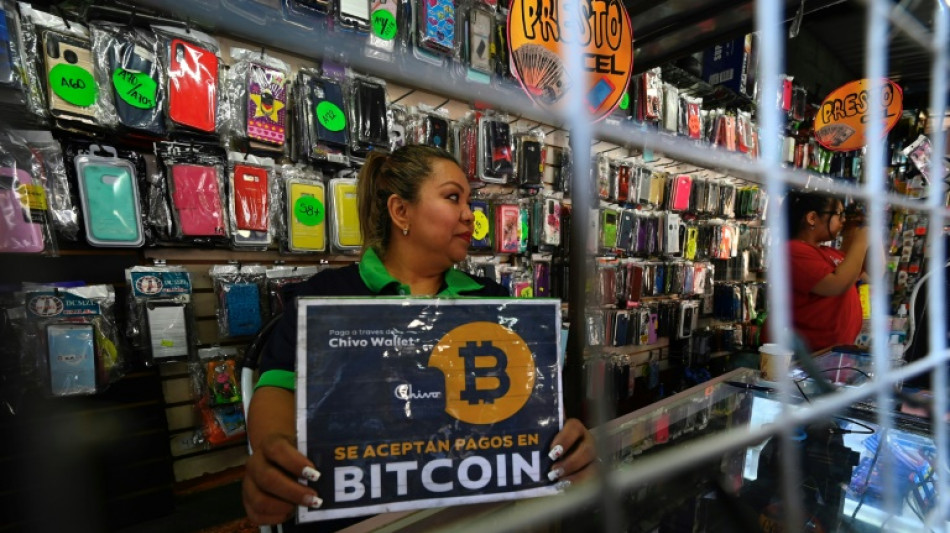
Salvadorans show support for bitcoin despite IMF criticism

 Lights out in Laos as electricity exports surge

 Steven Strogatz weighs AI mathematics advances and their consequences for researchers

 Anthropic boss calls for AI slowdown, Altman and Musk agree

 French IT giant Capgemini sells subsidiary after row over ICE links

 Quebec Brokerage Qubit Insurance Announces New Data on Coverage Shortfalls as Rebuilding Costs Rise

 Lady Gaga welcomes first child with fiance: US media

 Bhutan business bets on hazelnuts for farming future

 'Widow's Bay' and 'The Pitt' are favorites for Emmys night

 Coastal erosion forces cancellation of California music festival

 Argentina's Dirty War rears its head in Venice film

 UK lawmakers throw out bill to legalise assisted dying

 US inflation steady in August, fueling Fed rate hike expectations

 New York marks 25th anniversary of 9/11 attacks

 Nepal flood reconstruction bill to be $4.78 bn: foreign ministry

 JUMO and Standard Bank launch Social Finance Framework to scale inclusive finance in Africa

 Doomsday tech: could AI really kill us all?

 French comedy show 'Call my agent' makes film comeback

 It's all coming back: Celine Dion fans gear up for Paris return

 Researchers eye AI revolution in natural disaster forecasts

 US braces for inflation report that may push Fed to hike rates

 Musk threatens legal action over documentary

 Latin America fact-check group asks Meta not to replace verification practice

 AI Risks to Enter 60–80% of Liability and Cyber Insurance Underwriting by 2028, ScienceSoft Predicts

 Tribal Launches Campfire, Letting Business and Technical Teams Build on Salesforce Together

 Stocks fall as fresh oil surge fans inflation fears

Karen Hernandez sells mobile phone accessories in El Salvador and says business has been through the roof since the country started using bitcoin as legal tender.
She hopes President Nayib Bukele will ignore calls from the International Monetary Fund to drop use of the cryptocurrency.
"It has been a very, very good experience and increased (our sales). It has taken us to another level of business," the 45-year-old shopkeeper told AFP.
She owns a small store in the historic center of the capital, San Salvador, where many handmade signs announce "we accept bitcoin."
The government created a digital wallet called Chivo that lets users make and receive payments with both bitcoin and the US dollar, which the Central American country adopted in 2001 to help ensure monetary stability.
Bitcoin has been legal tender since September 2021.
- E-wallet training -
In the crowded streets of the capital, restaurants, hardware stores, pharmacies and even street vendors accept payment in the cryptocurrency.
Elizabeth Arevalo, 25, works at a computer store in an old building and teaches customers how to navigate the Chivo wallet so they can use it in her store.
"We give the customers a little orientation on how to use the wallet... Once they learn how to use it, they buy something from us. It's a win-win situation," Said Arevalo.
Not everyone has jumped on the bandwagon, though.
"I couldn't care less if they ditch bitcoin or not, there's no benefit to me, I only work with the dollar, I don't accept bitcoin," said banana seller Antonio Molina.
- 'Large risks' -
On Tuesday, the IMF called on El Salvador to stop using bitcoin as legal tender.
The IMF's board warned "there are large risks associated with the use of bitcoin on financial stability, financial integrity and consumer protection," as well as with issuing bitcoin-backed bonds.
Bukele responded on Twitter with a meme from The Simpsons that said: "I see you IMF. That's very nice."
Since coming to power in June 2019, his government has purchased 1,630 bitcoins with public funds.
Last year he also announced new bitcoin bonds worth $1 billion.
Juan Carlos Perez, 40, who runs a technology and perfume store in San Salvador, says he uses bitcoin in both his personal and professional life.
"There are risks, I know that... vulnerability in the exchange rate, (no) financial market controlling it. But it's practical," said Perez as he checked the Chivo app on his telephone.
- 'Fragility' -
El Salvador's government is trying to negotiate a $1.3 billion loan with the IMF, which it needs to also secure other loans.
And its stance on bitcoin has not helped.
"The logical thing would be for the El Salvador government to understand the fragility of its situation," said economist Luis Membreno.
He said El Salvador's financial health "revolves around this deal" with the IMF as it also hopes to secure loans of $400 million each from the World Bank and Inter-American Development Bank, and $200 million from the Central American Bank for Economic Integration.
All those loans are subject to the IMF agreement, Membreno said.
Despite its criticism, the IMF board did acknowledge that the use of cryptocurrencies could widen access to banking services in El Salvador.
Bukele "is not going to back down from a personal project of that magnitude," Membreno said.
"It seems that it (bitcoin) can provide financial inclusion, but you should not do it. The future does not wait for anyone #Bitcoin," Zelaya wrote on Twitter.
M.Anderson--CPN