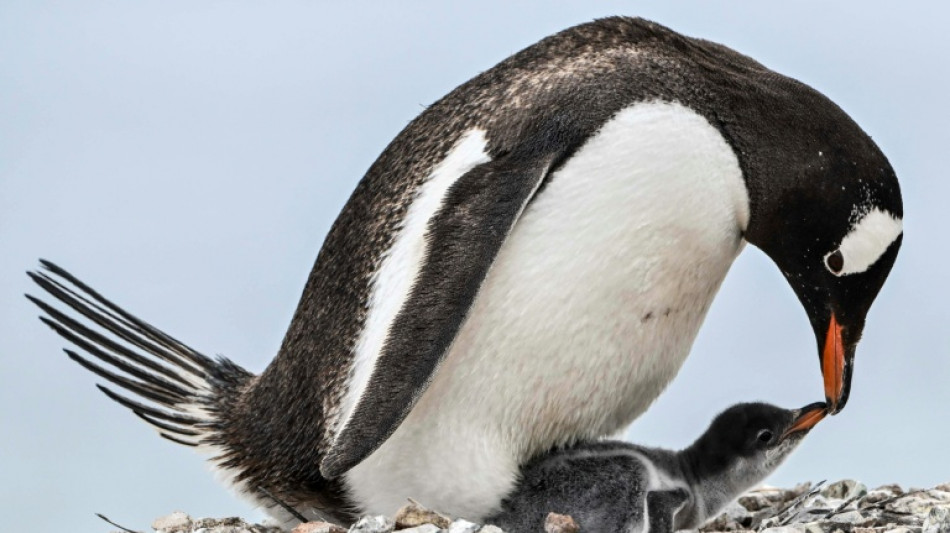
Penguins bring forward breeding season as Antarctica warms: study / Photo: JUAN BARRETO - AFP/File

 AI 'warning shots' focus Beijing on national security risks

 Philippine tribe in limbo over US-led tech hub

 Saudi-led coalition says Houthis fired ballistic missile at Riyadh

 Cuba works to restore power after another blackout

 Brigitte Bardot widower slams sale of star's belongings

 Indonesia accepts Malaysia's help to tackle wildfires

 Nvidia, OpenAI CEOs to attend Xi dinner at White House

 Cuba hit with seventh major blackout of the year

 Nigeria miners struggled to breathe in cell before 37 died: survivors

 Warren Buffett steps down as Berkshire Hathaway chairman

 Isolated Syrian-Druze city blames Damascus for shortages

 Kerry James Marshall: American 'blackness' painter celebrated in Europe

 Infantino 'must go', says German FA vice-president

 Japan's busiest rail station tests robot bins

 Backpackers fret over Australian visa crackdown

 Bank of Japan hikes rates to 31-year high to battle inflation

 AI doomsday warnings unlikely to slow IPOs but questions linger

 In Brazil's Amazon, the hunt for oil fuels hopes and fears

 Baby orangutans in India expose 'frightening' scale of trafficking

 Oversight Board blasts 'inadequate' Meta safeguards for AI deepfakes

 Harry makes first public appearance since return to UK

 Princess Diana's brother makes new explosive claims against Charles

 Trump admin overhauls key protection for endangered species

 Mbappe draws political fire over Ceuta t-shirt controversy

 Third malaria death in Germany from outbreak tied to Frankfurt airport

Penguins are bringing forward their breeding season at record rates as Antarctica rapidly warms due to climate change, according to research published by a global team of scientists on Tuesday.
The unprecedented shift observed over a decade in penguin breeding patterns was "highly correlated" with rising temperatures on the frozen continent, said the study's lead author Ignacio Juarez Martinez.
Penguin breeding is closely linked to food availability, and less sea ice has meant hunting grounds and nesting sites are more available during the year.
Scientists observing penguin populations in Antarctica had expected breeding to occur a little earlier but were "very surprised both by the scale and the speed of the advance", Martinez told AFP.
"The scale is so great that penguins in most areas are now breeding earlier than in any historical records," said Martinez, a scientist from the University of Oxford and Oxford Brookes University.
For this study, scientists observed nesting zones of Gentoo, Chinstrap and Adelie penguins between 2012 and 2022 using dozens of time-lapse cameras placed at colonies across Antarctica.
Gentoo penguins demonstrated the greatest change with the timing of their breeding season brought forward 13 days over the decade -- and up to 24 days in some colonies.
This is the fastest change in breeding season observed in any bird -- and possibly vertebrate -- to date, the scientists said.
Adelie and Chinstrap penguins also advanced their breeding season by an average of 10 days.
The findings were published in the Journal of Animal Ecology.
- Winners and losers -
Antarctica is one of the fastest-warming regions in the world and annual average temperatures there reached record highs last year, the EU climate monitor Copernicus said this month.
The exact mechanisms by which rising temperatures affect penguin behaviour are not yet fully understood by scientists.
The three species traditionally staggered their breeding seasons but the earlier timing was likely causing an overlap, increasing competition for food and snow-free nesting space.
This was better news for Gentoos -- natural foragers suited to more temperate conditions -- and less so for Chinstrap and Adelie penguins.
"We have already seen Gentoos take nests that were previously occupied by Adelies or Chinstraps," said Martinez.
Gentoo numbers are already expanding in a milder Antarctica while Chinstrap and Adelie penguins, more dependent on krill -- tiny shrimp-like creatures on which they feed -- and specific ice conditions, are declining.
"As penguins are considered 'a bellwether of climate change', the results of this study have implications for species across the planet," Fiona Jones, a co-author of the study from Oxford University, said in a statement.
Martinez said it was "too early to tell" if this adaptation was beneficial or if penguins were being forced to make drastic changes that could affect their breeding success.
"We are now studying their ability to raise chicks of each species. If they maintain a high number of chicks, that will mean this is a good news and they are indeed adapting to climate change," he said.
L.K.Baumgartner--CPN
