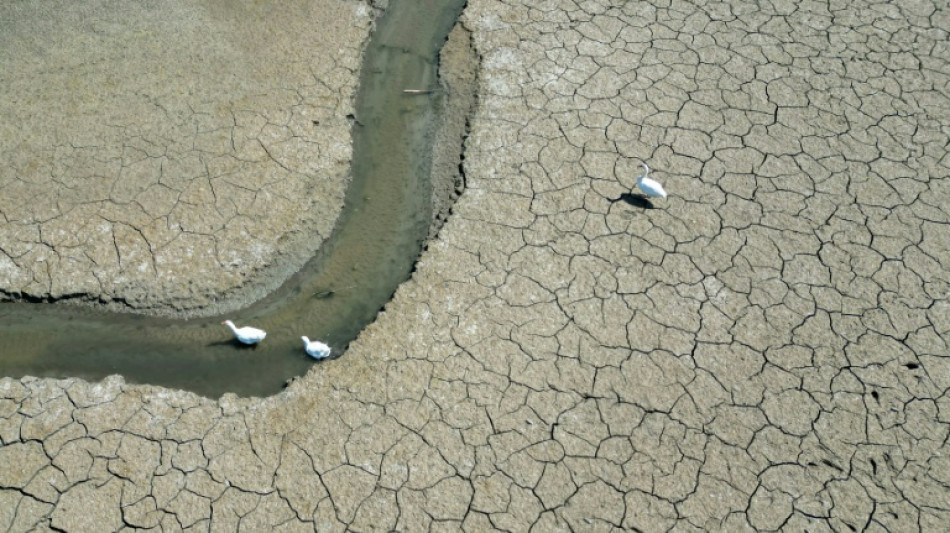
2025 on track to tie second hottest year on record: EU monitor / Photo: Nicolas TUCAT - AFP/File

 France's Macron, Canada's Carney announce closer ties

 AI 'warning shots' focus Beijing on national security risks

 Philippine tribe in limbo over US-led tech hub

 Saudi-led coalition says Houthis fired ballistic missile at Riyadh

 Cuba works to restore power after another blackout

 Brigitte Bardot widower slams sale of star's belongings

 Indonesia accepts Malaysia's help to tackle wildfires

 Nvidia, OpenAI CEOs to attend Xi dinner at White House

 Cuba hit with seventh major blackout of the year

 Nigeria miners struggled to breathe in cell before 37 died: survivors

 Warren Buffett steps down as Berkshire Hathaway chairman

 Isolated Syrian-Druze city blames Damascus for shortages

 Kerry James Marshall: American 'blackness' painter celebrated in Europe

 Infantino 'must go', says German FA vice-president

 Japan's busiest rail station tests robot bins

 Backpackers fret over Australian visa crackdown

 Bank of Japan hikes rates to 31-year high to battle inflation

 AI doomsday warnings unlikely to slow IPOs but questions linger

 In Brazil's Amazon, the hunt for oil fuels hopes and fears

 Baby orangutans in India expose 'frightening' scale of trafficking

 Oversight Board blasts 'inadequate' Meta safeguards for AI deepfakes

 Harry makes first public appearance since return to UK

 Princess Diana's brother makes new explosive claims against Charles

 Trump admin overhauls key protection for endangered species

 Mbappe draws political fire over Ceuta t-shirt controversy

The planet is on track to log its second hottest year on record in 2025, tied with 2023 after a historic high in 2024, Europe's global warming monitor said Tuesday.
The data from the Copernicus Climate Change Service reaffirms that global temperatures are on course to exceed 1.5C above pre-industrial levels -- the threshold considered safer in the 2015 Paris Agreement.
Temperatures rose by 1.48C on average between January and November, or "currently tied with 2023 to be the second-warmest year on record", according to the service's monthly update.
"The three-year average for 2023–2025 is on track to exceed 1.5C for the first time," Samantha Burgess, strategic lead for climate at Copernicus, said in a statement.
"These milestones are not abstract –- they reflect the accelerating pace of climate change and the only way to mitigate future rising temperatures is to rapidly reduce greenhouse gas emissions," Burgess said.
UN Secretary-General Antonio Guterres warned in October that the world would not be able to contain global warming below 1.5C in the next few years.
Last month was the third warmest November on record at 1.54C above pre-industrial levels, according to Copernicus, with the average surface air temperature reaching 14.02C.
Such incremental rises may appear small but scientists warn that is already destabilising the climate and making storms, floods and other disasters fiercer and more frequent.
"The month was marked by a number of extreme weather events, including tropical cyclones in Southeast Asia, causing widespread, catastrophic flooding and loss of life," the monitor said.
- Fossil fuel fight -
The Philippines were ravaged by back-to-back typhoons that killed some 260 people in November, while Indonesia, Malaysia and Thailand were hit by massive floods.
The global average temperature for the northern hemisphere autumn, from September to November, was also the third highest on record after 2023 and 2024.
"Temperatures were mostly above average across the world and especially in northern Canada, over the Arctic Ocean, and across Antarctica," the monitor said, adding that there were notable cold anomalies in northeastern Russia.
Copernicus takes its measurements using billions of satellite and weather readings, both on land and at sea, and their data extends back to 1940.
Global temperatures have been stoked ever higher by humanity's emissions of planet-heating gases, largely from fossil fuels burned on a massive scale since the industrial revolution.
Nations agreed to transition away from fossil fuels at the UN's COP28 climate summit in Dubai in 2023 but ambitions have stalled since then.
The COP30 climate conference in Belem, Brazil, concluded last month with a deal that avoided a new, explicit call to phase out oil, gas and coal following objections from fossil fuel-producing countries.
A.Levy--CPN
