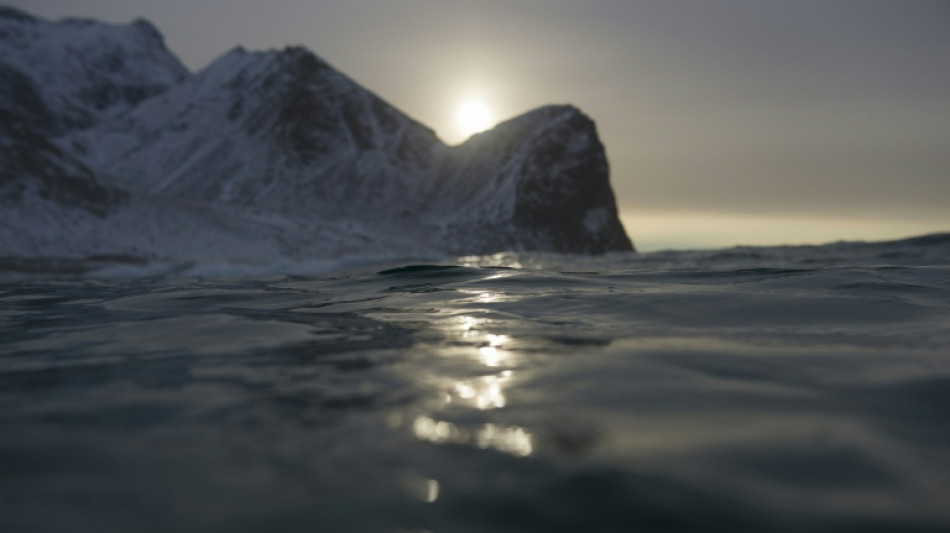
Norway postpones deep-sea mining activities for four years / Photo: OLIVIER MORIN - AFP/File

 France's Macron, Canada's Carney announce closer ties
 AI 'warning shots' focus Beijing on national security risks

 Philippine tribe in limbo over US-led tech hub

 Saudi-led coalition says Houthis fired ballistic missile at Riyadh

 Cuba works to restore power after another blackout

 Brigitte Bardot widower slams sale of star's belongings

 Indonesia accepts Malaysia's help to tackle wildfires

 Nvidia, OpenAI CEOs to attend Xi dinner at White House

 Cuba hit with seventh major blackout of the year

 Nigeria miners struggled to breathe in cell before 37 died: survivors

 Warren Buffett steps down as Berkshire Hathaway chairman

 Isolated Syrian-Druze city blames Damascus for shortages

 Kerry James Marshall: American 'blackness' painter celebrated in Europe

 Infantino 'must go', says German FA vice-president

 Japan's busiest rail station tests robot bins

 Backpackers fret over Australian visa crackdown

 Bank of Japan hikes rates to 31-year high to battle inflation

 AI doomsday warnings unlikely to slow IPOs but questions linger

 In Brazil's Amazon, the hunt for oil fuels hopes and fears

 Baby orangutans in India expose 'frightening' scale of trafficking

 Oversight Board blasts 'inadequate' Meta safeguards for AI deepfakes

 Harry makes first public appearance since return to UK

 Princess Diana's brother makes new explosive claims against Charles

 Trump admin overhauls key protection for endangered species

 Mbappe draws political fire over Ceuta t-shirt controversy

Norway on Wednesday postponed the first licences to permit deep-sea mining in its Arctic waters for four years, a delay environmentalists hope signals the "nail in the coffin" of the plans.
The country was the first in Europe aiming to commence the practice in its waters, but following thorny negotiations, Norway's minority Labour government clinched a deal with small political allies that secures a majority for its 2026 budget in exchange for the postponement.
The government agreed "not to launch the first tenders for deep-sea mining during the current legislative term", which ends in 2029, according to a deal that received the support of two key parties in the early hours of Wednesday.
"This must be the nail in the coffin for the deep sea mining industry in Norway," said Greenpeace deep sea mining campaigner Haldis Tjeldflaat Helle.
"Any government that is committed to sustainable ocean management cannot support deep-sea mining," she said in a statement.
Deep-sea mining is an emerging industry that aims to plumb previously untouched seabeds for commodities including nickel, cobalt and copper, which are used in everything from rechargeable batteries to military technology.
Groups like the World Wildlife Fund (WWF) and Greenpeace oppose the practice, saying it poses a threat to pristine ecosystems on the sea floor, while the European Parliament has called for an international moratorium.
The Norwegian government has meanwhile insisted on the need to end the world's dependence on countries like China for the minerals needed for the green transition.
According to an official 2023 assessment, Norway's seabed is believed to contain 38 million tonnes of copper and 45 million tonnes of zinc, as well as "significant" rare earth elements.
- 'Very detrimental' decision -
Norway's parliament gave the green light in 2024 for the start of deep-sea mining activities in its territorial waters.
The government had planned to start issuing exploration licences in 2025, arguing that prospecting was necessary to gain much-needed knowledge of the seabed.
But small parties that provide the government key backing in parliament to pass legislation opposed the move.
To pass the 2026 budget, which parliament is due to vote on this Friday, the Labour government once again bowed to the demands of its allies in parliament to suspend deep-sea mining activities.
Early on Wednesday, the two remaining holdout parties said they would support the budget project, which is conditioned on the deep-sea mining delay provision.
The WWF hailed the move as "a massive win for nature".
"This decision represents a significant shift in Norway's position and is a historic victory for nature, science, and public pressure," it said.
Industrial actors that had been chomping at the bit to start exploration meanwhile regretted what they said was a "very detrimental" decision.
"Actors counting on deep-sea minerals may be forced to turn to international projects while waiting for more predictable political conditions" in Norway, Egil Tjaland, secretary general of the Norwegian Forum for Marine Minerals, told AFP.
The head of the start-up Adepth Minerals, Anette Broch Mathisen Tvedt, said it was "concerning that small parties dictate Norway's future and jeopardise strategically important industries".
Other deep-sea mining projects exist elsewhere in the world.
The Cook Islands, in cooperation with China, awarded exploration licences to three companies in 2022.
And The Metals Company in Canada wants to exploit international waters in the Pacific Ocean without the approval of the International Seabed Authority (ISA), relying on a US law reinstated by President Donald Trump.
Ng.A.Adebayo--CPN
