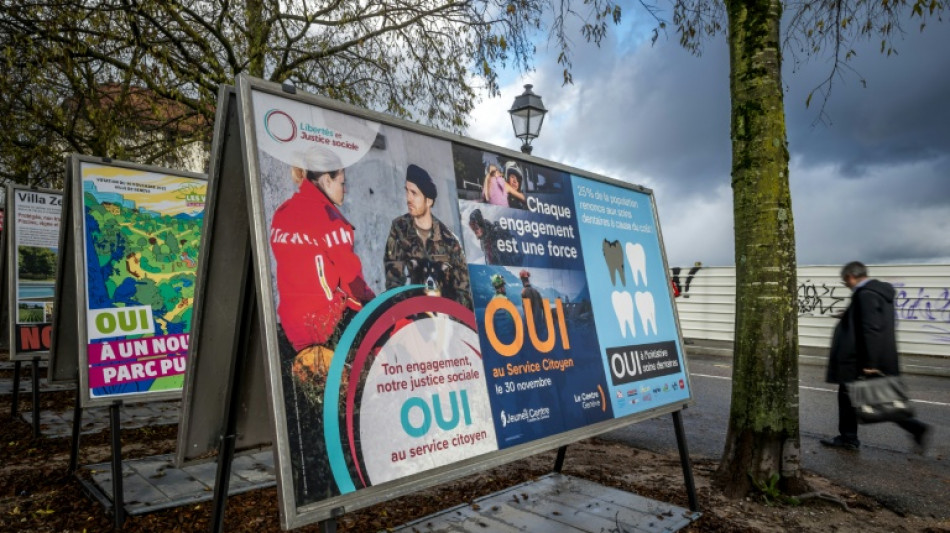
Swiss reject compulsory civic duty, climate tax for super-rich: projections / Photo: Fabrice COFFRINI - AFP

 France's Macron, Canada's Carney announce closer ties

 AI 'warning shots' focus Beijing on national security risks

 Philippine tribe in limbo over US-led tech hub
 Saudi-led coalition says Houthis fired ballistic missile at Riyadh

 Cuba works to restore power after another blackout

 Brigitte Bardot widower slams sale of star's belongings

 Indonesia accepts Malaysia's help to tackle wildfires
 Nvidia, OpenAI CEOs to attend Xi dinner at White House

 Cuba hit with seventh major blackout of the year

 Nigeria miners struggled to breathe in cell before 37 died: survivors

 Warren Buffett steps down as Berkshire Hathaway chairman

 Isolated Syrian-Druze city blames Damascus for shortages

 Kerry James Marshall: American 'blackness' painter celebrated in Europe

 Infantino 'must go', says German FA vice-president

 Japan's busiest rail station tests robot bins

 Backpackers fret over Australian visa crackdown

 Bank of Japan hikes rates to 31-year high to battle inflation

 AI doomsday warnings unlikely to slow IPOs but questions linger

 In Brazil's Amazon, the hunt for oil fuels hopes and fears

 Baby orangutans in India expose 'frightening' scale of trafficking

 Oversight Board blasts 'inadequate' Meta safeguards for AI deepfakes

 Harry makes first public appearance since return to UK

 Princess Diana's brother makes new explosive claims against Charles

 Trump admin overhauls key protection for endangered species

 Mbappe draws political fire over Ceuta t-shirt controversy

Swiss voters looked set Sunday to reject a proposal to replace the current men-only military conscription with a compulsory civic duty for all and another on taxing the super-rich to fund the climate fight.
Early projections after polls closed at noon (1100 GMT) indicated that voters had overwhelmingly rejected the two initiatives, which had generated significant discussion in the wealthy Alpine nation.
The so-called Civic Duty initiative, which called for requiring every Swiss citizen, regardless of gender, to do national service in the army or in a civilian capacity, was projected by public broadcaster SSR to be snubbed by a whopping 84 percent of voters.
The 'no' vote on the second item on Sunday's ballot, the "initiative for a future" calling for a new climate tax on big inheritances, was meanwhile projected to tick in at 79 percent, SSR said.
The projections were not surprising, with recent opinion polls suggesting the proposals had little chance of passing.
The Swiss government and parliament had also come out against both items, arguing that they would entail huge costs and could threaten the economy.
- 'True equality' -
The committee behind the Civic Duty initiative had maintained that requiring men and women alike to serve the nation would strengthen social cohesion.
The initiative aims for "true equality", committee head Noemie Roten told AFP before the vote.
She described the current system as discriminatory -- for men, but also for women, who are largely excluded from useful networks and experiences obtained during service.
Opponents of the initiative had denied it would enhance equality, pointing out that women already accounted for the vast majority of unpaid tasks in Swiss society.
"And now you are asking women to provide even more unpaid service. This would only exacerbate the imbalance," Cyrielle Huguenot, head of equality, family and migration issues at the Swiss Trade Union Federation (USS), told AFP before the vote.
The government had echoed that argument, and also insisted that doubling the number of recruits would far outstrip the needs, and estimating it would double the costs of Switzerland's current conscription system.
As the results began flooding in Sunday, Roten told SSR's French-language station RTS that she was "proud" to have helped "put fundamental questions on the table".
She pointed out that it can take time in Switzerland for big societal projects to gain ground, pointing to the first effort to push through women's right to vote, which was rejected by 67 percent of voters in 1959, only to finally pass by nearly 66 percent in 1971.
"The idea of a civic duty is not dead with today's vote. It will continue and I think it will win out in coming decades," she said.
- 'Hold-up' -
The "initiative for a future", put forward by the youth wing of Switzerland's Socialist Party, had meanwhile called for a 50-percent inheritance tax on fortunes above 50 million Swiss francs ($63 million) -- estimated to affect some 2,500 households.
Under the slogan "tax the rich, save the climate", the group calculated that the levy would rake in six billion Swiss francs annually, which could go towards funding an ecological transformation of Switzerland's economy through things like renovating buildings, developing renewable energy and expanding public transportation.
A massive opposition campaign had warned that very wealthy people might leave the country to avoid the tax, weakening the economy.
People inheriting family businesses might also be hurt, critics caution.
"The population understood that taking 50 percent of an inheritance would not be a tax, but a hold-up by the state," Johanna Gapany, a parliamentarian with the Liberals, told RTS Sunday.
Clarence Chollet, a parliamentarian with the Greens, meanwhile said the vote was "bad news for climate protection", decrying that the huge means that went into fighting the initiative had created a battle of "David against Goliath".
D.Goldberg--CPN
