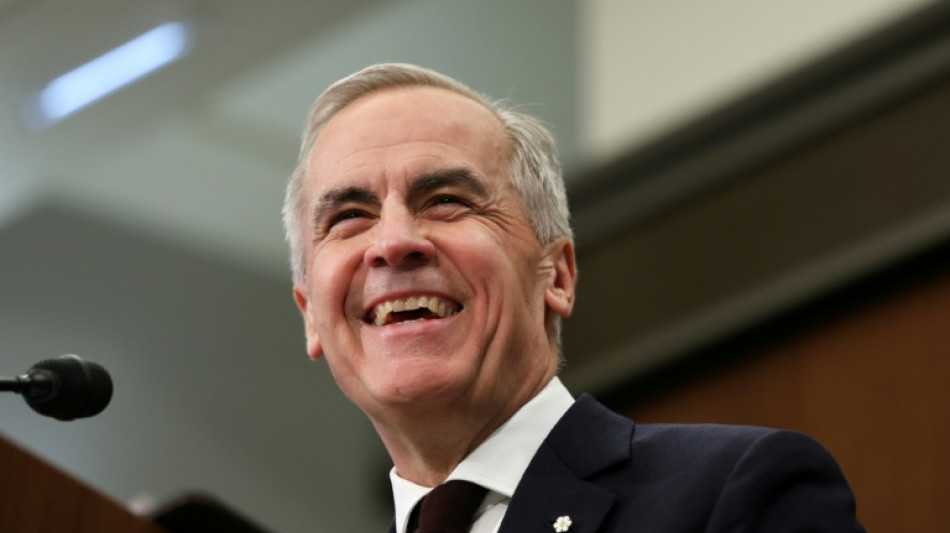
Carney advances new Canada oil pipeline, raising climate concerns / Photo: Dave Chan - AFP

 Asia stocks rise on AI, US-China trade talks optimism
 Multi-Asset Trading Venue Monochrome Exchange Announces IEO of Its Native Token, $MCR

 Data centre command hub keeps AI up and running
 Leo XIV, first US pope transcends his restrained style
 France's debt climbs to highest since 1978: ministry
 Thousands protest inaction over climate crisis in Switzerland

 UK actor Naomi Watts honoured at Spain film festival
 Trump signs bill authorizing sweeping Russia sanctions

 Anthropic picks Accenture for in-house AI safety evaluation
 Hushing and hedging: US companies retreat on climate

 Crisis-wracked Volkswagen warns of 10-bn-euro hit to profits

 Shakira to cap off world tour with Madrid 12-gig run

 Isolated Syrian-Druze city shortages

 UNESCO can be 'moderator' in AI debate: chief to AFP

 Russia seizes assets of Nestle, French firms

 Anthropic says AI systems moving towards building themselves

 Asian stocks boosted by falling oil, yen weakens after BoJ rate hike

 Afghan medical students in Pakistan hope court stops college expulsions

 Australia to detain tourists who overstay visa, minister says

 Asian stocks track Wall St rally as oil prices drop

 Prized Mexican relic returns on loan, two centuries on

 'In our lane': Fed's Warsh defies Trump but still fighting for credibility

 Trump admin makes major cut to endangered species protections

 GM delivers first components for US interceptor missiles

 Travis Scott and Keith Richards feature on GTA VI soundtrack

Canadian Prime Minister Mark Carney signed an agreement Thursday with the western energy-producing Alberta province to advance a new oil pipeline, a divisive move raising concern about Ottawa's commitment to confronting climate change.
The memorandum of understanding charts a plan for a pipeline going from Alberta to Canada's Pacific coast, specifically to boost oil exports to Asia -- in line with Carney's goal of expanding overseas trade to offset the damage of US President Donald Trump's trade war.
"At the core of the agreement, of course, is a priority to have a pipeline to Asia," Carney said ahead of the signing alongside Alberta's conservative Premier Danielle Smith.
The deal marked a clear pivot for Carney's Liberal Party and a departure from the policies that defined former prime minister Justin Trudeau's decade in power.
Relations between Alberta and Ottawa cratered under Trudeau.
Smith repeatedly accused him of suffocating Alberta's potential economic growth through what she termed radical pro-climate policies.
Smith took a jab at Trudeau on Thursday, saying "the last 10 years have been an extremely difficult time."
Carney, who grew up in Alberta, has worked to improve relations with Smith, repeatedly discussing his desire to make Canada an energy superpower.
In backing a new pipeline, Carney is exposing himself to accusations of betraying Canada's climate commitments, including from within his own party.
But the prime minister -- a UN climate envoy before entering Canadian politics earlier this year -- insisted the project will also make Canada's oil sector "more sustainable."
"The way we're going to do that is in combination with the Pathways Project, which will be the largest carbon capture project in the world," Carney said.
The IPCC, the UN's expert scientific panel on climate change, says carbon capture is one option for reducing emissions, but critics slam it as an excuse to keep burning fossil fuels.
Actual construction of a new pipeline remains far off. The plan calls for a formal project proposal to be ready by July 2026.
The memorandum of understanding mandates consultation with Indigenous groups and Indigenous co-ownership of any infrastructure.
But First Nations and Indigenous groups have often opposed large-scale oil projects.
A pipeline would also have to go through British Columbia, the west coast province currently led by a left-wing government, which was not party to Thursday's deal.
- Canada stronger? -
Trump's impact on the Canadian economy loomed over Thursday's announcement.
Alberta oil exports have headed to the United States, and Canadian energy products have largely been exempted from Trump's tariffs so far.
But Trump has cut off trade talks with Canada, threatening the future of the existing North American free trade agreement.
Carney has also warned that economic relations with the United States will never return to a pre-Trump normal.
Carney said Thursday's deal came "in the face of global trade shifts and profound uncertainty."
"This is a good day for Canada," the prime minister said.
"This agreement will make Canada and Alberta, of course, more independent, more resilient (and) stronger."
P.Schmidt--CPN
