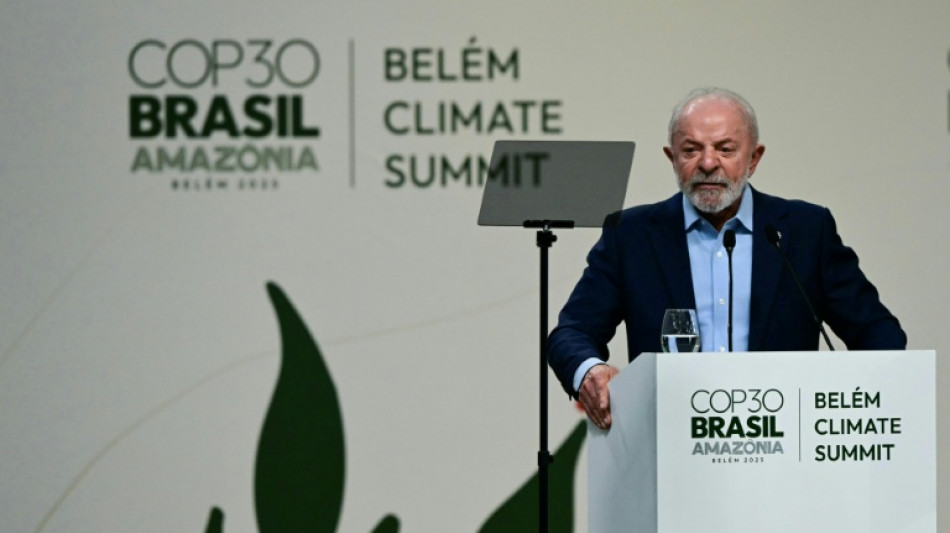
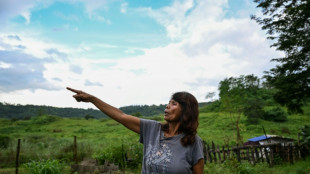
'Moral failure': Leaders seek to rally world at Amazon climate talks / Photo: Pablo PORCIUNCULA - AFP

 Spanish PM says unregulated AI could be 'devastating'

 From Korean Chipmakers to Leveraged Semiconductor ETFs: STARTRADER Launches 49 New 24/7 Stock and ETF CFDs
 Asia stocks rise on AI, US-China trade talks optimism
 Multi-Asset Trading Venue Monochrome Exchange Announces IEO of Its Native Token, $MCR

 Data centre command hub keeps AI up and running
 Leo XIV, first US pope transcends his restrained style
 France's debt climbs to highest since 1978: ministry
 Thousands protest inaction over climate crisis in Switzerland

 UK actor Naomi Watts honoured at Spain film festival
 Trump signs bill authorizing sweeping Russia sanctions

 Anthropic picks Accenture for in-house AI safety evaluation
 Hushing and hedging: US companies retreat on climate

 Crisis-wracked Volkswagen warns of 10-bn-euro hit to profits

 Shakira to cap off world tour with Madrid 12-gig run

 Isolated Syrian-Druze city shortages

 UNESCO can be 'moderator' in AI debate: chief to AFP

 Russia seizes assets of Nestle, French firms

 Anthropic says AI systems moving towards building themselves

 Asian stocks boosted by falling oil, yen weakens after BoJ rate hike

 Afghan medical students in Pakistan hope court stops college expulsions

 Australia to detain tourists who overstay visa, minister says

 Asian stocks track Wall St rally as oil prices drop

 Prized Mexican relic returns on loan, two centuries on

 'In our lane': Fed's Warsh defies Trump but still fighting for credibility

 Trump admin makes major cut to endangered species protections

Fears of a fracturing global resolve loomed over climate talks in the Brazilian Amazon on Thursday as world leaders acknowledged their failure to contain global warming to agreed limits.
Heads of state and government met in the city of Belem ahead of the UN COP30 conference, which is set to take place without the United States -- one of the nations most responsible for planet-warming emissions.
Opening the leaders gathering, UN Secretary-General Antonio Guterres set the tone by declaring the world had failed in its promise to hold long-term warming to 1.5 degrees Celsius since the pre-industrial era.
"This is moral failure -- and deadly negligence," he said, adding that to minimize the danger, governments must now act with even more urgency to slash fossil fuel emissions and protect nature.
The UN's weather and climate agency on Thursday said 2025 would be among the hottest years ever recorded.
Brazil hopes COP30, which officially begins on Monday, can reaffirm that climate change remains a global priority despite wars, trade tensions, economic uncertainty and the chilling effect of the Trump administration.
President Trump has dismissed climate science as a "con job" and has sought to torpedo international climate action in other forums, all the while boosting fossil fuels.
America's absence cast a shadow over Thursday's summit, where speakers took turns condemning Trump's climate denialism and lamenting the loss of global momentum.
"The president of the United States in the last UN assembly said that the climate crisis does not exist, and that is a lie," said Chile's Gabriel Boric, while Colombia's Gustavo Petro, whose US visa was canceled by Trump's government, likewise tore into him.
Brazilian president and host Luiz Inacio Lula da Silva referred to "extremist forces (that) fabricate fake news to obtain electoral gains and imprison future generations."
The world's biggest emitter, China, was present at the summit and pledged to double down on its climate action, which has included the vast rollout of renewable energy and green technologies at home and abroad.
"China is a country that honors its commitments," Chinese Vice Premier Ding Xuexiang said pointedly.
He added his country would "accelerate the green transition in all areas of economic and social development" and chided those who would put up trade barriers against its solar panels, batteries and electric cars.
- Uphill battle -
Leaders from other major economies, including the European Union, Britain and France were also in attendance to show that the international community could still pull together.
Britain's Keir Starmer said "the UK is all in" -- framing investment in the energy transition as an economic opportunity, but raised fears that the global climate "consensus is gone."
The choice of Belem, a city of 1.4 million people, half of whom live in working-class neighborhoods known as favelas, has been controversial due to its limited infrastructure, with sky-high hotel fees complicating the participation of small delegations and NGOs.
Brazil's recent approval of oil drilling near the mouth of the Amazon River will sit awkwardly at the conference.
So, too, will the unanswered call for a wave of ambitious new climate pledges ahead of COP30.
- 'Heaviest price' -
Brazil launched a new rainforest conservation fund on Thursday, with a promised contribution from Norway of up to 30 billion kroner ($2.9 billion) in loans.
COP30 will also focus on adaptation, a demand of countries which cannot afford to build defenses against climate disasters.
DR Congo President Felix Tshisekedi on Thursday said that "insufficient" climate finance was helping to drive an inequality crisis.
"Those who have contributed the least to climate change are now paying the heaviest price," he said.
These countries want concrete detail on how climate finance can be substantially boosted to $1.3 trillion a year by 2035 -- the estimated need in the developing world.
The hosts are also under pressure to marshal a response to the 1.5C failure. Even if all commitments are enacted in full, global warming is still set to reach up to 2.5C by century's end.
C.Peyronnet--CPN