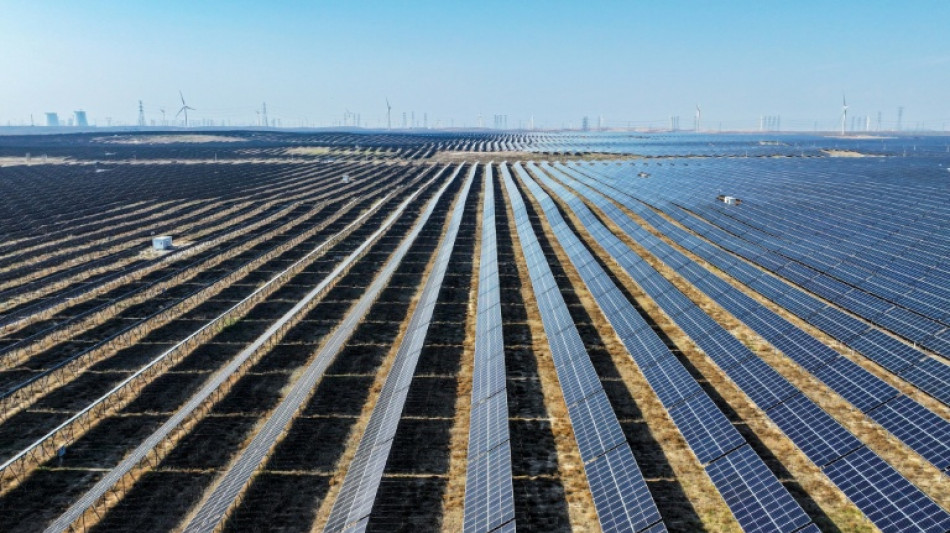
Biggest emitter, record renewables: China's climate scorecard / Photo: STR - AFP

 Global stocks rally on lower oil prices, US-China hopes

 Spanish PM says unregulated AI could be 'devastating'

 From Korean Chipmakers to Leveraged Semiconductor ETFs: STARTRADER Launches 49 New 24/7 Stock and ETF CFDs

 Asia stocks rise on AI, US-China trade talks optimism

 Multi-Asset Trading Venue Monochrome Exchange Announces IEO of Its Native Token, $MCR

 Data centre command hub keeps AI up and running

 Leo XIV, first US pope transcends his restrained style

 France's debt climbs to highest since 1978: ministry

 Thousands protest inaction over climate crisis in Switzerland

 UK actor Naomi Watts honoured at Spain film festival

 Trump signs bill authorizing sweeping Russia sanctions

 Anthropic picks Accenture for in-house AI safety evaluation

 Hushing and hedging: US companies retreat on climate

 Crisis-wracked Volkswagen warns of 10-bn-euro hit to profits

 Shakira to cap off world tour with Madrid 12-gig run

 Isolated Syrian-Druze city shortages

 UNESCO can be 'moderator' in AI debate: chief to AFP

 Russia seizes assets of Nestle, French firms

 Anthropic says AI systems moving towards building themselves

 Asian stocks boosted by falling oil, yen weakens after BoJ rate hike

 Afghan medical students in Pakistan hope court stops college expulsions

 Australia to detain tourists who overstay visa, minister says

 Asian stocks track Wall St rally as oil prices drop

 Prized Mexican relic returns on loan, two centuries on

 'In our lane': Fed's Warsh defies Trump but still fighting for credibility

China is the world's biggest emitter of planet-warning greenhouse gases but is also installing more renewable energy sources and putting more electric vehicles on its roads than any other country.
Ahead of the COP30 climate talks in Brazil, here is a look at China's climate commitments:
- Emissions -
China emits over 30 percent of global greenhouse gases -- an estimated 15.6 gigatons of carbon dioxide equivalent in 2024, according to the latest UN figures.
Both its total historical emissions and its emissions per capita are still below those of the United States, but are catching up fast.
Coal, a major source of pollution, accounted for nearly 60 percent of Chinese power generation last year, though massive installations of renewable energy are helping meet new electricity demand.
It is also a leader in the electric vehicle market, accounting for over 70 percent of global production. Almost half of new cars in China were electric battery-powered or plug-in hybrids in 2024, according to the International Energy Agency.
- Reduction targets -
In September, China announced its first numerical greenhouse gas reduction targets, pledging to slash emissions by 7-10 percent by 2035.
But it did not set a baseline year from which to measure those reductions and experts say China needs to cut emissions by closer to 30 percent from 2023 levels to keep global temperaturesfrom rising over 1.5C above pre-industrial levels.
There is hope however that China will "underpromise but overachieve" as it has with some previous targets, including on renewable energy.
Beijing had previously committed to a peak in emissions by 2030 and to achieve net-zero carbon status three decades later.
Some analysts believe emissions have already peaked or are close to doing so thanks to the rising use of renewables and nuclear power.
- Renewable goals –
China's official climate roadmap this week confirmed President Xi Jinping's September target announcements.
The plan was welcomed by UN climate chief Simon Stiell as "a significant moment in our collective climate effort."
It includes new targets for renewables, including increasing solar and wind power capacity by six times their 2020 levels to 3,600 gigawatts (GW) by 2035.
China said earlier this year it currently has 1,482 GW of wind and solar capacity.
Reaching Beijing's new goal would require installing around 200GW of wind and solar capacity a year, far less than China added in 2024.
Though renewable energy growth could slow, analysts widely view China as likely to hit and possibly exceed its 2035 target early.
- Fossil fuels, EVs -
China wants to raise the share of non-fossil fuels in its total energy consumption to over 30 percent by 2035.
That too is considered an achievable and unambitious pledge given recent forecasts already project that figure will hit 36 percent in a decade.
The Chinese president also promised to ensure "new energy vehicles", which include electric vehicles (EVs), become the "mainstream" in new sales.
That is arguably already the case given EVs make up over 40 percent of new purchases.
- Emissions trading, forest cover -
China's new commitments include a pledge to expand its carbon emissions trading scheme to cover all high-emission sectors.
The scheme is already in the process of expanding from the power sector to cover heavy industry including cement, steel and aluminum, and officials have signalled plans to apply it to even more sectors.
Beijing's 2035 pledge also targets forest cover of 24 billion cubic metres, up from 20 billion currently, according to official figures.
A.Zimmermann--CPN