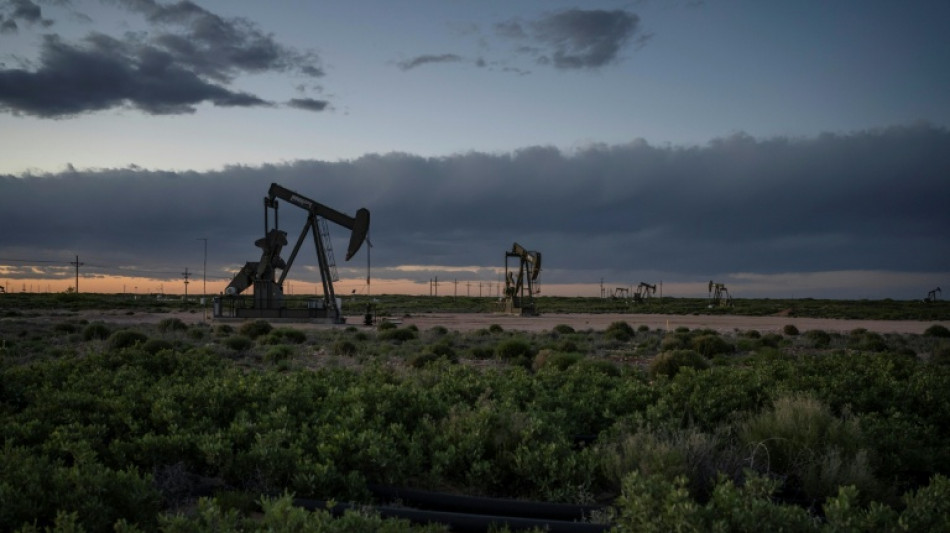
US oil giants produce mainly at home but send more tax dollars overseas / Photo: Paul Ratje - AFP/File

 US networks halt Trump coverage in revolt over White House ban

 NOWPayments Releases Cross-Chain Payout Data Revealing Key Performance Benchmarks Across TRON, BNB Chain, and Solana

 COP31 host says AI climate footprint to be a summit priority
 Global stocks rally on lower oil prices, US-China hopes
 Spanish PM says unregulated AI could be 'devastating'

 From Korean Chipmakers to Leveraged Semiconductor ETFs: STARTRADER Launches 49 New 24/7 Stock and ETF CFDs

 Asia stocks rise on AI, US-China trade talks optimism

 France's Macron, Canada's Carney announce closer ties

 AI 'warning shots' focus Beijing on national security risks

 Philippine tribe in limbo over US-led tech hub

 Saudi-led coalition says Houthis fired ballistic missile at Riyadh

 Cuba works to restore power after another blackout

 Brigitte Bardot widower slams sale of star's belongings

 Indonesia accepts Malaysia's help to tackle wildfires

 Nvidia, OpenAI CEOs to attend Xi dinner at White House

 Cuba hit with seventh major blackout of the year
 Nigeria miners struggled to breathe in cell before 37 died: survivors

 Warren Buffett steps down as Berkshire Hathaway chairman

 Isolated Syrian-Druze city blames Damascus for shortages

 Kerry James Marshall: American 'blackness' painter celebrated in Europe

 Infantino 'must go', says German FA vice-president

 Japan's busiest rail station tests robot bins

 Backpackers fret over Australian visa crackdown

 Bank of Japan hikes rates to 31-year high to battle inflation

 AI doomsday warnings unlikely to slow IPOs but questions linger

US fossil fuel giants produce most of their oil and gas domestically but pay billions more in taxes overseas than they do at home because of subsidies that have only grown during President Donald Trump's second term, a report said Thursday.
The analysis, titled "America-Last and Planet-Last: How US Tax Policy Subsidizes Oil and Gas Extraction Abroad," looked at disclosures from 11 publicly traded US companies since 2017, finding they paid an effective current-year tax rate of 12.1 percent -- far below the statutory 21 percent corporate tax rate.
In the case of Chevron this fell to 7.9 percent.
The US has assumed the mantle of the world's largest oil and gas producer in recent years. But even though the companies studied produced 51 percent of their output domestically, they owed just 18 percent of their total taxes in the United States.
In one example, American's biggest oil company, ExxonMobil, was found to have paid $11.5 billion to the United Arab Emirates across 2023 and 2024 -- nearly five times the amount it paid to the United States in the same time.
Another leading US giant, ConocoPhillips, paid more than twice as much tax to Libya as it did to the US, despite producing more than 70 percent of its oil and gas domestically.
"The headline finding of our report is that these companies are indeed very lightly taxed. They are under-taxed relative to any kind of number of metrics," author Zorka Milin, of the nonprofit Financial Accountability and Corporate Transparency (FACT) Coalition told AFP.
"These policies make no sense economically, environmentally, or ethically," she added. "It's time for Congress to close these loopholes."
These low rates are driven by a web of industry-specific subsidies and rules that allow companies to offset US taxes with payments to foreign governments, including in countries plagued by corruption or weak oversight.
The oil and gas industry has benefited from tax subsidies dating back more than a century, when the US tax code was in its infancy.
But it has continually pressed for more, including spending $20 million on lobbying efforts in the six months leading to the passage of the "Big Beautiful Bill," which undid corporate tax reform measures put in place under former president Joe Biden.
M.P.Jacobs--CPN