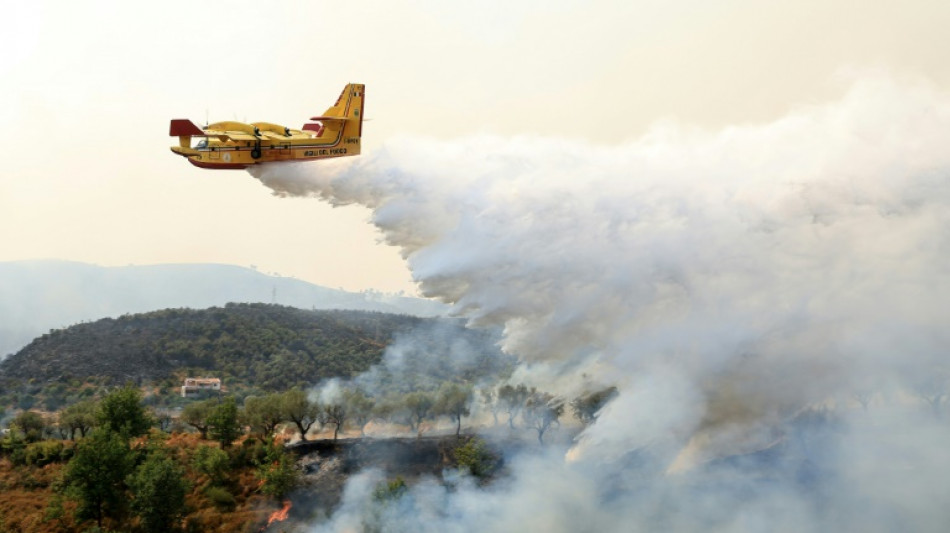
Rising wildfires spur comeback for Canadian water bomber / Photo: Adnan Beci - AFP/File

 In Bangladesh, Pakistan's Jinnah photo stirs anger

 China's robot dancers limber up for America's Got Talent final
 Green policies just good politics, says UK minister

 El Nino weather pattern enters record territory: scientist

 US networks halt Trump coverage in revolt over White House ban

 NOWPayments Releases Cross-Chain Payout Data Revealing Key Performance Benchmarks Across TRON, BNB Chain, and Solana

 COP31 host says AI climate footprint to be a summit priority

 Global stocks rally on lower oil prices, US-China hopes

 Spanish PM says unregulated AI could be 'devastating'

 From Korean Chipmakers to Leveraged Semiconductor ETFs: STARTRADER Launches 49 New 24/7 Stock and ETF CFDs
 Asia stocks rise on AI, US-China trade talks optimism

 France's Macron, Canada's Carney announce closer ties

 AI 'warning shots' focus Beijing on national security risks

 Philippine tribe in limbo over US-led tech hub

 Saudi-led coalition says Houthis fired ballistic missile at Riyadh

 Cuba works to restore power after another blackout

 Brigitte Bardot widower slams sale of star's belongings

 Indonesia accepts Malaysia's help to tackle wildfires
 Nvidia, OpenAI CEOs to attend Xi dinner at White House

 Cuba hit with seventh major blackout of the year

 Nigeria miners struggled to breathe in cell before 37 died: survivors

 Warren Buffett steps down as Berkshire Hathaway chairman

 Isolated Syrian-Druze city blames Damascus for shortages

 Kerry James Marshall: American 'blackness' painter celebrated in Europe

 Infantino 'must go', says German FA vice-president

The Canadair water bomber revolutionized the fight against wildfires after it debuted in the skies decades ago.
Then demand waned and production stopped, but with major blazes intensifying globally, the water-scooping marvel is making a comeback.
At a production site in Calgary, in western Canada, workers building a next-generation version of the aircraft are busy trying to keep up with orders, which have poured in from Europe, as well as across Canada.
The amphibious plane hit the market in the late 1960s. It was the first aircraft specifically designed to scoop up and dump water on flames -- a departure from other planes that had been modified for that purpose.
Through the latter half of the 20th century, it was a pillar of firefighting efforts in many countries.
With about 160 of the aircraft in operation, governments began sharing them. That caused new sales to sag, which led aviation firm Bombardier to stop production in 2015.
The next year, Calgary-based De Havilland Canada acquired the rights to the water bomber program.
"The aircraft are getting older, the summers are getting hotter. There's more demand. So that's why we brought the aircraft back into production," Neil Sweeney, De Havilland's vice president for corporate affairs, told AFP.
France, Italy, Greece, Spain, Croatia and Portugal -- all imperiled by growing wildfire seasons -- ordered 22 next-generation Canadair planes at the Paris Air Show in June.
- Keeping what works -
De Havilland has estimated that global orders could rise to between 250 and 350 planes.
With most of the aircraft's 50,000 parts assembled by hand, producing that number of planes could take up to 10 years.
To expedite production and meet rising demand, De Havilland decided to modernize the existing Canadair design, rather than develop a new model.
"Our strategy was to leave the elements that made the aircraft successful untouched," said Jean-Philippe Cote, vice president of business improvement at De Havilland.
He said the bomber’s silhouette remains unchanged but the cockpit and electronic set-up has been completely redesigned.
John Gradek, a supply chain expert at McGill University, estimated that sustaining production to meet growing demand would likely require millions of dollars in investment.
- 'Tractor of the sky' -
Pierre Boulanger, a Canadair pilot from Quebec who travels to California to fight wildfires every summer, celebrated the resumption of production, calling the model the most "efficient" tanker aircraft on the market.
"It's the tractor of the sky," he said.
Two hydraulically-operated scoops under the fuselage allow the plane to pick up 6,000 liters of water in just 12 seconds without landing, which others must do.
"If the water source is very close, we can make a drop every two minutes," said Boulanger, 35.
He explained that the planes are extremely precise, allowing the pilot to maintain control even at very low speeds.
After the devastating European wildfire season this year and the increasing area burned annually in North America, Boulanger said it seemed as though "we will never have enough Canadairs."
Y.Ibrahim--CPN