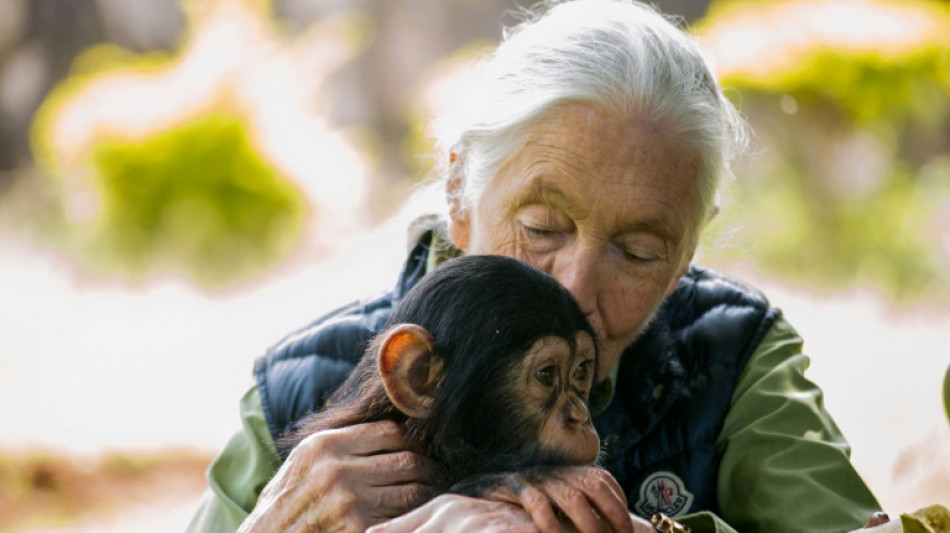
Jane Goodall: crusader for chimpanzees and the planet / Photo: SUMY SADURNI - AFP/File

 In Bangladesh, Pakistan's Jinnah photo stirs anger

 China's robot dancers limber up for America's Got Talent final
 Green policies just good politics, says UK minister
 El Nino weather pattern enters record territory: scientist
 US networks halt Trump coverage in revolt over White House ban

 NOWPayments Releases Cross-Chain Payout Data Revealing Key Performance Benchmarks Across TRON, BNB Chain, and Solana

 COP31 host says AI climate footprint to be a summit priority
 Global stocks rally on lower oil prices, US-China hopes

 Spanish PM says unregulated AI could be 'devastating'

 From Korean Chipmakers to Leveraged Semiconductor ETFs: STARTRADER Launches 49 New 24/7 Stock and ETF CFDs
 Asia stocks rise on AI, US-China trade talks optimism

 France's Macron, Canada's Carney announce closer ties
 AI 'warning shots' focus Beijing on national security risks

 Philippine tribe in limbo over US-led tech hub

 Saudi-led coalition says Houthis fired ballistic missile at Riyadh
 Cuba works to restore power after another blackout
 Brigitte Bardot widower slams sale of star's belongings

 Indonesia accepts Malaysia's help to tackle wildfires

 Nvidia, OpenAI CEOs to attend Xi dinner at White House

 Cuba hit with seventh major blackout of the year

 Nigeria miners struggled to breathe in cell before 37 died: survivors

 Warren Buffett steps down as Berkshire Hathaway chairman

 Isolated Syrian-Druze city blames Damascus for shortages

 Kerry James Marshall: American 'blackness' painter celebrated in Europe

 Infantino 'must go', says German FA vice-president

British primatologist Jane Goodall imitated chimpanzees, sat with them in trees and shared their bananas during her trail-blazing research in Tanzania into the apes' true nature.
Acclaimed for her discoveries she later morphed into a wildlife crusader, criss-crossing the world to plead the cause of human's closest ape relatives and the wider planet.
She died, aged 91, while conducting a speaking tour in the United States, her institute said Wednesday.
Clad in her classic collared shirt and shorts, binoculars in hand, Goodall transformed human understanding of chimpanzees.
She was the first researcher to give them names, rather than numbers.
She was also the first scientist to observe that the apes, like humans, use tools and feel emotions.
Fellow naturalist and friend David Attenborough told Britain's Daily Telegraph in 2010 she was "a woman who had turned the world of zoology upside down".
Her scientific breakthroughs "have profoundly altered the world's view of animal intelligence and enriched our understanding of humanity", the head of the US-based John Templeton Foundation said in 2021 when awarding her its prestigious individual lifetime achievement award.
- Termites and twigs -
Born on April 3, 1934, in London, Goodall's love of wild animals began in infancy, when her father gave her a stuffed toy chimpanzee, which she kept for the rest of her life.
She was also a fan of Tarzan books, about a boy raised in the jungle by apes who falls in love with a woman called Jane.
"When I was 10, I dreamed of going to Africa, living with animals and writing books about them," she told CNN in 2017.
In 1957 she took up a friend's invitation to visit Kenya, where she began working for famed palaeontologist Louis Leakey.
Her big break came when Leakey sent her to study chimpanzees in the wild in Tanzania, becoming the first of three women he appointed to study great apes in their natural habitat, along with America's Dian Fossey (gorillas) and Canada's Birute Galdikas (orangutans).
Despite Goodall's lack of scientific training, Leakey "felt her passion for and knowledge of animals and nature, high energy, and fortitude made her a great candidate to study the chimpanzees," according to National Geographic magazine, which featured Goodall on its cover in 1965.
It was in Gombe National Park that Goodall famously witnessed a male whom she called David Greybeard using a grass stalk to fish termites out of a termite mound.
She later saw Greybeard and a second animal, Goliath, stripping leaves off a twig to turn it into a better tool for digging out termites.
On the strength of her discoveries Leakey packed Goodall off to Cambridge University for doctoral research.
She became only the eighth person to earn a PhD at Cambridge without first possessing an undergraduate degree.
- From scientist to activist -
Her life as an activist began at a US conference on chimpanzees in the 1980s, where she heard accounts of endangered chimpanzees being used in medical research, snared for bush meat and having their habitats destroyed.
"I went in as a scientist happily learning about chimpanzee behaviour... but I left that conference as an activist," Goodall told an audience in Nairobi in 2013.
Her unique insights into the animal world -- she livened up conferences with her renditions of chimpanzee calls in Gombe Park, to which she regularly returned -- got people to sit up and take notice.
When she "knocks at somebody's door they come," said Ian Redmond, chair of the Ape Alliance, a coalition of conservation groups.
In 1977 Goodall founded an institute in her name to further the study of chimpanzees and in 1991 created the Roots and Shoots project, which works with young people in over 60 countries on environmental issues.
- Barbie doll -
In 1964, Goodall married Dutch photographer Hugo van Lawick, who had immortalised her and her chimpanzees in National Geographic and LIFE magazines. A model of David Greybeard graced the wedding cake.
The couple had a son Hugo Eric Louis Van Lawick, nicknamed Grub.
Goodall married her second husband Derek Bryceson, a former director of Tanzania's national parks and MP, in 1975. Five years later Bryceson died of cancer.
In April 2002, UN Secretary-General Kofi Annan named her a United Nations Messenger of Peace, and she became a Dame Commander of the Order of the British Empire in 2004.
She has a Barbie doll named after her, complete with binoculars, safari outfit and chimpanzee.
burs/jmy/cb
M.Anderson--CPN